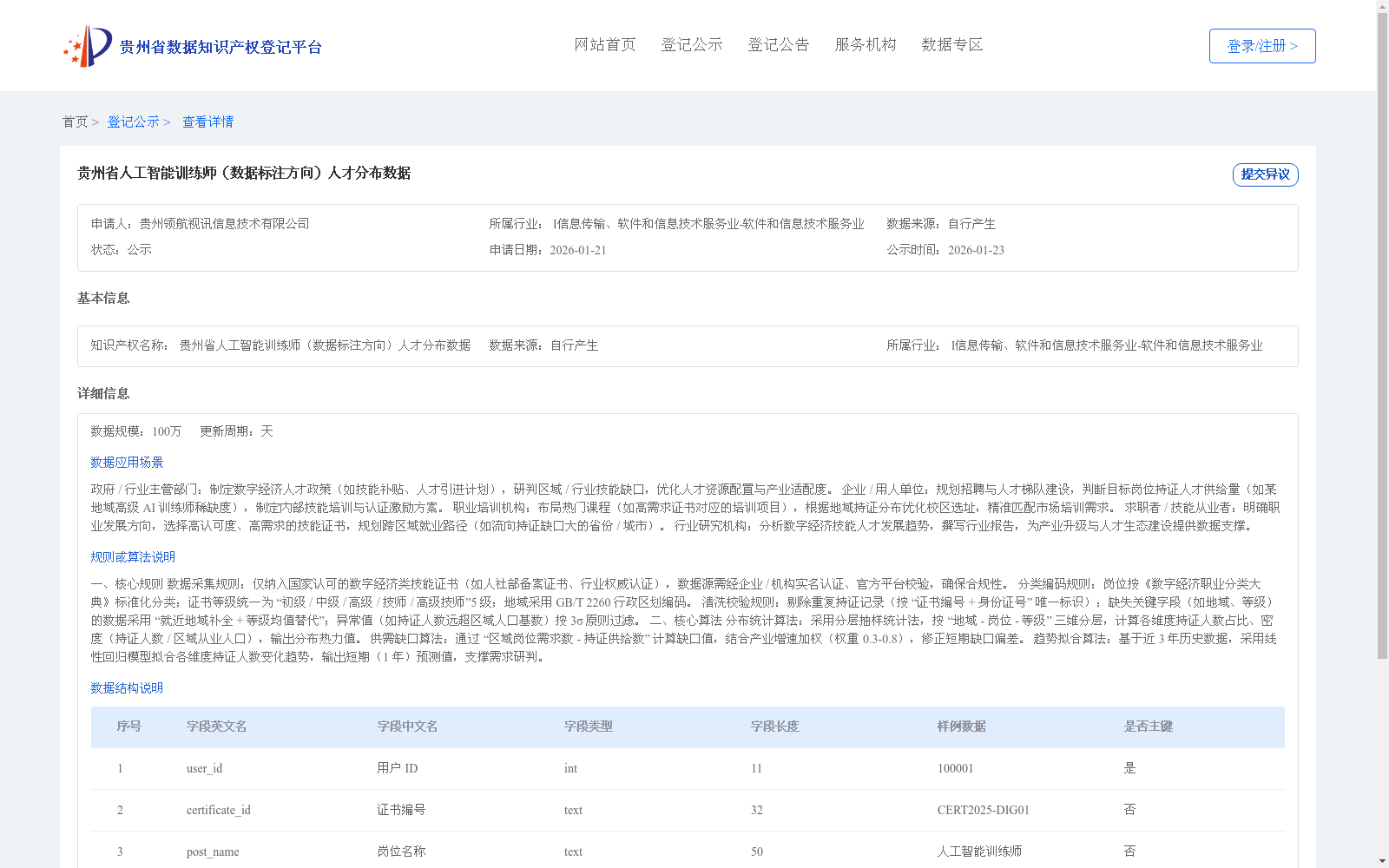
贵州省人工智能训练师(数据标注方向)人才分布数据
收藏资源简介:
一、核心规则 数据采集规则:仅纳入国家认可的数字经济类技能证书(如人社部备案证书、行业权威认证),数据源需经企业 / 机构实名认证、官方平台校验,确保合规性。 分类编码规则:岗位按《数字经济职业分类大典》标准化分类;证书等级统一为 “初级 / 中级 / 高级 / 技师 / 高级技师”5 级;地域采用 GB/T 2260 行政区划编码。 清洗校验规则:剔除重复持证记录(按 “证书编号 + 身份证号” 唯一标识);缺失关键字段(如地域、等级)的数据采用 “就近地域补全 + 等级均值替代”;异常值(如持证人数远超区域人口基数)按 3σ 原则过滤。 二、核心算法 分布统计算法:采用分层抽样统计法,按 “地域 - 岗位 - 等级” 三维分层,计算各维度持证人数占比、密度(持证人数 / 区域从业人口),输出分布热力值。 供需缺口算法:通过 “区域岗位需求数 - 持证供给数” 计算缺口值,结合产业增速加权(权重 0.3-0.8),修正短期缺口偏差。 趋势拟合算法:基于近 3 年历史数据,采用线性回归模型拟合各维度持证人数变化趋势,输出短期(1 年)预测值,支撑需求研判。
1. Core Rules Data Collection Rules: Only national-recognized digital economy skill certificates (e.g., certificates filed by the Ministry of Human Resources and Social Security, industry authoritative certifications) are included. Data sources must undergo real-name authentication by enterprises or institutions and verification via official platforms to ensure compliance. Classification and Coding Rules: Jobs are classified according to the standardized categories in the *Classification Dictionary of Digital Economy Occupations*; certificate levels are uniformly set to 5 grades: Junior, Intermediate, Senior, Technician, and Senior Technician; regional codes adopt the GB/T 2260 administrative division coding standard. Cleaning and Verification Rules: Duplicate certificate holding records (uniquely identified by "certificate number + ID card number") shall be removed; for data with missing key fields (e.g., region, level), the method of "completing with nearby region data + replacing with average level value" is adopted; outliers (e.g., the number of certificate holders far exceeding the regional population base) are filtered out using the 3σ principle. 2. Core Algorithms Distribution Statistics Algorithm: Stratified sampling statistics is adopted, with three-dimensional stratification based on "region - job - level", calculating the proportion and density (number of certificate holders / regional employed population) of certificate holders in each dimension, and outputting distribution heat values. Supply and Demand Gap Algorithm: The gap value is calculated by "regional job demand quantity - certified supply quantity", which is weighted by industrial growth rate (weight range: 0.3-0.8) to correct short-term gap deviations. Trend Fitting Algorithm: Based on the historical data of the past 3 years, a linear regression model is used to fit the change trend of the number of certificate holders in each dimension, and short-term (1-year) forecast values are output to support demand research and judgment.