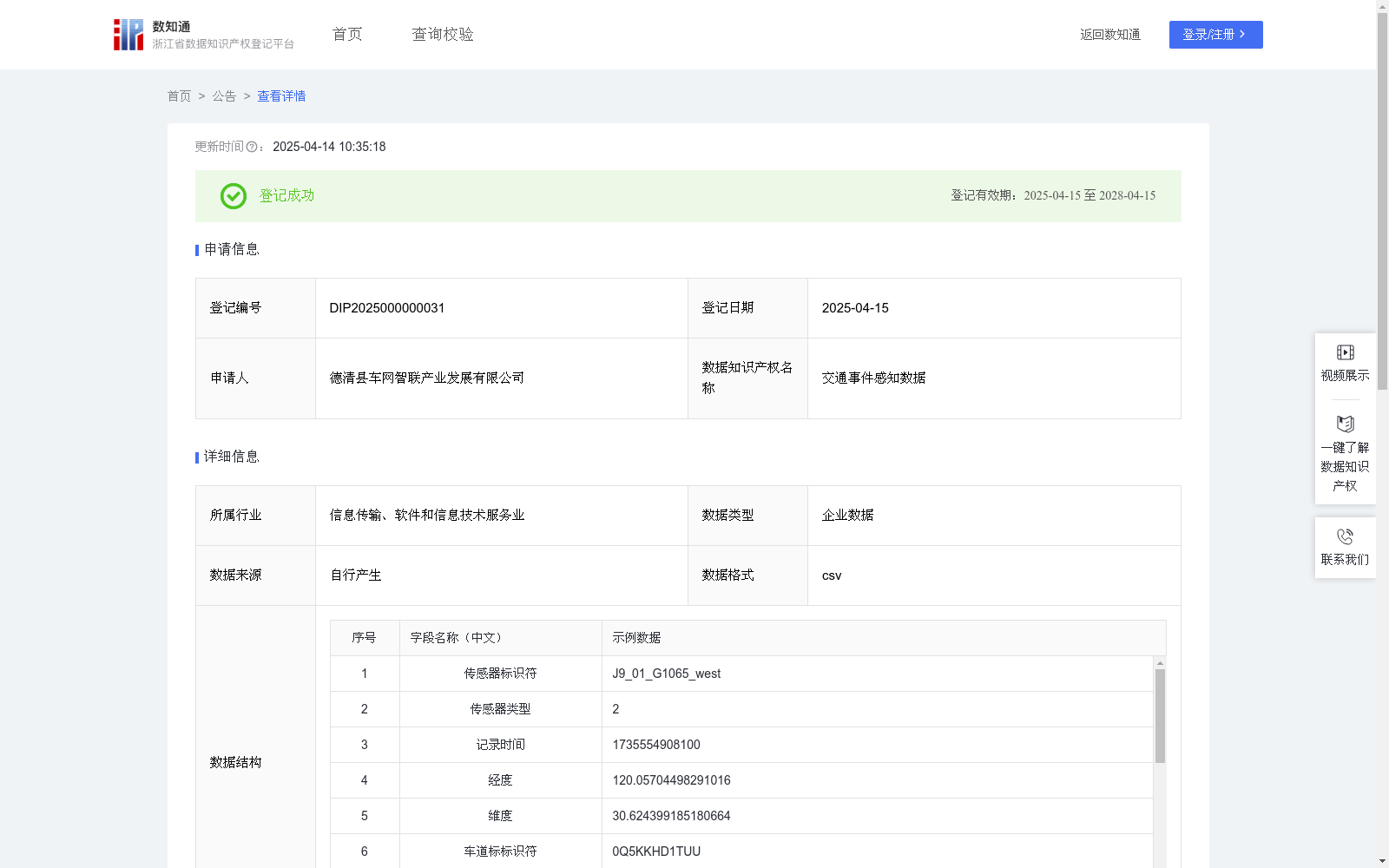
交通事件感知数据
收藏资源简介:
本交通事件感知数据适用于交通管理部门及相关研究机构,主要用于解决城市交通管理中的实时监测与应急响应问题。数据集通过路侧视频监测,覆盖逆行、非法停车、事故、拥堵等8种交通事件,满足城市道路的实时监控需求。数据适用于城市主干道、交叉口及施工区域等场景,算法基于车道线识别、多目标跟踪、深度学习等技术。数据主要面向交通管理部门,用于交通应急指挥、事件处置及拥堵治理研究;可为高校和研究机构提供事件感知算法和信控优化算法提供数据支持。本数据集聚焦城市交通管理的实时性与精准性需求,为交通治理提供高效支持。通过实时监测交通事件,帮助管理部门快速响应事故、拥堵等问题,减少交通延误和安全隐患。交通事件主要由路侧mec计算单元(mec标识符字段)通过分析实时摄像头画面识别并记录8种交通事件,识别记录数据包括: 1.数据源传感器信息:传感器标识符、传感器类型。 2.事件时间地点:记录时间、经度、维度、车道标识符、车道类型。其中经度维度和车道通过视频画面标定数据以及事件在画面中的位置计算得出; 3.事件信息:事件标识符、事件区域、事件类型、事件关联对象标识符、事件关联对象类型(事件中出现的交通参与者,可用于重建事件仿真场景); 4.源数据信息:事件坐标(事件在视频画面中的框坐标xyxy)、视频地址(源视频存储位置)。 交通事件识别类型及规则: 1.逆行(Retrograde):车辆行驶方向与车道指示相反。使用车道线识别技术确定正确的行驶方向。多目标跟踪算法监控车辆运动轨迹,判断逆行。结合电子围栏合法行驶区域,超区判定逆行。 2.道路维修(Road Repair):检测到施工标志牌、锥桶等施工设施。训练专用检测模型识别施工设施。分析视频流静态元素变化,如长时间存在的障碍物或封闭路段。对比历史图像数据,识别出新出现的施工设施。 3.非法停车(Illegal Stop):车辆在规定时间内停放在禁停区。利用目标检测模型识别车辆,结合电子围栏判断越界。判定车辆停留时间是否超过阈值。 4.事故(Accident):检测到道路上车辆停止且有人下车在车辆周围停留。根据目标识别算法,识别道路上行人和车辆的运动轨迹,判断车辆和人的轨迹的轨迹相关性,当车辆停止并且有相关人员时,判定为交通事故。 5.抛洒物(Discard):道路上出现未预期的物体(如掉落物品)。通过背景建模和前景提取技术识别异常物体,并结合物体移动模式排除误检。利用深度学习模型对抛洒物进行分类识别,提高检测精度。 6.路口溢出(Overflow):排队等待的车辆超出交叉口出口道安全等待区。定义安全边界,区域车辆排队超过该边界即触发。 7.行人进入机动车道(Person on Lane):行人出现在机动车道。利用人体姿态估计技术识别行人,分析行人的运动轨迹,并通过电子围栏判断其是否进入不允许行走区域。 8.拥堵(Congestion):根据平均速度、车辆密度等因素判断是否达到拥堵阈值。 计算路段检测区车辆的平均速度和空间占有率,均达到阈值时触发。
This traffic event perception dataset is designed for traffic management departments and relevant research institutions, primarily to address real-time monitoring and emergency response issues in urban traffic management. Collected via roadside video monitoring, this dataset covers 8 types of traffic events including retrograde driving, illegal parking, accidents, congestion and others, meeting the real-time monitoring requirements of urban roads. It is applicable to scenarios such as urban arterial roads, intersections and construction zones, with algorithms based on lane line recognition, multi-object tracking, deep learning and other technologies. The dataset is mainly targeted at traffic management departments, used for traffic emergency command, event disposal and congestion control research; it can also provide data support for universities and research institutions to develop event perception algorithms and traffic signal control optimization algorithms. This dataset focuses on the real-time and accurate requirements of urban traffic management, providing efficient support for traffic governance. By real-time monitoring of traffic events, it helps management departments quickly respond to accidents, congestion and other issues, reducing traffic delays and potential safety hazards. Traffic events are mainly identified and recorded by roadside Multi-Access Edge Computing (MEC) computing units (via the MEC identifier field) by analyzing real-time camera footage, covering the 8 aforementioned traffic events. The identified and recorded data includes: 1. Data source sensor information: sensor identifier, sensor type. 2. Event time and location: recording time, longitude, latitude, lane identifier, lane type. Among them, longitude, latitude and lane are calculated based on the calibration data of the video frame and the position of the event in the frame. 3. Event information: event identifier, event area, event type, associated object identifier, associated object type (traffic participants appearing in the event, which can be used to reconstruct the event simulation scene). 4. Source data information: event coordinates (bounding box coordinates xyxy of the event in the video frame), video address (storage location of the source video). Traffic event identification types and rules: 1. Retrograde: The driving direction of the vehicle is opposite to the lane indication. Lane line recognition technology is used to determine the correct driving direction. The multi-object tracking algorithm monitors the vehicle's motion trajectory to determine retrograde driving. Combined with the legally driving area defined by the electronic fence, driving beyond the area is judged as retrograde. 2. Road Repair: Construction facilities such as construction signs and traffic cones are detected. A dedicated detection model is trained to identify construction facilities. Changes in static elements in the video stream are analyzed, such as long-standing obstacles or closed road sections. Newly appeared construction facilities are identified by comparing with historical image data. 3. Illegal Stop: Vehicles are parked in no-parking zones beyond the specified time limit. The object detection model is used to identify vehicles, combined with the electronic fence to determine if they cross the boundary. Whether the vehicle's parking duration exceeds the threshold is judged. 4. Accident: It is detected that a vehicle stops on the road and someone gets off and stays around the vehicle. According to the object recognition algorithm, the motion trajectories of pedestrians and vehicles on the road are identified, and the trajectory correlation between the vehicle and the person is judged. When the vehicle stops and there are relevant personnel nearby, it is judged as a traffic accident. 5. Discard: Unexpected objects (such as dropped items) appear on the road. Abnormal objects are identified through background modeling and foreground extraction technology, and false detections are excluded by combining the object movement patterns. A deep learning model is used to classify and identify discarded objects to improve detection accuracy. 6. Overflow: Queuing waiting vehicles exceed the safe waiting area of the intersection exit lane. A safety boundary is defined, and the event is triggered when the number of queuing vehicles in the area exceeds this boundary. 7. Person on Lane: Pedestrians appear on motor vehicle lanes. Human pose estimation technology is used to identify pedestrians, analyze their motion trajectories, and determine whether they enter the forbidden walking area via the electronic fence. 8. Congestion: Whether the congestion threshold is reached is judged based on factors such as average speed and vehicle density. The average speed and space occupancy rate of vehicles in the road section detection area are calculated, and the event is triggered when both reach the threshold.