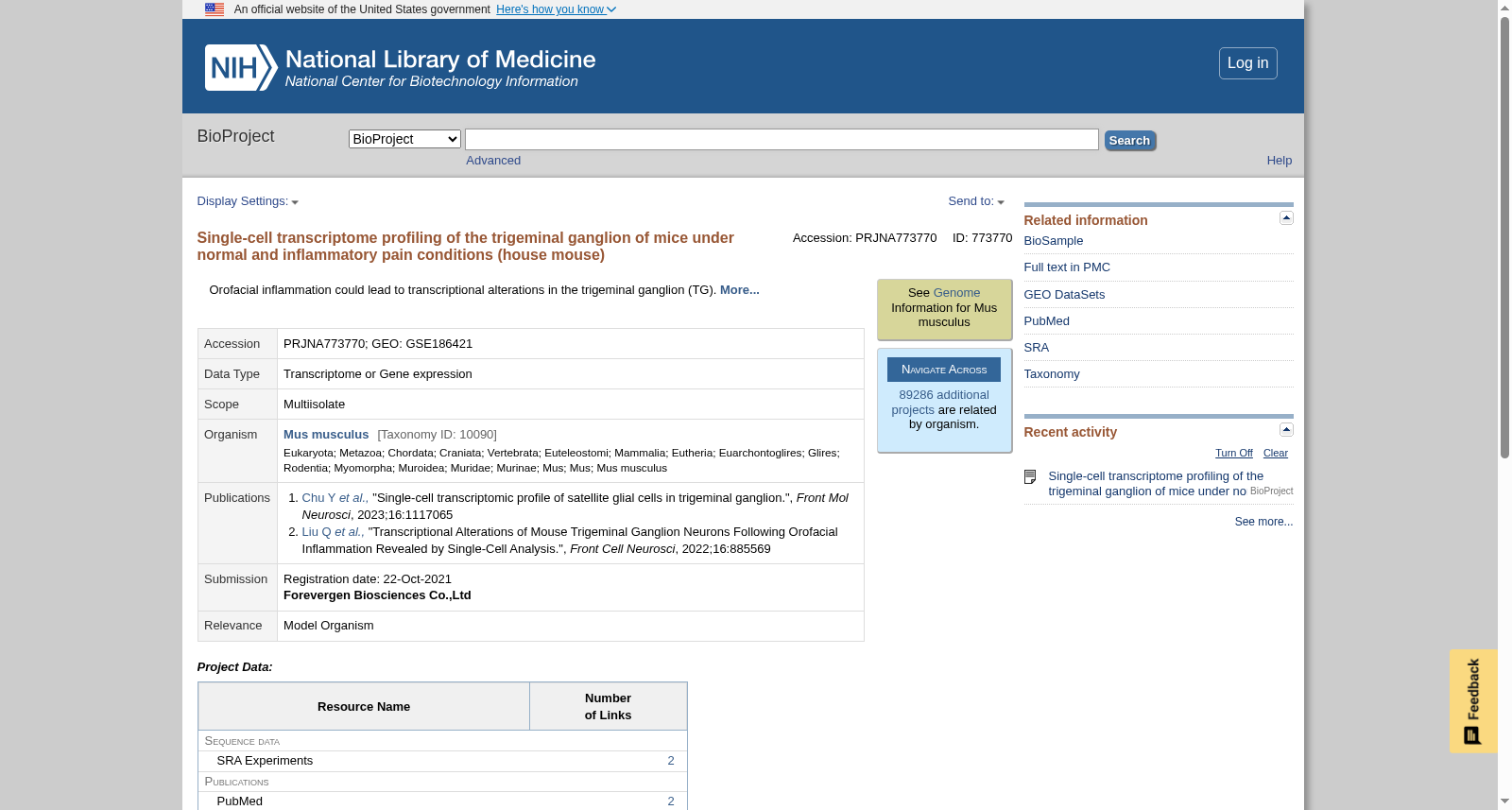
Single-cell transcriptome profiling of the trigeminal ganglion of mice under normal and inflammatory pain conditions. Single-cell transcriptome profiling of the trigeminal ganglion of mice under normal and inflammatory pain conditions
收藏资源简介:
Orofacial inflammation could lead to transcriptional alterations in the trigeminal ganglion (TG). In this study, we performed single-cell RNA-sequencing (scRNA-seq) analysis of mouse TG to identify all cell types and profile transcriptomic alterations of TG cells under inflammatory conditions. A total of 7 types of cells including endothelial cells, fibroblasts, glial cells, granulocytes, lymphocytes, monocyte-macrophages and several subtypes of neurons were identified. In addition, we performed annotation of neuronal subtypes and differential gene expression analysis among TG neurons, identifying several differential genes involved in pain modulation such as Scn10a, Zbtb20 and Runx1. Collectively, our study revealed the heterogeneity of TG cells and diverse neuronal transcriptomic responses to orofacial inflammation, which aids in the development of novel therapeutics for orofacial inflammatory pain. Overall design: 2 samples, 5-8 weeks mouse under control and inflammatory pain conditions respectively
口面部炎症可诱导三叉神经节(trigeminal ganglion, TG)发生转录组改变。本研究对小鼠三叉神经节开展单细胞RNA测序(single-cell RNA-sequencing, scRNA-seq)分析,以鉴定其中所有细胞类型,并解析炎症状态下三叉神经节细胞的转录组变化特征。本研究共鉴定出7类细胞,包括内皮细胞、成纤维细胞、胶质细胞、粒细胞、淋巴细胞、单核-巨噬细胞以及多种神经元亚型。此外,本研究还对神经元亚型进行了注释,并对三叉神经节神经元开展差异基因表达分析,鉴定出多个参与疼痛调控的差异基因,例如Scn10a、Zbtb20及Runx1。综上,本研究揭示了三叉神经节细胞的异质性以及神经元对口面部炎症的多样化转录组应答,为开发口面部炎性疼痛的新型治疗手段提供了理论支撑。实验设计:共2份样本,分别取自5~8周龄的正常对照小鼠与炎性疼痛模型小鼠。