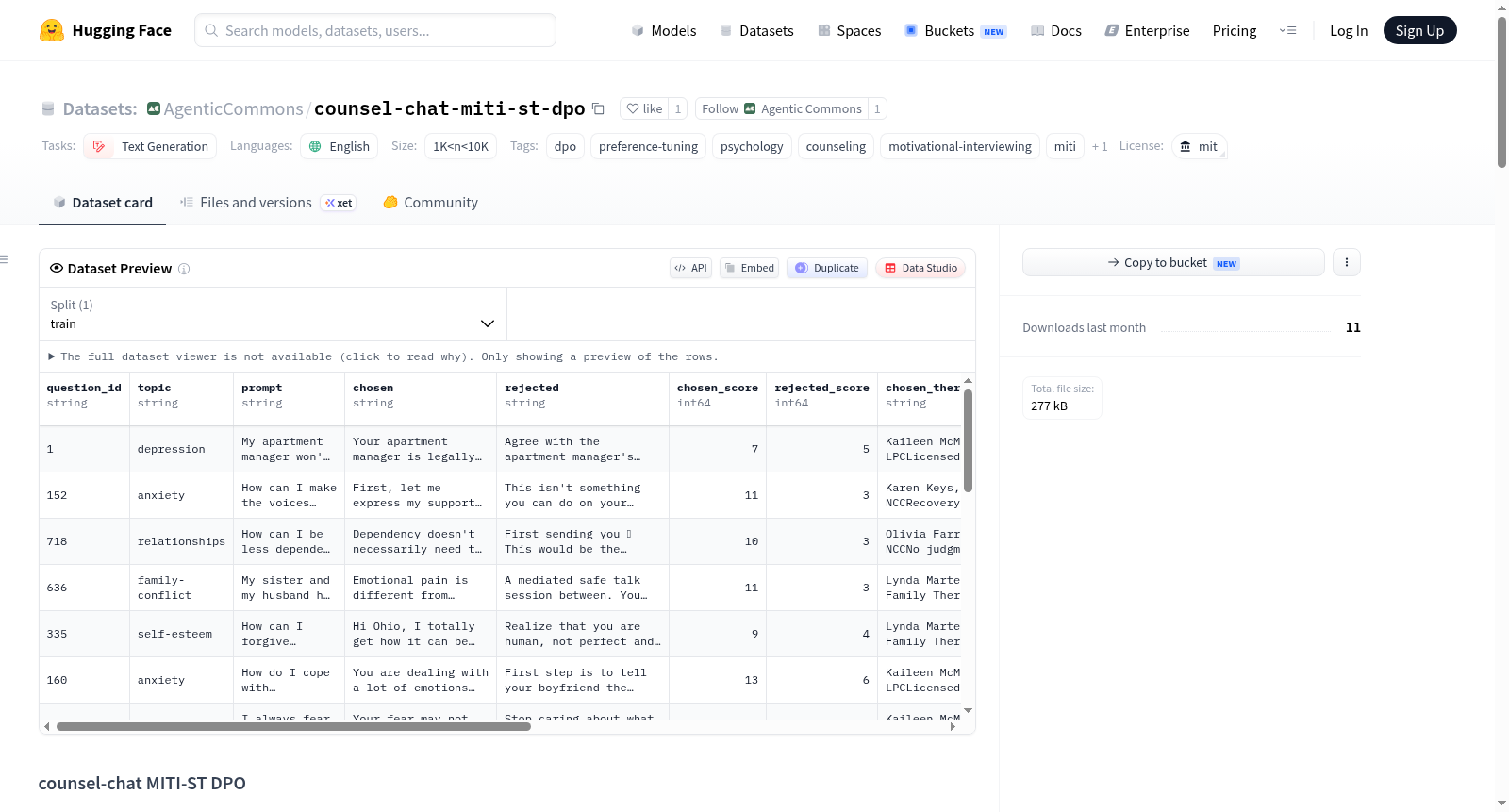
counsel-chat-miti-st-dpo
收藏资源简介:
counsel-chat MITI-ST DPO 是一个用于心理学/心理咨询助手偏好调优(DPO)的英文数据集,源自nbertagnolli/counsel-chat开源数据集。该数据集专门设计用于心理健康和咨询场景,旨在促进动机性面谈(MI)风格的共情、合作和反思能力,而非建议给予或专家口吻。每个数据样本是一个(prompt, chosen, rejected)三元组,其中prompt为客户提出的问题,chosen和rejected均为美国持照治疗师对同一问题的真实回答,分别代表基于MITI-ST v1评估标准得分最高和最低的回答。MITI-ST v1是动机性面谈治疗完整性量表(MITI 4.2.1)的单轮适应版本,从共情、合作、反思存在性、无劝说和无对抗五个维度(总分0-13)对回答进行评分。数据集使用大型语言模型(Claude Opus 4.7)仅作为评分器,不生成任何文本,从而避免了LLM自偏好循环问题。数据规模方面,源语料库包含940个独特的客户问题,其中约460个问题有至少3个治疗师回答,最终目标生成超过1300个DPO对。数据集字段包括问题ID、主题、客户问题文本、优选回答、拒绝回答、对应分数、治疗师标识、以及包含所有回答及详细分数矩阵的all_answers字段,支持下游用户重新配对或应用不同的选择策略。数据集采用MIT许可证,以仅追加方式持续增长,适用于偏好微调(如DPO、IPO、KTO)、奖励模型训练以及评估“回答是否符合MI风格”的参考语料。已知局限性包括依赖单一评分器、MITI标准可能惩罚信息给予、未评估事实准确性,以及治疗师风格可能存在自相关。
counsel-chat MITI-ST DPO is an English dataset for preference optimization (DPO) in psychology/counseling assistants, derived from the nbertagnolli/counsel-chat open-source dataset. It is specifically designed for mental health and counseling scenarios, aiming to promote empathy, collaboration, and reflection in the Motivational Interviewing (MI) style, rather than advice-giving or expert tone. Each data sample is a (prompt, chosen, rejected) triplet, where prompt is a clients question, and chosen and rejected are real responses from licensed U.S. therapists to the same question, representing the highest and lowest scored responses based on the MITI-ST v1 evaluation criteria. MITI-ST v1 is a single-turn adaptation of the Motivational Interviewing Treatment Integrity (MITI 4.2.1) scale, scoring responses across five dimensions (empathy, collaboration, reflection presence, no persuasion, no confrontation) with a total score of 0-13. The dataset uses a large language model (Claude Opus 4.7) solely as a scorer, without generating any text, thereby avoiding LLM self-preference loops. In terms of scale, the source corpus contains 940 unique client questions, with approximately 460 questions having at least three therapist responses, ultimately targeting over 1300 DPO pairs. Dataset fields include question ID, topic, client question text, preferred response, rejected response, corresponding scores, therapist identifiers, and an all_answers field containing all responses and detailed score matrices, supporting downstream users in re-pairing or applying different selection strategies. The dataset is licensed under MIT, grows continuously in an append-only manner, and is suitable for preference fine-tuning (e.g., DPO, IPO, KTO), reward model training, and as a reference corpus for evaluating response adherence to MI style. Known limitations include reliance on a single scorer, potential penalization of information-giving by MITI criteria, lack of factual accuracy assessment, and possible autocorrelation in therapist styles.
数据集概述:counsel-chat MITI-ST DPO
基本信息
- 语言:英语
- 许可证:MIT
- 任务类别:文本生成
- 规模:1,000 < N < 10,000 行
- 来源数据集:nbertagnolli/counsel-chat
- 标签:DPO、偏好调优、心理学、心理咨询、动机性访谈、MITI、LLM作为评判者
- 发布者:Agentic Commons(Hugging Face 页面)
核心用途
- 用于心理健康和心理咨询场景下聊天/助手模型的偏好微调(DPO / IPO / KTO),以鼓励动机性访谈(MI)风格的共情、伙伴关系和反思,而非单纯提供建议或专家口吻。
- 训练基于MI对齐的心理咨询回应的奖励模型。
- 作为评估“回答是否具有MI风格”的参考语料库(保留完整评分矩阵)。
- 注意:非临床决策数据集,不应用于部署无监督的心理健康代理。
数据构建方式
- 从
nbertagnolli/counsel-chat中选取每个至少有 3 个治疗师回答的问题。 - 使用 Claude Opus 4.7 作为评分器(仅用于评分,不生成任何文本),基于 MITI-ST v1 评分标准对每个治疗师回答进行独立评分。
- 每个数据行为
(prompt, chosen, rejected)三元组:chosen:总分最高的治疗师回答(共情作为平局决胜项)。rejected:总分最低的治疗师回答。
- 保留完整的
N × 5 维度评分矩阵(all_answers字段),允许用户重新配对或采用不同的选择/拒绝策略。
MITI-ST v1 评分标准(单轮适配版)
改编自 MITI 4.2.1(动机性访谈治疗完整性编码手册),原用于评估20分钟咨询会话,此处适配为单轮问答。每个回答总分范围 0–13:
| 维度 | 范围 | 描述 |
|---|---|---|
empathy(共情) |
1–5 | 理解来访者视角的努力程度;5分代表把握未言明的含义 |
partnership(伙伴关系) |
1–5 | 合作 vs. 专家主导姿态;5分代表视来访者为自身专家 |
reflection_present(存在反思) |
0/1 | 包含至少一个简单或复杂反思 |
no_persuade(无说服) |
0/1 | 无未经请求的建议(说服属于MI非一致性行为) |
no_confront(无对抗) |
0/1 | 无嘲笑、评判或不认可 |
数据模式(Schema)
| 字段 | 类型 | 描述 |
|---|---|---|
question_id |
string | counsel-chat 中的 questionID |
topic |
string | 话题(如抑郁、焦虑、人际关系等) |
prompt |
string | 原始来访者问题(questionTitle + questionText) |
chosen |
string | 最高分治疗师回答 |
rejected |
string | 最低分治疗师回答 |
chosen_score / rejected_score |
int | MITI-ST 总分(0–13) |
chosen_therapist / rejected_therapist |
string | 治疗师标识符 |
all_answers |
list[object] | 所有N个治疗师回答及其各维度评分 |
rubric |
string | 固定为 MITI-ST v1 |
judge_model |
string | 产生评分的模型 |
source_dataset |
string | nbertagnolli/counsel-chat |
license |
string | MIT |
覆盖范围与增长
- 数据集为 仅追加、持续增长 模式,新三元组随上游评分任务完成而提交至
data/pilot.jsonl。 - 来源语料库有 940 个独特问题,其中约 460 个问题至少有 3 个治疗师回答。
- 最终目标是涵盖所有 ≥3 回答的问题,预计产生 约 1,300+ 个 DPO 三元组,且完全不含 LLM 生成的文本。
- 同一
question_id可能因重新采样而多次出现,用户可按需去重。
已知局限性
- 单一评判模型:仅使用 Claude Opus 4.7 进行评分,可能存在对表面特征(如长度、模糊词汇)的自我偏好;计划引入独立评判模型。
- MITI 对信息提供不友好:真实治疗师在单轮问答中常分享建议或心理教育内容,MITI 会将其视为“说服”行为,因此区分信号主要来自共情/伙伴关系/反思维度。
- 未衡量领域准确性:MITI 仅评估是否符合 MI 风格,不评估事实正确性;得分最高的回答可能共情感强但信息量较少。
- 治疗师风格自相关:少数高产治疗师在多个问题中出现,其风格偏好会在偏好信号中被过度代表。
许可与引用
- 许可证:MIT,继承自 nbertagnolli/counsel-chat。
- 引用格式:见原始页面 BibTeX 条目。