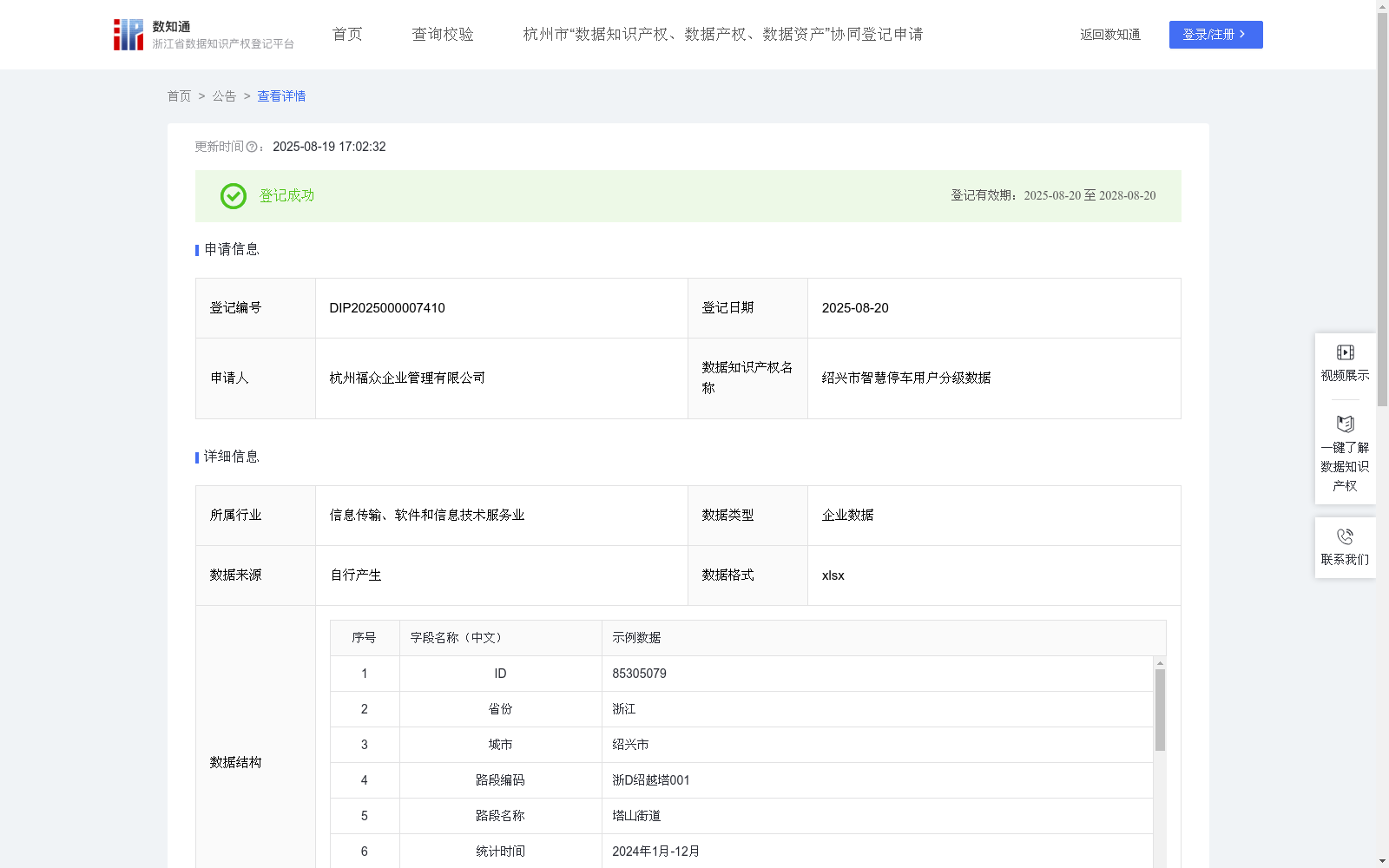
绍兴市智慧停车用户分级数据
收藏资源简介:
在智慧交通与城市停车管理领域,该数据用于绍兴市街道停车管理系统。系统面向停车管理部门、停车服务运营商以及停车用户,需要实时收集、存储和分析停车数据。 停车管理部门:通过分析用户在各街道的停车次数、时长、收费等数据,优化停车资源配置,规划新增停车位,制定更合理的交通政策,缓解城市停车难问题。 停车服务运营商:根据用户评级,为高等级用户提供优惠、优先停车等差异化服务,提高用户满意度和忠诚度,进而提升运营收益;同时,通过分析停车数据,优化停车收费策略。一、数据处理:对采集到的停车用户敏感信息进行加密处理,如车牌号和手机号敏感信息不被泄露 。 二、1. 停车频率分(权重 40%)计算逻辑:阶梯式分段评分,鼓励高频次停车行为。评分规则:该街道停车次数50次及以上:100分(高频用户);该街道停车次数40-49次:80分(次高频用户);该街道停车次数30-39次:60分(中频用户);该街道停车次数20-29次:40分(低频用户);该街道停车次数10-19次:20分(极低频用户);该街道停车次数10次以下:10分(新用户或休眠用户)。2. 消费金额分(权重 60%)计算逻辑:分段线性计分 + 封顶机制,侧重激励中高消费用户,总分严格控制在 0-100 分。评分规则:累计停车费0-100元:每1元得0.3分(如50元得15分,100元得30分);累计停车费101-300元:基础30分+超出部分×0.2分(如200元得 30+100×0.2=50分);累计停车费301元及以:基础70分+超出部分×0.1分(如500元得 70+200×0.1=90分);封顶100分(防止高消费过度主导评分);公式表达:消费金额分=累计停车费×0.3(0≤累计停车费≤100)、30+(累计停车费−100)×0.2(100 <累计停车费≤300)、70+(累计停车费−300)×0.1(300<累计停车费≤900)、100(累计停车费>900);3. 综合评分计算规则:计算逻辑:将停车频率分和消费金额分按权重加权求和,公式如下:综合评分=停车频率分×40%+消费金额分×60%。权重分配依据:消费金额分(60%):侧重用户经济贡献,引导合理消费;停车频率分(40%):体现用户粘性,避免 “高消费低频率” 用户过度占优。4. 用户分级规则:钻石会员:综合评分≥90分 高价值用户,高频次且高消费,享受顶级服务;白金会员:70分≤综合评分 < 90分 中高价值用户,消费或频率表现突出,为重点维护对象;黄金会员:50分≤综合评分 < 70分 中等价值用户,行为稳定,具备提升潜力;白银会员:30分≤综合评分 < 50分 基础价值用户,需通过活动提升粘性;青铜用户:综合评分<30分 低价值或新用户,需引导养成停车习惯。
In the field of smart transportation and urban parking management, this dataset is applied to the Shaoxing Street Parking Management System. The system serves parking management departments, parking service operators, and parking users, and requires real-time collection, storage, and analysis of parking data. For parking management departments: By analyzing data including users' parking times, durations, and fees on each street, they can optimize parking resource allocation, plan new parking spaces, formulate more rational traffic policies, and alleviate urban parking shortages. For parking service operators: Based on user ratings, they provide differentiated services such as discounts and priority parking for high-tier users to improve user satisfaction and loyalty, thereby increasing operational revenue; meanwhile, they optimize parking pricing strategies by analyzing parking data. 1. Data Processing: Sensitive information of collected parking users, such as license plate numbers and mobile phone numbers, is encrypted to prevent leakage. 2.1 Parking Frequency Score (weighted at 40%): The calculation logic adopts stepwise segment-based scoring to encourage high-frequency parking behavior. The scoring rules are as follows: - 50 or more parking times on this street: 100 points (high-frequency users) - 40-49 parking times on this street: 80 points (sub-high-frequency users) - 30-39 parking times on this street: 60 points (medium-frequency users) - 20-29 parking times on this street: 40 points (low-frequency users) - 10-19 parking times on this street: 20 points (very low-frequency users) - Fewer than 10 parking times on this street: 10 points (new users or dormant users) 2.2 Consumption Amount Score (weighted at 60%): The calculation logic uses piecewise linear scoring plus a capping mechanism, focusing on incentivizing mid-to-high consumption users, with the total score strictly controlled within 0-100. The scoring rules are as follows: - Cumulative parking fees 0-100 yuan: 0.3 points per yuan (e.g., 50 yuan yields 15 points, 100 yuan yields 30 points) - Cumulative parking fees 101-300 yuan: 30 basic points + 0.2 points per excess yuan (e.g., 200 yuan yields 30 + 100×0.2 = 50 points) - Cumulative parking fees 301 yuan and above: 70 basic points + 0.1 points per excess yuan (e.g., 500 yuan yields 70 + 200×0.1 = 90 points) - Capped at 100 points (to prevent high-consumption users from overly dominating the score) The formula is expressed as: Consumption Amount Score = cumulative parking fees × 0.3 (0 ≤ cumulative parking fees ≤ 100), 30 + (cumulative parking fees - 100) × 0.2 (100 < cumulative parking fees ≤ 300), 70 + (cumulative parking fees - 300) × 0.1 (300 < cumulative parking fees ≤ 900), 100 (cumulative parking fees > 900) 2.3 Comprehensive Score Calculation Rules: The calculation logic is to perform weighted summation of the Parking Frequency Score and the Consumption Amount Score according to the given weights, with the formula as follows: Comprehensive Score = Parking Frequency Score × 40% + Consumption Amount Score × 60% Weight allocation basis: - Consumption Amount Score (60%): Focuses on users' economic contributions to guide rational consumption - Parking Frequency Score (40%): Reflects user stickiness to avoid overly dominant positions for high-consumption and low-frequency users 2.4 User Classification Rules: - Diamond Member: Comprehensive Score ≥ 90 points (high-value users, high-frequency and high-consumption, enjoying top-tier services) - Platinum Member: 70 ≤ Comprehensive Score < 90 points (mid-to-high value users, with outstanding performance in consumption or frequency, as key maintenance targets) - Gold Member: 50 ≤ Comprehensive Score < 70 points (medium value users, with stable behavior and growth potential) - Silver Member: 30 ≤ Comprehensive Score < 50 points (basic value users, requiring activities to improve stickiness) - Bronze User: Comprehensive Score < 30 points (low-value or new users, requiring guidance to develop parking habits)