
AGU 2023 EMMA Workshop
收藏www.hydroshare.org2023-12-13 更新2025-03-24 收录
下载链接:
https://www.hydroshare.org/resource/d99a7d3c300e4184becad2f8bc611780
下载链接
链接失效反馈官方服务:
资源简介:
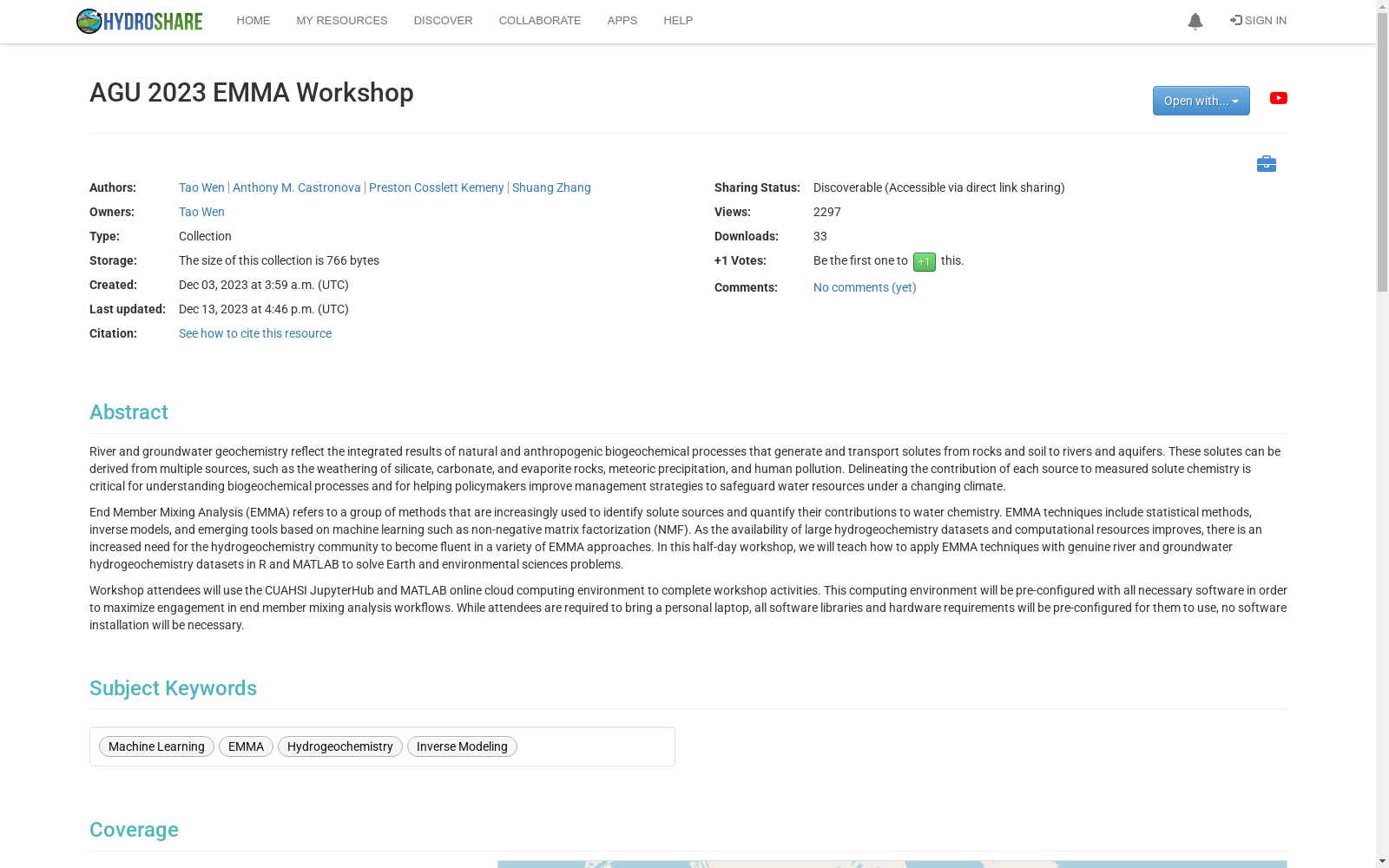
River and groundwater geochemistry reflect the integrated results of natural and anthropogenic biogeochemical processes that generate and transport solutes from rocks and soil to rivers and aquifers. These solutes can be derived from multiple sources, such as the weathering of silicate, carbonate, and evaporite rocks, meteoric precipitation, and human pollution. Delineating the contribution of each source to measured solute chemistry is critical for understanding biogeochemical processes and for helping policymakers improve management strategies to safeguard water resources under a changing climate.
End Member Mixing Analysis (EMMA) refers to a group of methods that are increasingly used to identify solute sources and quantify their contributions to water chemistry. EMMA techniques include statistical methods, inverse models, and emerging tools based on machine learning such as non-negative matrix factorization (NMF). As the availability of large hydrogeochemistry datasets and computational resources improves, there is an increased need for the hydrogeochemistry community to become fluent in a variety of EMMA approaches. In this half-day workshop, we will teach how to apply EMMA techniques with genuine river and groundwater hydrogeochemistry datasets in R and MATLAB to solve Earth and environmental sciences problems.
Workshop attendees will use the CUAHSI JupyterHub and MATLAB online cloud computing environment to complete workshop activities. This computing environment will be pre-configured with all necessary software in order to maximize engagement in end member mixing analysis workflows. While attendees are required to bring a personal laptop, all software libraries and hardware requirements will be pre-configured for them to use, no software installation will be necessary.
河流与地下水地球化学特征反映了自然与人为生物地球化学过程的综合作用,这些过程从岩石和土壤中生成并运输溶质至河流和地下水层。这些溶质可能源自多种来源,例如硅酸盐、碳酸盐和蒸发岩的风化,降水,以及人类污染。明确每种来源对测定的溶质化学成分的贡献对于理解生物地球化学过程至关重要,并且有助于政策制定者改善管理策略,以保护在气候变化背景下的水资源。
端元混合分析(End Member Mixing Analysis,简称EMMA)是指一组用于识别溶质来源并量化其对水化学贡献的方法,这些方法的应用日益广泛。EMMA技术包括统计方法、逆模型以及基于机器学习的崭新工具,如非负矩阵分解(NMF)。随着大型水文地球化学数据集和计算资源的日益丰富,水文地球化学界需要熟练掌握多种EMMA方法。在本半天研讨会上,我们将教授如何使用R和MATLAB等真实河流和地下水水文地球化学数据集应用EMMA技术,以解决地球和环境科学问题。
研讨会参与者将使用CUAHSI JupyterHub和MATLAB在线云计算环境来完成研讨活动。此计算环境将预先配置所有必要软件,以最大化参与端元混合分析工作流程的互动性。虽然参与者需携带个人笔记本电脑,但所有软件库和硬件要求都将为他们预先配置,无需进行软件安装。
提供机构:
www.hydroshare.org
搜集汇总
数据集介绍
背景与挑战
背景概述
该数据集是AGU 2023 EMMA研讨会的资源集合,专注于端元混合分析(EMMA)方法在水文地球化学中的应用,包含机器学习、逆建模等主题的演示和工具。数据集旨在支持研讨会参与者使用R和MATLAB处理真实河流和地下水数据,以解决环境科学问题,并采用开放许可共享,由美国国家科学基金会资助。
以上内容由遇见数据集搜集并总结生成



