
minimal data set
收藏DataCite Commons2025-05-01 更新2024-08-18 收录
下载链接:
https://figshare.com/articles/dataset/minimal_data_set/24192573/2
下载链接
链接失效反馈官方服务:
资源简介:
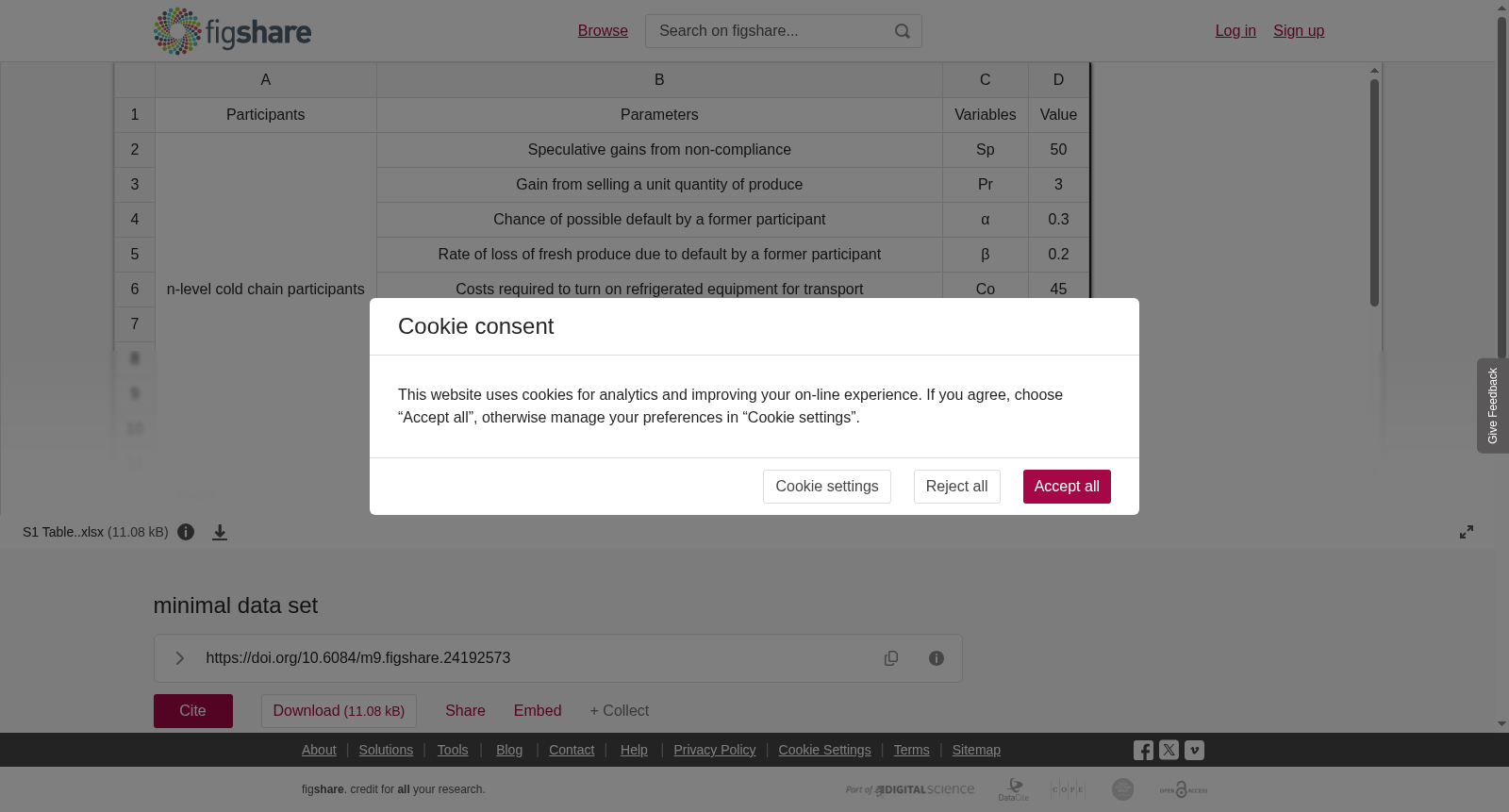
The global cold chain logistics market is witnessing a significant upswing, driven by the rising demand for perishable food products and increasing shipment volumes worldwide. Technological advancements are leading to a more intelligent and digitally enabled cold chain logistics system. However, the high loss rate of fresh agricultural products in China poses a significant threat to the country's food security. Therefore, it is imperative to explore innovative solutions, such as blockchain, to address the challenges of traditional cold chain logistics. In this paper, inspired by the prospect theory and evolutionary game theory, we propose an evolutionary game model to analyze the behavioral strategies of the tripartite of n-level cold chain participants, consumers, and government. Using MATLAB software, the numerical simulation of the game path of this tripartite theory is conducted, and the influence of variable parameters on the evolutionary process and outcomes of the system is analyzed. The results the following: (1) The development of an effective cold chain supply chain system can be divided into three stages, and blockchain technology plays a pivotal role in creating a seamless cold chain environment. The cost of blockchain adoption, government rewards, as well as penalties can significantly influence the behavioral choices of the three stakeholders. (2) The behavior of individual cold chain participants has a strong negative externality, which can impact the behavior of others. We also find that the larger the scale of the cold chain, the lower the probability of default by the participants. (3) The government's adoption of blockchain technology and the implementation of effective incentive policies can foster the successful development of the cold chain blockchain infrastructure. Our research contributes to the theoretical understanding of cold chain logistics decision making and policy creation for the tripartite stakeholders, including cold chain participants, consumers, and government. Our findings can serve as a valuable reference for scientific decision making and policy formulation to encourage the development of a robust cold chain supply chain system.
全球冷链物流市场正迎来显著增长,这一趋势由易腐食品需求的持续攀升以及全球范围内货运量的增加所驱动。技术进步正推动冷链物流系统向更智能、数字化方向迭代升级。然而,中国生鲜农产品的高损耗率正对该国粮食安全构成重大威胁。因此,探索区块链(Blockchain)等创新解决方案以应对传统冷链物流的挑战已迫在眉睫。
本文受前景理论(Prospect Theory)与演化博弈论(Evolutionary Game Theory)的启发,构建了演化博弈模型,用以分析多级冷链参与方、消费者与政府三方的行为策略。借助MATLAB软件,对该三方博弈的演化路径开展了数值仿真,并剖析了可变参数对系统演化过程与最终结果的影响。
研究结果如下:
(1) 高效冷链供应链体系的发展可划分为三个阶段,区块链技术在打造无缝衔接的冷链运营环境中发挥着关键枢纽作用。区块链部署成本、政府奖励与惩戒措施,均会显著影响三类利益相关方的行为选择。
(2) 单个冷链参与方的行为具有较强的负外部性,会对其他主体的行为产生连锁影响。同时研究发现,冷链规模越大,参与方的违约概率越低。
(3) 政府应用区块链技术并推行有效的激励政策,可有效推动冷链区块链基础设施的建成落地。
本研究深化了冷链物流决策制定以及面向冷链参与方、消费者与政府三方利益相关者的政策制定的理论认知。研究结论可为科学决策与政策制定提供宝贵参考,以助力构建稳健可靠的冷链供应链体系。
提供机构:
figshare
创建时间:
2023-11-08
搜集汇总
数据集介绍
背景与挑战
背景概述
该数据集聚焦于冷链物流市场,特别是中国生鲜农产品的高损耗问题,研究利用区块链技术和进化博弈论分析三方参与者行为策略,为冷链供应链系统的决策和政策制定提供理论支持。
以上内容由遇见数据集搜集并总结生成



