Inbound Arrivals: Using weather surveillance radar to quantify the diurnal timing of spring trans-Gulf bird migration - Data Set
收藏资源简介:
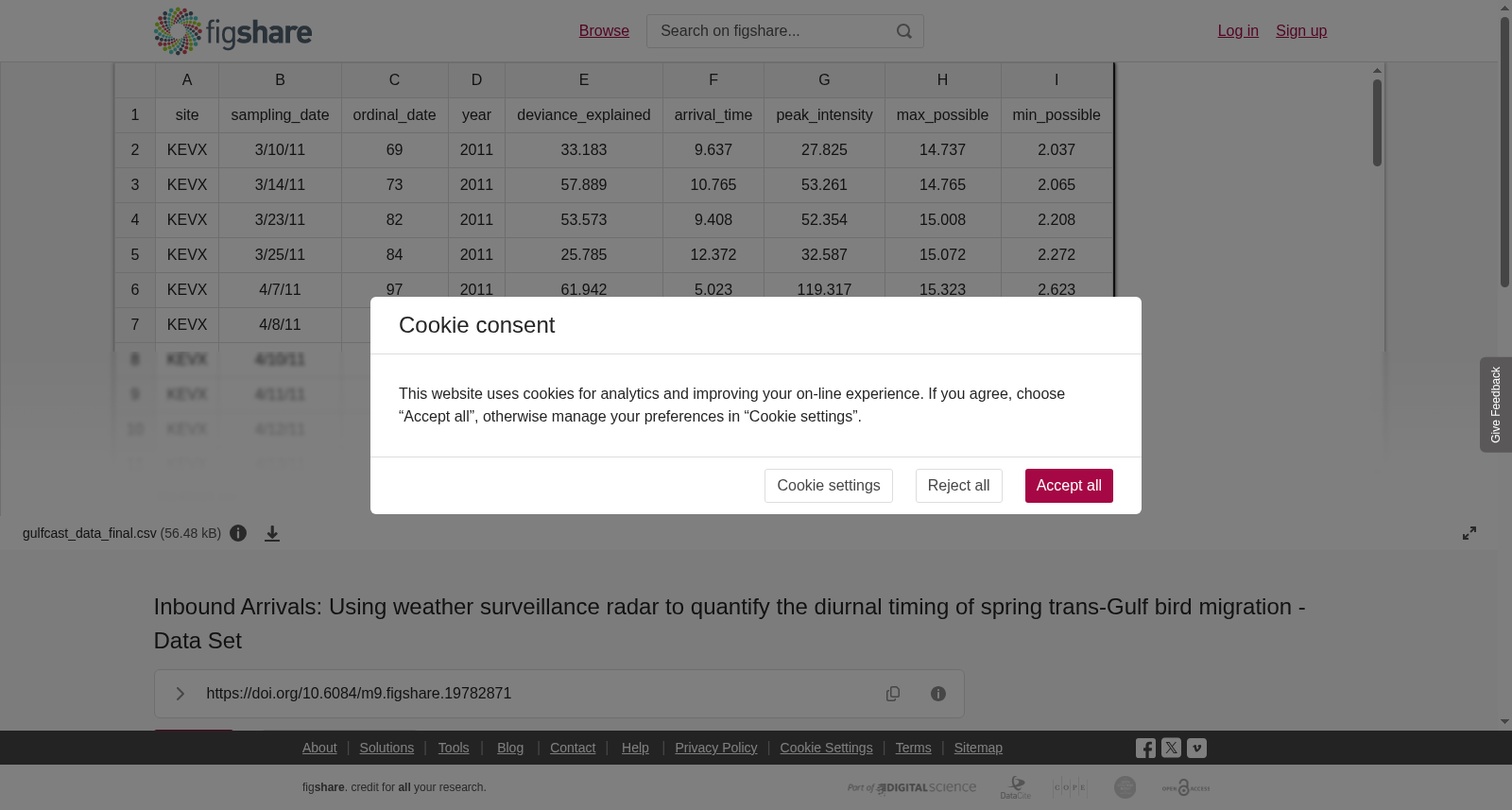
Hundreds of millions of migratory songbirds cross the Gulf of Mexico each spring en route to breeding grounds in North America, making the northern Gulf coast a critical region for these migrants as it provides the first possible stopover location after a long, nonstop trans-Gulf crossing. However, this region has high levels of anthropogenic activity, making migrants vulnerable to a multitude of potentially lethal obstacles. Understanding the timing of mass migratory arrivals along the coast is imperative for advancing conservation of this critical region through the identification of key times in which to direct conservation actions (e.g., temporary halting of wind turbines, reduction of light pollution). To this end, we assessed 10 years of weather surveillance radar data from 5 sites along the northern Gulf of Mexico coast to quantify the daily timing and intensity of trans-Gulf migrant arrival. On a daily scale, we found that migrant intensity peaked an average of 9 hours after local sunrise, occurring earliest at furthest eastern regions of the Gulf. On a seasonal level, the greatest number of arrivals occurred between late April and early May, with peak intensity occurring latest at furthest west sites. Overall intensity of migration across all ten years of data was greatest at the most western sites and decreased the further east a site was located. These findings emphasize the use of the Gulf of Mexico region by migratory birds, providing information that can both advance our understanding of trans-Gulf migration and support conservation of migratory birds in this critical region. <strong>Data Set Key </strong> <strong>site</strong>: NEXRAD radar station ID <strong>deviance_explained</strong>: r2 value, the amount of variation explained by a generalized additive model with a response of migration intensity and a predictor of hour after sunrise. <strong>arrival_time:</strong> The time (hours after sunrise) in which migratory intensity was at its peak. <strong>peak_intensity</strong>: the peak of migration intensity measured on a given day as a value of eta - a measurement of radar reflectivity (i.e., the density of birds in the airspace). <strong>min_possible</strong> and <strong>max_possible</strong>: Range of data for a given day, the earliest and latest possible arrival time in hours after sunrise.
每年春季,数亿只迁徙鸣禽会穿越墨西哥湾,前往北美繁殖地。墨西哥湾北部沿岸作为它们完成长途不间断跨湾飞行后首个可行的中途停歇地,成为这类迁徙鸟类的关键栖息区域。然而,该区域人类活动强度较高,致使迁徙鸟类面临诸多潜在致命威胁。 明确了解沿岸大规模迁徙抵达的时间节点,对于通过确定保护行动的关键时段(例如临时关停风力涡轮机、降低光污染)来推进该关键区域的保护工作至关重要。 为此,我们评估了墨西哥湾北部沿岸5个监测点的10年天气监视雷达数据,以量化跨湾迁徙鸟类抵达的每日时间与强度。 在日尺度上,我们发现迁徙强度平均在当地日出后9小时达到峰值,且海湾最东部区域的抵达时间最早;在季节尺度上,最大规模的迁徙抵达发生在4月末至5月初,且最西部站点的峰值强度出现时间最晚。整体来看,十年间的迁徙总强度在最西部站点最高,且随站点位置向东逐渐降低。 这些研究结果凸显了墨西哥湾区域对迁徙鸟类的重要性,相关信息既有助于加深我们对跨湾迁徙行为的认知,也能为该关键区域的迁徙鸟类保护工作提供支撑。 <strong>数据集关键说明</strong> <strong>站点(site)</strong>:NEXRAD雷达站编号 <strong>偏差解释度(deviance_explained)</strong>:决定系数(r²值),即响应变量为迁徙强度、预测变量为日出后小时数的广义可加模型(generalized additive model)所解释的变异量。 <strong>抵达时间(arrival_time)</strong>:迁徙强度达到峰值的时间(以日出后小时数计)。 <strong>峰值强度(peak_intensity)</strong>:单日迁徙强度的峰值,以eta值衡量——该指标为雷达反射率的量化值,即空域内鸟类的密度。 <strong>最小可能值(min_possible)</strong>与<strong>最大可能值(max_possible)</strong>:单日数据的取值范围,即日出后最早与最晚的可能抵达时间(以小时数计)。