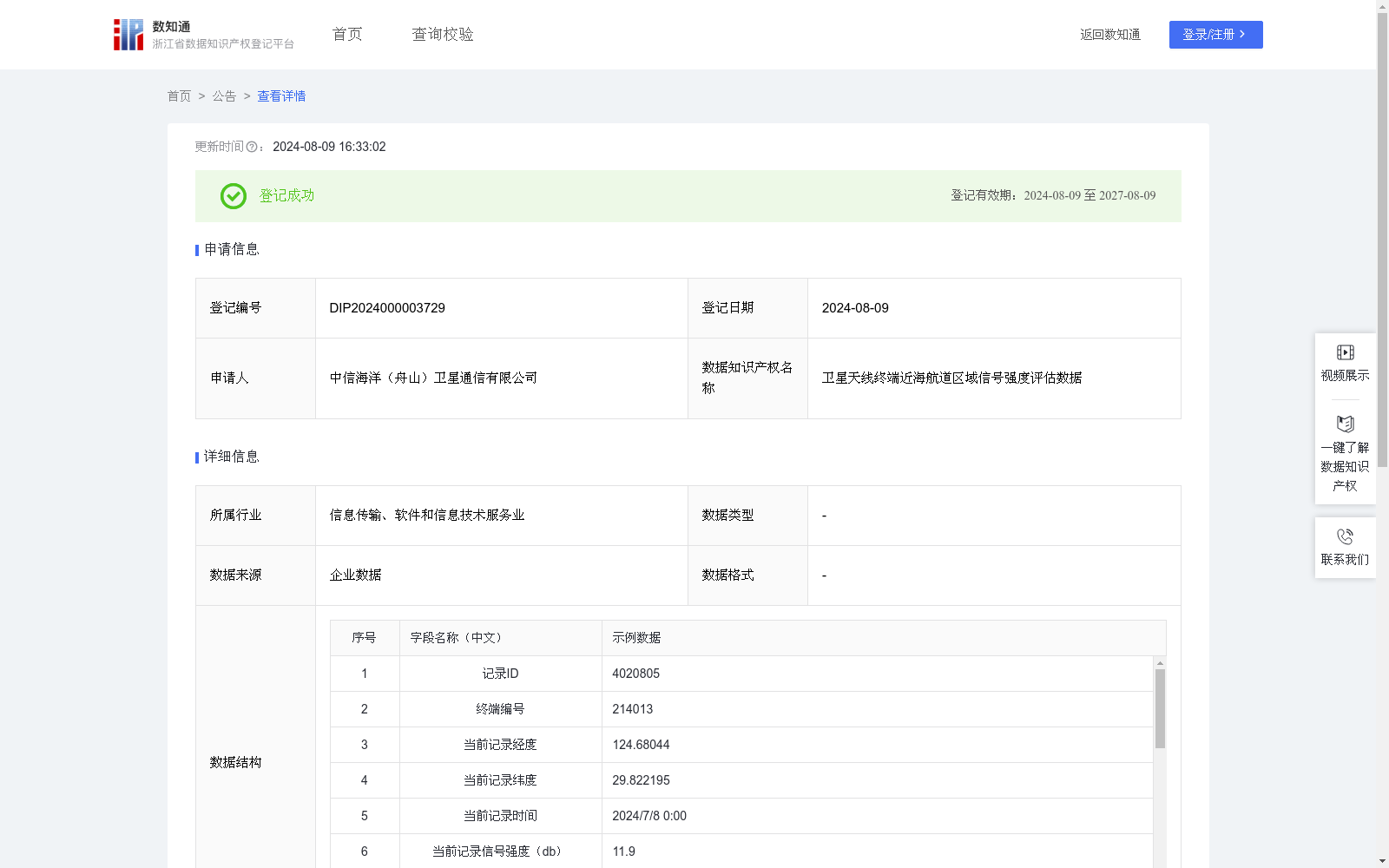
卫星天线终端近海航道区域信号强度评估数据
收藏资源简介:
通过安装在各种船舶上的卫星天线终端收集各类信号强度相关反馈信息,通过计算分析当前记录地点信号强度评估系数、当前记录地点信号强度评估等级、区域信号强度评估系数、区域信号强度评估等级等数据,得出卫星天线终端近海航道区域信号强度评估数据;可为海上航行安全、海洋科研数据收集、海上安全监管应急响应、渔业通信等应用场景,提供通信质量优化与提高的稳定性和可靠性的数据支持,支持了更广泛的海上活动和作业,也为卫星天线终端生产企业、卫星通讯的服务企业优化产品质量、提高区域通讯服务质量提供了参考数据支持。1.数据采集:通过对船舶卫星天线终端信号强度相关信息进行采集整理汇总;收集当前记录经度纬度、当前记录时间、当前记录信号强度、信号上行下行带宽、信号延迟等数据。2.数据计算:根据当前记录经度纬度计算出记录点之间距离,筛选当前记录半径1公里信号强度,求平均值,计算当前记录地点信号强度评估系数=当前记录信号强度*当前记录半径1公里平均信号强度*(信号上行带宽+信号下行带宽)-信号延迟;讲当前记录经度、当前记录纬度取整数部分与小数点后一位,得区域经度、区域纬度,数值相同的记录属于同一区域,对同一区域内的全部记录的信号强度进行统计分析,得到区域1个月、3个月、1年的平均信号强度,计算区域信号强度评估系数=区域1个月平均信号强度*区域3个月平均信号强度*区域1年平均信号强度。3.数据分析:当前记录地点信号强度评估系数≥1000,则评估等级为A级-强,≥500为B级-一般,<500为C级-弱;区域信号强度评估系数≥1500,则评估等级为A级-强,≥1000为B级-一般,<1000为C级-弱。4.数据应用:为海上航通信提供质量优化数据支持,为卫星天线终端生产和通信服务企业改进产品和提升服务提供参考。
Signal strength-related feedback data is collected via satellite antenna terminals installed on various vessels. By calculating and analyzing metrics including the signal strength evaluation coefficient and grade for the current recording location, as well as the regional signal strength evaluation coefficient and grade, the signal strength evaluation data for offshore waterway areas of satellite antenna terminals is derived. This dataset provides data support for optimizing communication quality and improving stability and reliability across application scenarios such as maritime navigation safety, marine scientific research data collection, maritime safety supervision and emergency response, and fishery communication, enabling more extensive maritime activities and operations. It also offers reference data for satellite antenna terminal manufacturers and satellite communication service enterprises to optimize product quality and regional communication service quality. 1. Data Collection: Collect, organize and summarize signal strength-related information of vessel satellite antenna terminals, including current recording longitude, latitude, recording time, current signal strength, uplink/downlink bandwidth, signal delay and other related data. 2. Data Calculation: Calculate the distance between recording points based on their longitude and latitude, filter out signal strength data within a 1-kilometer radius of the current recording location and calculate their average value. The signal strength evaluation coefficient for the current recording location is calculated as: current signal strength × average signal strength within 1-kilometer radius × (uplink bandwidth + downlink bandwidth) - signal delay. Truncate the current longitude and latitude to their integer part plus one decimal place to obtain regional longitude and regional latitude; records with identical regional longitude and latitude belong to the same region. Conduct statistical analysis on the signal strength of all records in the same region to obtain the regional average signal strength over 1 month, 3 months and 1 year respectively. The regional signal strength evaluation coefficient is calculated as: regional 1-month average signal strength × regional 3-month average signal strength × regional 1-year average signal strength. 3. Data Analysis: If the signal strength evaluation coefficient of the current recording location is ≥ 1000, the evaluation grade is Grade A (Strong); if ≥ 500, it is Grade B (General); if < 500, it is Grade C (Weak). If the regional signal strength evaluation coefficient is ≥ 1500, the evaluation grade is Grade A (Strong); if ≥ 1000, it is Grade B (General); if < 1000, it is Grade C (Weak). 4. Data Application: Provide data support for optimizing the quality of maritime communication, and offer references for satellite antenna terminal manufacturers and communication service enterprises to improve their products and services.