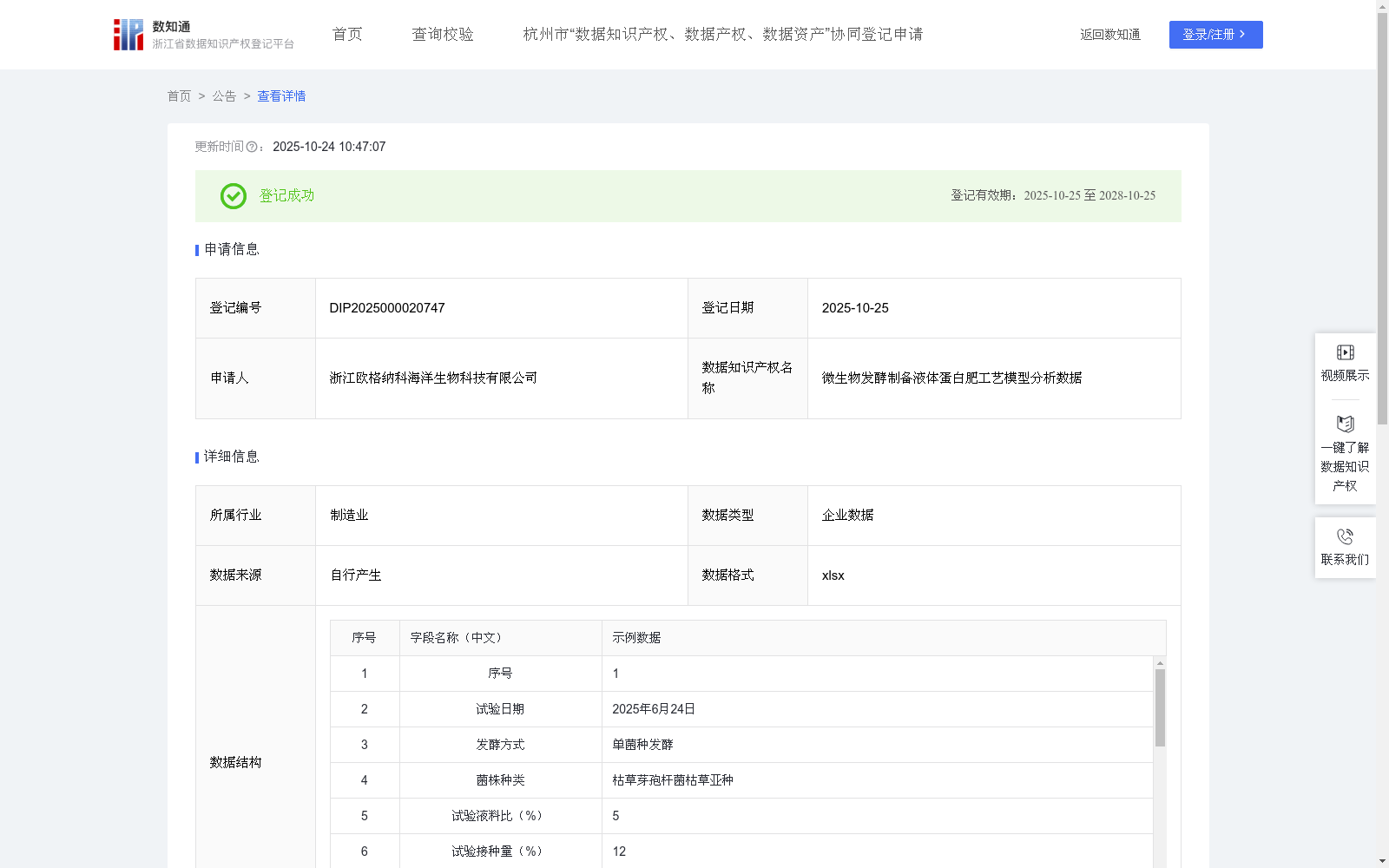
微生物发酵制备液体蛋白肥工艺模型分析数据
收藏资源简介:
一、适用条件与范围 微生物发酵制备液体蛋白肥工艺模型适用于以低值水产加工副产物为原料,采用微生物进行发酵生产的工艺场景。 二、适用对象 该模型主要面向生物有机肥生产企业、农业科技公司及固废资源化机构,用于替代传统发酵工艺优化中的反复试验,精准预测游离氨基酸产出,显著提高生产效率与产品稳定性。 三、解决的问题 替代传统试错实验,精准预测游离氨基酸,解决工艺参数优化效率低、成本高、质量控制难的问题。 四、核心价值点 其核心价值在于通过数字化模型快速确定最佳发酵条件,指导生产获得高氨基酸含量的优质液肥,大幅降低研发周期与成本。 五、外部复用价值 该模型具备良好的外部复用性,可扩展至其他有机废弃物(如豆粕、餐厨废料)的发酵工艺优化,通过调整菌种与回归参数适配不同场景,并可集成至生产管理系统(MES)或肥料工艺设计平台,为有机肥行业提供标准化、智能化的工艺控制解决方案。一、数据采集 基于响应面法(RSM)设计三因素(液料比、接种量、时间)的实验方案,进行微生物发酵制备液体蛋白肥工艺模型实验。每组试验记录发酵方式、菌株种类、液料比(%)、接种量(%)、时间(d),并测定实际发酵液中游离氨基酸含量(g/L)。 二、数据处理 对原始实验数据:试验液料比(%)、试验接种量(%)、试验时间(d)进行标准化处理,将实际值转换为编码值:液料比X₁、接种量X₂、时间X₃; 生成交互项与平方项数据:液料比-接种量交互项X₁X₂、液料比-时间交互项X₁X₃、接种量-时间交互项X₂X₃、液料比平方项X₁²、接种量平方项X₂²、时间平方项X₃²。 三、核心算法规则 根据响应面法分析因素及水平,将实际值转换为编码值,实际值与编码值的对应关系如下: 液料比的水平:-1水平对应5%,0水平对应10%,+1水平对应15%; 接种量的水平:-1水平对应12%,0水平对应16%,+1水平对应20%; 时间的水平:-1水平对应5d,0水平对应6d,+1水平对应7d; 编码值X与实际值Z的转换公式为X=(Z−Z₀)/Δ,Z₀是中心点(0水平)的实际值,Δ是水平间距(从-1到0或0到1的实际值差值)。 将实际值转换为编码值,代入交互项与平方项中后,将所有单项、交互项、平方项代入回归方程模型进行相加。 回归方程模型的公式如下: 预测发酵液中游离氨基酸含量K(g/L)=82.91-2.57X₁+11.73X₂-3.3X₃+5.37X₁X₂+0.24X₁X₃+2.4X₂X₃-22.13X₁²-25.34X₂²-31.5X₃² 预测误差ΔK(%)=|预测发酵液中游离氨基酸含量K(g/L)-实际发酵液中游离氨基酸含量(g/L)(试验值)| 4、数据应用 以发酵液中游离氨基酸含量为指标采用响应面试验对发酵条件进行优化,为后续研究产品提供理论依据。
1. Applicable Conditions and Scope The process model for preparing liquid protein fertilizer via microbial fermentation is applicable to production scenarios where low-value aquatic processing by-products are used as raw materials and fermented with microorganisms. 2. Target Users This model is mainly targeted at bio-organic fertilizer manufacturers, agricultural technology companies, and solid waste resource utilization institutions. It is used to replace repeated trials in traditional fermentation process optimization, accurately predict the yield of free amino acids, and significantly improve production efficiency and product stability. 3. Solved Problems It replaces traditional trial-and-error experiments, accurately predicts free amino acids, and solves the problems of low efficiency, high cost, and difficult quality control in process parameter optimization. 4. Core Value Its core value lies in quickly determining the optimal fermentation conditions through a digital model, guiding production to obtain high-quality liquid fertilizer with high amino acid content, and greatly reducing the R&D cycle and costs. 5. External Reusability Value This model has excellent external reusability and can be extended to the fermentation process optimization of other organic wastes (such as soybean meal, catering waste). It can adapt to different scenarios by adjusting strains and regression parameters, and can be integrated into manufacturing execution systems (MES) or fertilizer process design platforms, providing standardized and intelligent process control solutions for the organic fertilizer industry. 1. Data Collection Based on the three-factor (liquid-solid ratio, inoculum size, fermentation time) experimental scheme designed by Response Surface Methodology (RSM), experiments for the microbial fermentation preparation of liquid protein fertilizer process model were conducted. For each group of experiments, the fermentation method, strain type, liquid-solid ratio (%), inoculum size (%), and fermentation time (d) were recorded, and the actual free amino acid content (g/L) in the fermentation broth was determined. 2. Data Processing For the original experimental data: the liquid-solid ratio (%), inoculum size (%), and fermentation time (d) were standardized, and their actual values were converted into coded values: liquid-solid ratio X₁, inoculum size X₂, fermentation time X₃. Interaction term and squared term data were generated: liquid-solid ratio-inoculum size interaction term X₁X₂, liquid-solid ratio-fermentation time interaction term X₁X₃, inoculum size-fermentation time interaction term X₂X₃, liquid-solid ratio squared term X₁², inoculum size squared term X₂², and fermentation time squared term X₃². 3. Core Algorithm Rules The actual values were converted into coded values based on the factors and levels analyzed by Response Surface Methodology. The corresponding relationship between the coded value X and the actual value Z is as follows: Liquid-solid ratio levels: -1 level corresponds to 5%, 0 level corresponds to 10%, +1 level corresponds to 15%; Inoculum size levels: -1 level corresponds to 12%, 0 level corresponds to 16%, +1 level corresponds to 20%; Fermentation time levels: -1 level corresponds to 5 d, 0 level corresponds to 6 d, +1 level corresponds to 7 d; The conversion formula between coded value X and actual value Z is X=(Z−Z₀)/Δ, where Z₀ is the actual value of the central point (0 level), and Δ is the horizontal spacing (the difference in actual values from -1 to 0 or 0 to 1). After converting the actual values into coded values and substituting them into the interaction terms and squared terms, all single terms, interaction terms, and squared terms were added into the regression equation model. The formula of the regression equation model is as follows: Predicted free amino acid content in fermentation broth K (g/L) = 82.91 - 2.57X₁ + 11.73X₂ - 3.3X₃ + 5.37X₁X₂ + 0.24X₁X₃ + 2.4X₂X₃ - 22.13X₁² - 25.34X₂² - 31.5X₃² Prediction error ΔK (%) = |Predicted free amino acid content in fermentation broth K (g/L) - Actual free amino acid content in fermentation broth (experimental value, g/L)| 4. Data Application Using the free amino acid content in the fermentation broth as the indicator, the fermentation conditions were optimized through response surface experiments, providing a theoretical basis for subsequent product research.