
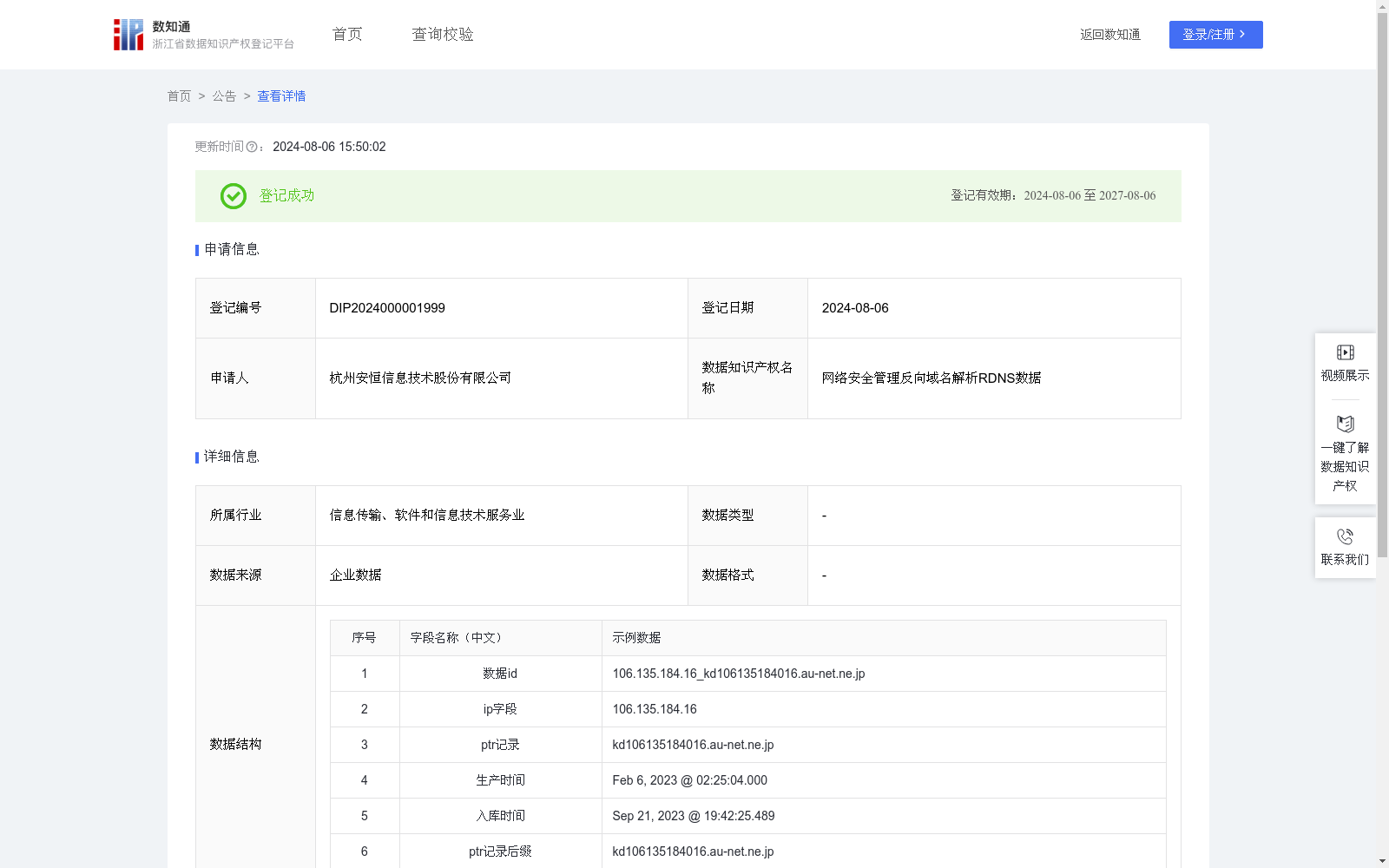
网络安全管理反向域名解析RDNS数据
收藏浙江省数据知识产权登记平台2024-08-06 更新2024-08-07 收录
下载链接:
https://www.zjip.org.cn/home/announce/trends/47959
下载链接
链接失效反馈官方服务:
资源简介:
反向域名解析(RDNS)是一种将IP地址映射回其域名的过程,它在多种场景中有着重要应用。例如,在网络安全领域,RDNS可以帮助识别和追踪网络攻击的来源;在邮件服务器中,它用于验证发件人地址的真实性,防止垃圾邮件和欺诈;在网络管理中,RDNS可以辅助进行网络流量分析和监控,提高网络的可靠性和性能。此外,RDNS也是实现负载均衡和内容分发网络(CDN)服务的关键技术之一,通过它可以根据用户的地理位置提供更快的访问速度。网络安全管理反向域名解析RDNS数据算法规则:
步骤1:数据收集
从开源Rapid7收集需要进行RDNS查询的IP地址列表。
步骤2:RDNS查询
对每个IP地址执行RDNS查询,以获取其对应的PTR记录。
步骤3:解析PTR记录
解析PTR记录以提取反向域名。
步骤4:数据关联
将解析出的反向域名与IP地址关联,并存储在数据库中。
Reverse Domain Name System (RDNS) is a process that maps IP addresses back to their corresponding domain names, and it has important applications in various scenarios. For example, in the field of cybersecurity, RDNS can help identify and trace the source of network attacks; in mail servers, it is used to verify the authenticity of sender addresses to prevent spam and fraud; in network management, RDNS can assist in network traffic analysis and monitoring, thereby improving network reliability and performance.
Additionally, RDNS is also one of the key technologies for implementing load balancing and Content Delivery Network (CDN) services, which can provide faster access speeds based on the user's geographic location.
Algorithm Rules for RDNS Data in Cybersecurity Management:
Step 1: Data Collection
Collect the list of IP addresses requiring RDNS queries from open-source Rapid7 datasets.
Step 2: RDNS Query
Perform RDNS queries on each IP address to obtain its corresponding PTR records.
Step 3: PTR Record Parsing
Parse the PTR records to extract reverse domain names.
Step 4: Data Association
Associate the extracted reverse domain names with their corresponding IP addresses and store them in a database.
提供机构:
杭州安恒信息技术股份有限公司
创建时间:
2024-06-21
搜集汇总
数据集介绍
特点
该数据集为网络安全管理反向域名解析RDNS数据,包含2037条记录,每日更新,应用于网络安全、邮件服务器验证等领域。数据包含IP字段、PTR记录等关键信息,通过特定算法规则处理。
以上内容由遇见数据集搜集并总结生成


