
Paternal Y chromosomal genotyping reveals multiple large-scale admixtures in the formation of Lolo-Burmese–speaking populations in southwest China
收藏DataCite Commons2024-02-19 更新2024-07-27 收录
下载链接:
https://tandf.figshare.com/articles/dataset/Paternal_Y_chromosomal_genotyping_reveals_multiple_large-scale_admixtures_in_the_formation_of_Lolo-Burmese_speaking_populations_in_southwest_China/11353511
下载链接
链接失效反馈官方服务:
资源简介:
<b>Background:</b> Bai and Yi people are two Tibeto-Burman speaking ethnic groups in Yunnan, southwest China. The genetic structure and history of these two groups are largely unknown due to a lack of available genetic data. <b>Aim:</b> To investigate the paternal genetic structure and population relationship of the Yi and Bai people. <b>Subjects and methods:</b> We collected samples from 278 Bai individuals and 283 Yi individuals from Yunnan and subsequently genotyped 43 phylogenetically relevant Y-SNPs in those samples. We estimated haplogroup frequencies and merged our data with a reference database including 46 representative worldwide populations to infer genetic relationships. <b>Results:</b> Y chromosomal haplogroup O-M175 is the dominant lineage in both Bai and Yi people. The Bai and Yi show a close genetic relationship with other Tibeto-Burman<b>–</b>speaking populations with high frequencies of haplogroup O2a2b1a1-Page23, which is also confirmed by PCA. The frequencies of the Tai-Kadai specific lineage O1a-M119, the southern China widespread lineage O1b-P31 and the eastern China enriched lineage O2a1b-002611, are also relatively high in our studied populations. <b>Conclusions:</b> The paternal Y chromosomal affinity of the Bai and Yi with Tibeto-Burman groups is consistent with the language classification. During the formation of the Bai and Yi populations, there were multiple large-scale admixtures, including the expansion of Neolithic farming populations from northern China, the assimilation of Tai-Kadai–speaking populations in southwest China, the demographic expansion driven by Neolithic agricultural revolution from southern China, and the admixture with populations of military immigration from northern and eastern China.
**背景**:白族与彝族是中国西南云南省境内的两支藏缅语族(Tibeto-Burman)族群。由于缺乏可用的遗传数据,这两个族群的遗传结构与演化历史目前尚未得到充分阐明。
**研究目的**:探究彝族与白族的父系遗传结构及群体亲缘关系。
**研究对象与方法**:本研究从云南省采集了278名白族个体与283名彝族个体的样本,随后对这些样本进行了43个系统发育相关的Y染色体单核苷酸多态性(Y-SNPs)基因分型。我们估算了单倍群频率,并将本研究数据与包含全球46个代表性群体的参考数据库进行整合,以推断群体间的遗传亲缘关系。
**结果**:Y染色体单倍群O-M175是白族与彝族的优势父系谱系。白族与彝族与其他藏缅语族群体遗传关系紧密,这类群体普遍携带高频率的单倍群O2a2b1a1-Page23,这一结论也通过主成分分析(Principal Component Analysis, PCA)得到验证。本研究涉及的两个族群中,侗台语族(Tai-Kadai)特异性谱系O1a-M119、中国南方广泛分布的谱系O1b-P31以及中国东部富集的谱系O2a1b-002611的频率也相对较高。
**结论**:白族与彝族的父系Y染色体亲缘关系与藏缅语族的语言分类一致。在白族与彝族的族群形成过程中,曾发生过多轮大规模基因交流事件,包括来自中国北方的新石器时代农耕族群扩张、中国西南地区侗台语族群体的同化、源自中国南方的新石器时代农业革命驱动的人口扩张,以及与来自中国北方及东部的军事移民群体的基因交流。
提供机构:
Taylor & Francis
创建时间:
2019-12-11
搜集汇总
数据集介绍
背景与挑战
背景概述
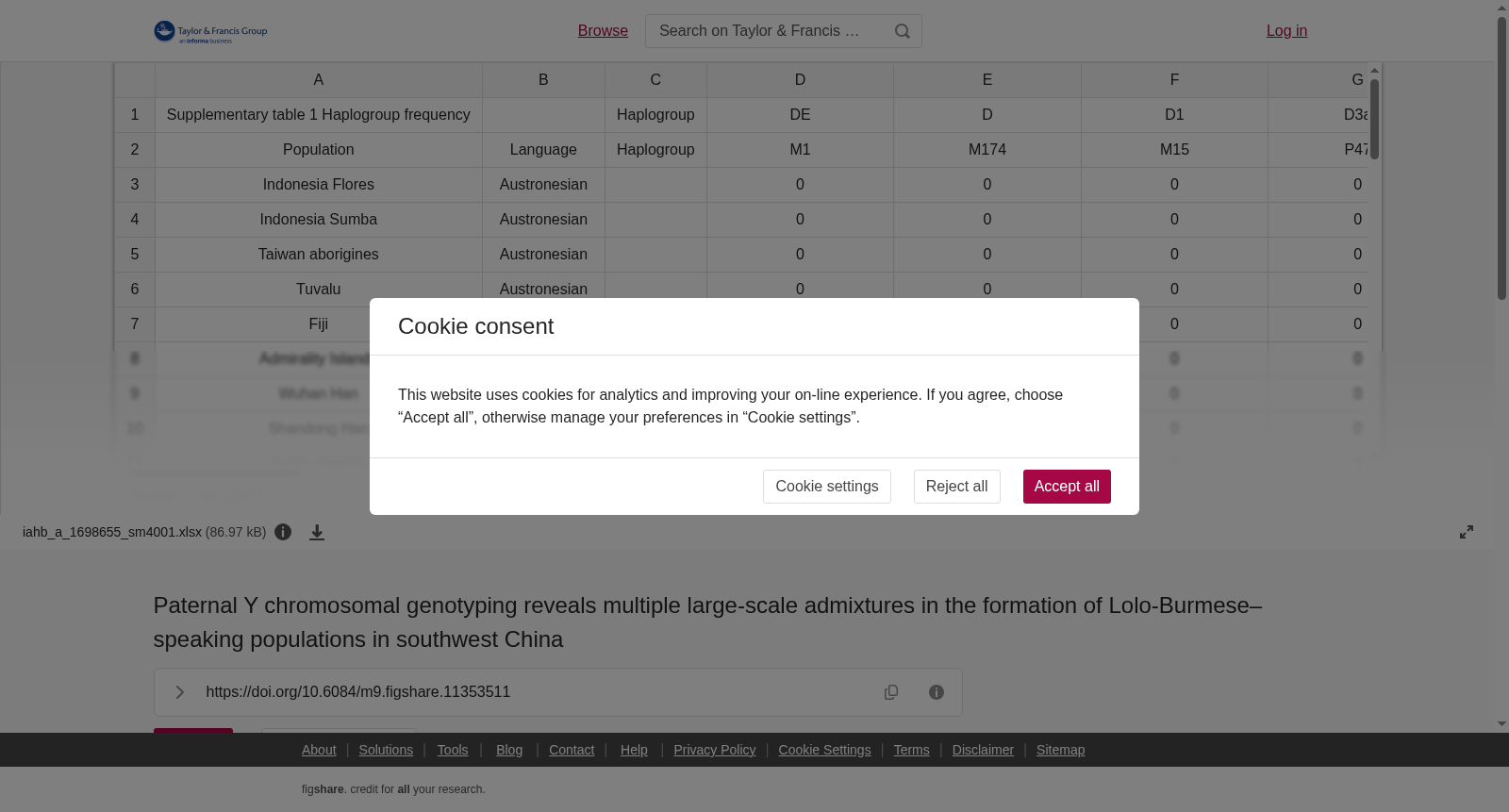
该数据集包含中国云南白族和彝族的Y染色体基因分型数据,揭示了这些族群在形成过程中经历了多次与不同语族群体的大规模混合。研究通过43个Y-SNP标记分析,发现O-M175单倍群是主要谱系,表明白族和彝族与藏缅语族群体有密切的遗传关系。
以上内容由遇见数据集搜集并总结生成


