大学生心理健康变化轨迹分析结果数据集
收藏资源简介:
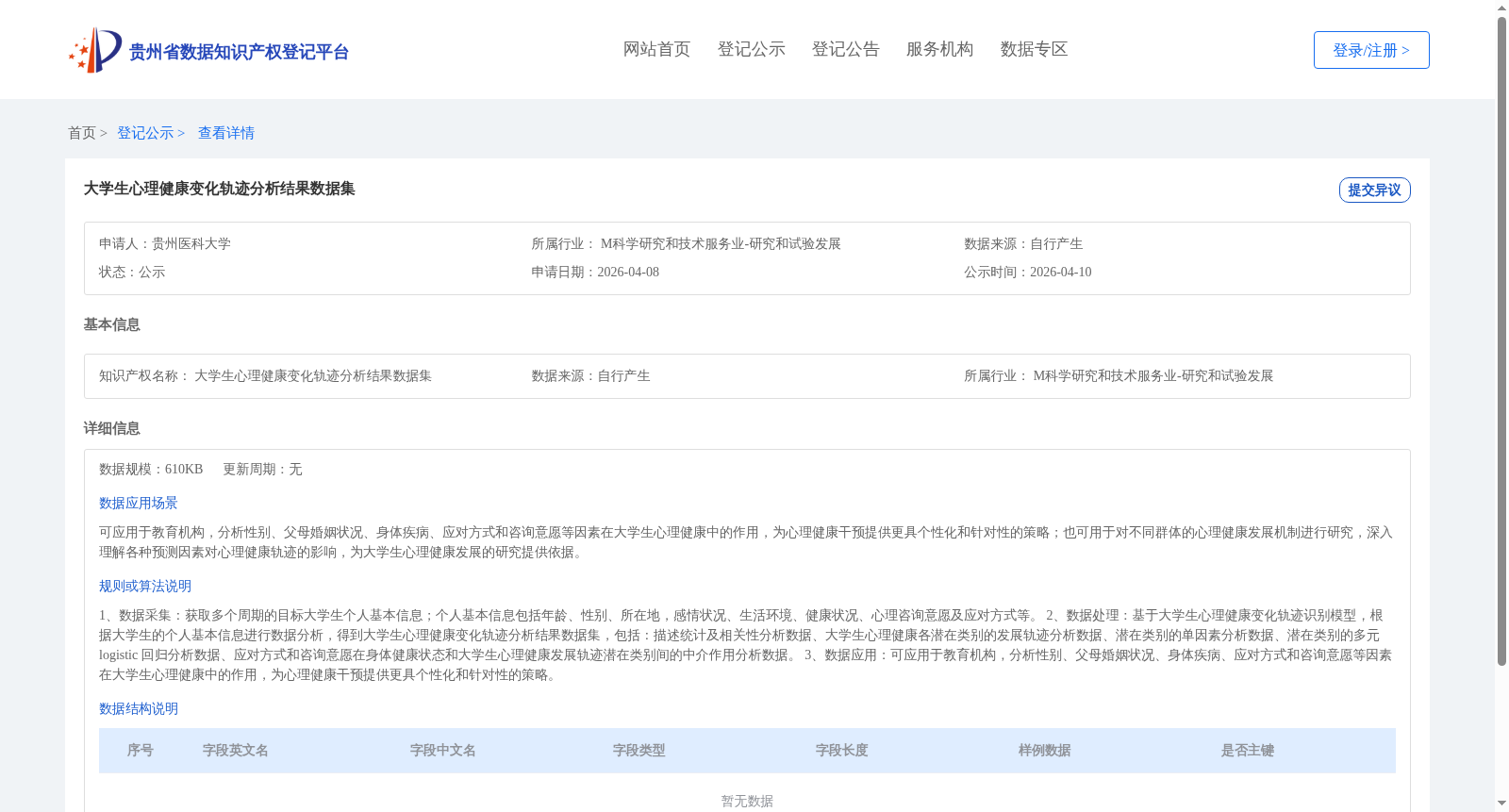
1、数据采集:获取多个周期的目标大学生个人基本信息;个人基本信息包括年龄、性别、所在地,感情状况、生活环境、健康状况、心理咨询意愿及应对方式等。 2、数据处理:基于大学生心理健康变化轨迹识别模型,根据大学生的个人基本信息进行数据分析,得到大学生心理健康变化轨迹分析结果数据集,包括:描述统计及相关性分析数据、大学生心理健康各潜在类别的发展轨迹分析数据、潜在类别的单因素分析数据、潜在类别的多元 logistic 回归分析数据、应对方式和咨询意愿在身体健康状态和大学生心理健康发展轨迹潜在类别间的中介作用分析数据。 3、数据应用:可应用于教育机构,分析性别、父母婚姻状况、身体疾病、应对方式和咨询意愿等因素在大学生心理健康中的作用,为心理健康干预提供更具个性化和针对性的策略。
1. Data Collection: Collect basic personal information of target college students across multiple cycles. The basic personal information includes age, gender, location, relationship status, living environment, health status, willingness to receive psychological counseling, coping styles, etc. 2. Data Processing: Conduct data analysis based on the college students' mental health change trajectory recognition model using their basic personal information, to obtain the analysis result dataset of college students' mental health change trajectories. The dataset includes: descriptive statistics and correlation analysis data, development trajectory analysis data of each latent class of college students' mental health, univariate analysis data of latent classes, multiple logistic regression analysis data of latent classes, and mediation effect analysis data of coping styles and counseling willingness between physical health status and the latent classes of college students' mental health development trajectories. 3. Data Application: Can be applied to educational institutions to analyze the roles of factors such as gender, parental marital status, physical illnesses, coping styles and counseling willingness in college students' mental health, so as to provide more personalized and targeted strategies for mental health intervention.