
Global climate changes decoupled soil nitrogen mineralization and immobilization
收藏DataCite Commons2024-10-12 更新2024-11-06 收录
下载链接:
https://figshare.com/articles/dataset/Global_climate_changes_decoupled_soil_nitrogen_mineralization_and_immobilization/27214659/1
下载链接
链接失效反馈官方服务:
资源简介:
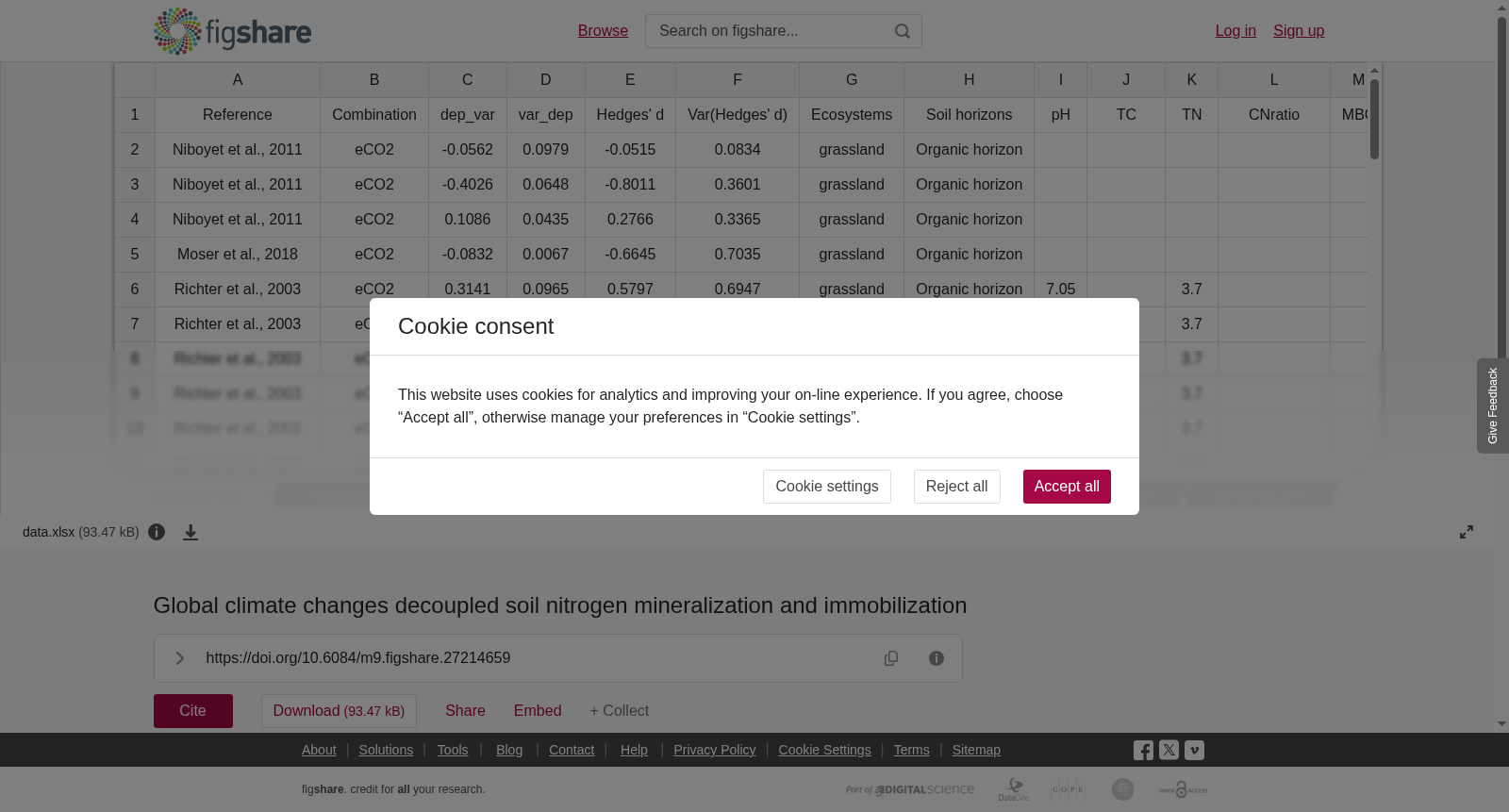
Global climate changefactors (GCFs), including elevated CO2 (eCO2), warming, rainfall, drought, and nitrogen (N) deposition, and their combination have profoundly affected soil N cycling. Organic N mineralization and inorganic N immobilization are two fundamental pathways, whose difference determined soil available N production. However, critical knowledge gaps exist in the effect of GCFs on soil mineralization-immobilization turnover. We conducted a meta-analysis using 662 paired field observations to evaluate the individual and combined effect of GCFs on gross nitrogen mineralization(GM) and immobilization(GI). The results, for the first time, showed that both individual and combined GCFs could increase GM(with overall effect of 0.2434and 0.1840) but decrease GI(with overall effect of -0.1470and -0.1914), potentially increasing the production of available Nin the soil.The decoupling patterns were categorized into: (1) GM increasing and GI unchanging (e.g. eCO2, rainfall, N addition, rainfall+Naddition), (2) GM increasing and GI decreasing (e.g. warming+drought), and(3) GM unchanging and GI decreasing (e.g. warming, eCO2+warming, eCO2+rainfall). In addition, soil GM was influenced by GCFs depending on ecosystems, soil horizons and climatic zones. However, GCFs affected GI regardless of ecosystems, soil horizons and climatic zones, apparently due to the mirror-image responses of GIA and GIN to GCFs. Moreover, soil properties (including pH, total C, total N, and C:N ratio) were the most important factors controlling the response of GM and GI to GCFs, followed by climatic conditions (MAT and MAP) and experimental settings (magnitude and duration). Taken together, these findings suggested an enhanced soil available N production under global climate changes, and soil properties are the first factors to be considered for the evaluation and model-building of soil available N production.
全球气候变化驱动因子(Global Climate Changefactors, GCFs)包括高浓度二氧化碳(eCO2)、增温、降雨、干旱以及氮(N)沉降,及其复合作用已对土壤氮循环造成深远影响。有机氮矿化(organic N mineralization)与无机氮固持(inorganic N immobilization)是土壤氮循环的两个核心途径,二者的动态差值决定了土壤有效氮(available N)的生成过程。然而,当前学界关于GCFs对土壤矿化-固持周转(mineralization-immobilization turnover)过程的影响仍存在关键认知空白。本研究依托662组配对野外观测数据开展元分析(meta-analysis),以评估GCFs单独及复合作用对总氮矿化(gross nitrogen mineralization, GM)与总氮固持(immobilization, GI)的影响。本研究首次发现,GCFs的单独及复合作用均可提升总氮矿化(整体效应值分别为0.2434与0.1840),但会降低总氮固持(整体效应值分别为-0.1470与-0.1914),进而可能提升土壤有效氮的生成水平。此类解耦模式可分为三类:(1)总氮矿化提升且总氮固持不变(如eCO2、降雨、氮添加、降雨+氮添加);(2)总氮矿化提升且总氮固持降低(如增温+干旱);(3)总氮矿化不变且总氮固持降低(如增温、eCO2+增温、eCO2+降雨)。此外,GCFs对土壤总氮矿化的影响因生态系统类型、土壤发生层(soil horizons)及气候区(climatic zones)的不同而异。但GCFs对总氮固持的影响则不受生态系统、土壤发生层及气候区的调控,这一现象主要源于GIA与GIN对GCFs的镜像响应模式。此外,土壤属性(soil properties)包括酸碱度(pH)、总有机碳(total C)、总氮(total N)及碳氮比(C:N ratio),是调控总氮矿化与总氮固持对GCFs响应的最关键因子,其次为气候条件(年均温(Mean Annual Temperature, MAT)与年均降水量(Mean Annual Precipitation, MAP))及实验设置(experimental settings,涵盖处理强度与实验时长)。综上,本研究结果表明,全球气候变化背景下土壤有效氮的生成过程将得到增强,且在开展土壤有效氮生成的评估与模型构建时,土壤属性应作为首要考虑因素。
提供机构:
figshare
创建时间:
2024-10-12
搜集汇总
数据集介绍
背景与挑战
背景概述
该数据集通过元分析研究了全球气候变化因素对土壤氮矿化和固定的影响,发现这些因素普遍增加氮矿化但减少氮固定,可能导致土壤有效氮增加。研究还揭示了三种解耦模式,并指出土壤性质是影响这些过程的最重要因素。
以上内容由遇见数据集搜集并总结生成



