
全球海洋溶解氧浓度空间网格数据集(2005-2022)
收藏地球大数据科学工程2024-07-06 收录
下载链接:
https://data.casearth.cn/sdo/detail/66820888819aec7e28ee1647
下载链接
链接失效反馈官方服务:
资源简介:
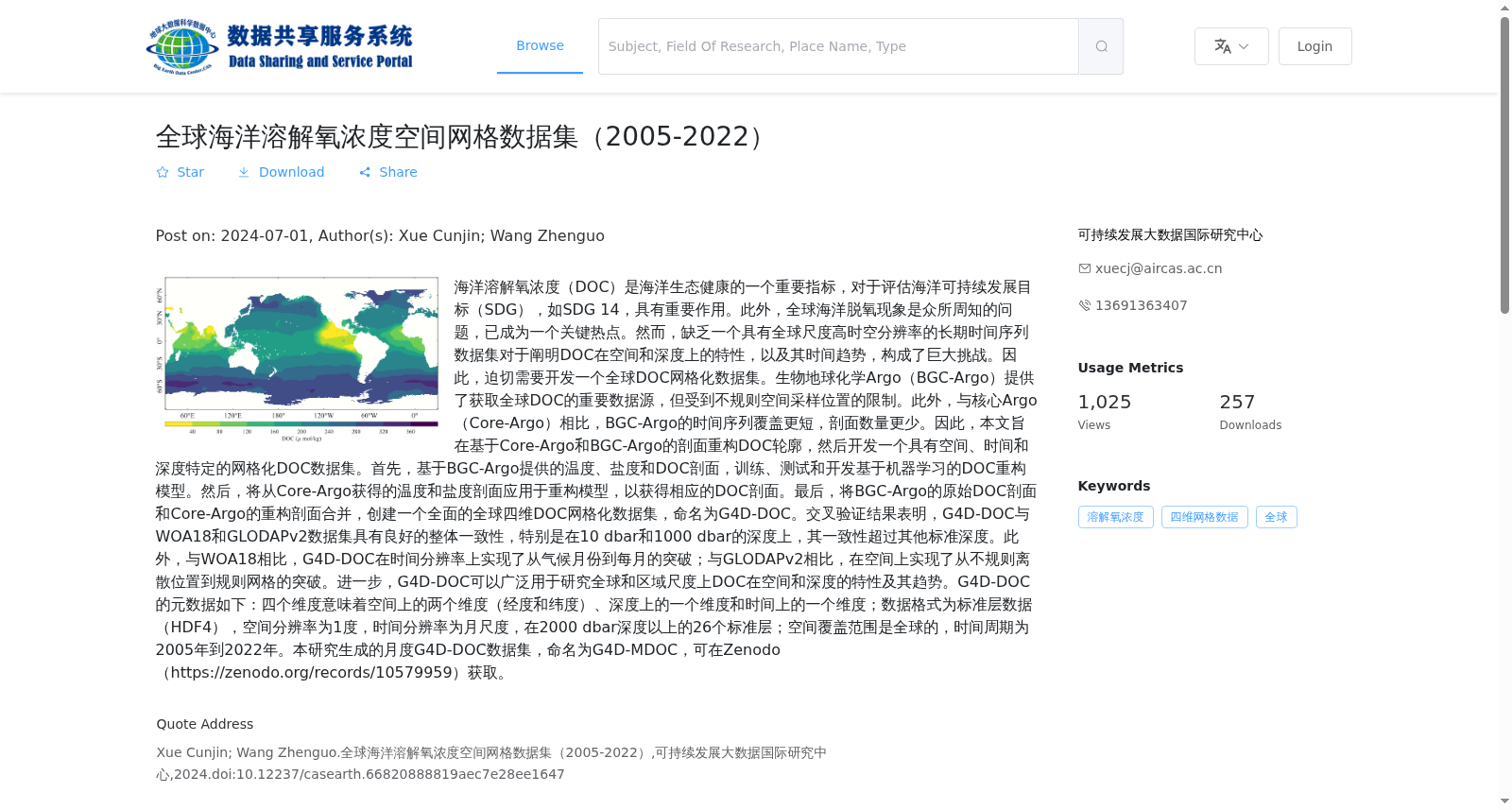
海洋溶解氧浓度(DOC)是海洋生态健康的一个重要指标,对于评估海洋可持续发展目标(SDG),如SDG 14,具有重要作用。此外,全球海洋脱氧现象是众所周知的问题,已成为一个关键热点。然而,缺乏一个具有全球尺度高时空分辨率的长期时间序列数据集对于阐明DOC在空间和深度上的特性,以及其时间趋势,构成了巨大挑战。因此,迫切需要开发一个全球DOC网格化数据集。生物地球化学Argo(BGC-Argo)提供了获取全球DOC的重要数据源,但受到不规则空间采样位置的限制。此外,与核心Argo(Core-Argo)相比,BGC-Argo的时间序列覆盖更短,剖面数量更少。因此,本文旨在基于Core-Argo和BGC-Argo的剖面重构DOC轮廓,然后开发一个具有空间、时间和深度特定的网格化DOC数据集。首先,基于BGC-Argo提供的温度、盐度和DOC剖面,训练、测试和开发基于机器学习的DOC重构模型。然后,将从Core-Argo获得的温度和盐度剖面应用于重构模型,以获得相应的DOC剖面。最后,将BGC-Argo的原始DOC剖面和Core-Argo的重构剖面合并,创建一个全面的全球四维DOC网格化数据集,命名为G4D-DOC。交叉验证结果表明,G4D-DOC与WOA18和GLODAPv2数据集具有良好的整体一致性,特别是在10 dbar和1000 dbar的深度上,其一致性超过其他标准深度。此外,与WOA18相比,G4D-DOC在时间分辨率上实现了从气候月份到每月的突破;与GLODAPv2相比,在空间上实现了从不规则离散位置到规则网格的突破。进一步,G4D-DOC可以广泛用于研究全球和区域尺度上DOC在空间和深度的特性及其趋势。G4D-DOC的元数据如下:四个维度意味着空间上的两个维度(经度和纬度)、深度上的一个维度和时间上的一个维度;数据格式为标准层数据(HDF4),空间分辨率为1度,时间分辨率为月尺度,在2000 dbar深度以上的26个标准层;空间覆盖范围是全球的,时间周期为2005年到2022年。本研究生成的月度G4D-DOC数据集,命名为G4D-MDOC,可在Zenodo(https://zenodo.org/records/10579959)获取。
Marine Dissolved Oxygen Concentration (DOC) is a critical indicator of marine ecological health, and plays a vital role in evaluating the United Nations Sustainable Development Goals (SDGs), such as SDG 14. Moreover, global ocean deoxygenation is a well-documented issue that has become a key research hotspot. However, the lack of a long-term time-series dataset with high spatiotemporal resolution at the global scale poses a significant challenge to clarifying the spatial, depth-wise, and temporal characteristics of DOC. Therefore, there is an urgent need to develop a global gridded DOC dataset. Biogeochemical Argo (BGC-Argo) provides an important data source for obtaining global DOC, but it is limited by irregular spatial sampling locations. Additionally, compared with Core-Argo, BGC-Argo has a shorter time-series coverage and fewer profiles. Thus, this study aims to reconstruct DOC profiles based on both Core-Argo and BGC-Argo profiles, and then develop a gridded DOC dataset with specific spatial, temporal, and depth dimensions. First, a machine learning-based DOC reconstruction model is trained, tested, and validated using the temperature, salinity, and DOC profiles provided by BGC-Argo. Then, the temperature and salinity profiles obtained from Core-Argo are input into the reconstruction model to generate corresponding DOC profiles. Finally, the original DOC profiles from BGC-Argo and the reconstructed profiles from Core-Argo are merged to create a comprehensive global four-dimensional gridded DOC dataset, named G4D-DOC. Cross-validation results show that G4D-DOC has good overall consistency with the WOA18 and GLODAPv2 datasets, particularly at depths of 10 dbar and 1000 dbar, where its consistency outperforms that at other standard depths. Furthermore, compared with WOA18, G4D-DOC has improved temporal resolution from climatological months to monthly; compared with GLODAPv2, it has achieved a breakthrough in spatial scale from irregular discrete locations to regular grids. Further, G4D-DOC can be widely used to study the spatial, depth-wise, and temporal characteristics and trends of DOC at global and regional scales. The metadata of G4D-DOC is as follows: the four dimensions refer to two spatial dimensions (longitude and latitude), one depth dimension, and one temporal dimension; the data format is standard layer data (HDF4), with a spatial resolution of 1 degree, a temporal resolution of monthly scale, and 26 standard layers above 2000 dbar; the spatial coverage is global, and the time period spans from 2005 to 2022. The monthly G4D-DOC dataset generated in this study, named G4D-MDOC, is available on Zenodo (https://zenodo.org/records/10579959).
提供机构:
可持续发展大数据国际研究中心
搜集汇总
数据集介绍
背景与挑战
背景概述
该数据集是一个全球海洋溶解氧浓度(DOC)的四维网格化数据集(G4D-DOC),覆盖2005年至2022年,具有高时空分辨率(空间1度、月尺度)和深度维度(2000 dbar以上26层)。它通过融合BGC-Argo和Core-Argo数据,利用机器学习方法重构DOC剖面,解决了长期DOC数据缺乏的问题,适用于分析全球和区域海洋脱氧趋势及其生态影响。
以上内容由遇见数据集搜集并总结生成


