
RNA sequencing to identify differentially-expressed genes in HER3-depleted KatoII MET-amplified cancer cells
收藏NIAID Data Ecosystem2026-03-13 收录
下载链接:
https://www.ncbi.nlm.nih.gov/sra/SRP347510
下载链接
链接失效反馈官方服务:
资源简介:
Receptor tyrosine kinases (RTKs) are recognized as targets of precision medicine in human cancer upon their gene amplification or constitutive activation, resulting in increased downstream signal complexity including heterotypic crosstalk with other RTKs. The Met hepatocyte growth factor RTK exhibits such reciprocal crosstalk with several members of the human EGFR (HER) family of RTKs when amplified in cancer cells. We observed that Met signaling converges on HER3 tyrosine phosphorylation across a panel of seven MET-amplified cancer cell lines and that HER3 is required for cancer cell expansion and oncogenic capacity in vitro and in vivo. In order to identify genes required for cancer cell proliferation in the MET-amplified setting whose expression, we stably transduced KatoII MET-amplified cells with shRNA targeting ERBB3, the gene encoding HER3. Stably-transduced cells were selected with puromycin, assayed for proliferative phenotype, and lysed for RNA extraction. Pooled libraries of total RNA were then sequenced using the Illumina HiSeq4000 platform, and differentially-expressed genes were identified from read counts normalized across samples. Differentially-expressed genes were further assayed for dependence on HER3 in other MET-amplified cell lines to identify genes recurrently dependent on HER3 in the MET-amplified setting. Overall design: MET-amplified KatoII cells were lentivirally transduced with shRNA targeting the human ERBB3 gene. Stably-transduced cells were selected with puromycin, assayed for proliferation phenotype and lysed in parallel. RNA sequencing of total RNA reads were mapped to genes, normalized across samples and assessed for differential gene expression.
受体酪氨酸激酶(Receptor tyrosine kinases, RTKs)被视为人类癌症精准医学的靶点,当其发生基因扩增或组成型激活时,会引发下游信号复杂度升高,包括与其他RTKs的异型串扰。肝细胞生长因子受体酪氨酸激酶Met(hepatocyte growth factor RTK, Met)在癌细胞中发生扩增时,会与人类EGFR(HER)家族的多个RTK成员发生双向串扰。我们在7株MET扩增的癌细胞系组成的检测面板中观察到,Met信号通路会汇聚于HER3(人表皮生长因子受体3)的酪氨酸磷酸化,且HER3对于癌细胞的体外、体内扩增及致瘤能力均不可或缺。为了鉴定MET扩增背景下癌细胞增殖所必需的基因,我们用靶向编码HER3的ERBB3基因的短发夹RNA(short hairpin RNA, shRNA)稳定转导MET扩增的KatoII细胞。随后用嘌呤霉素(puromycin)筛选稳定转导的细胞,检测其增殖表型,并裂解细胞以提取总RNA。随后利用Illumina HiSeq4000测序平台对总RNA混合文库进行测序,并通过跨样本归一化的读段计数鉴定差异表达基因。我们还在其他MET扩增的癌细胞系中进一步检测差异表达基因对HER3的依赖性,以筛选出MET扩增背景下复发性依赖HER3的基因。实验整体设计:将靶向人类ERBB3基因的短发夹RNA通过慢病毒载体转导至MET扩增的KatoII细胞。对稳定转导的细胞用嘌呤霉素筛选,并行增殖表型检测与细胞裂解。对总RNA读段进行基因比对、跨样本归一化,并分析差异基因表达。
创建时间:
2025-01-31
搜集汇总
数据集介绍
背景与挑战
背景概述
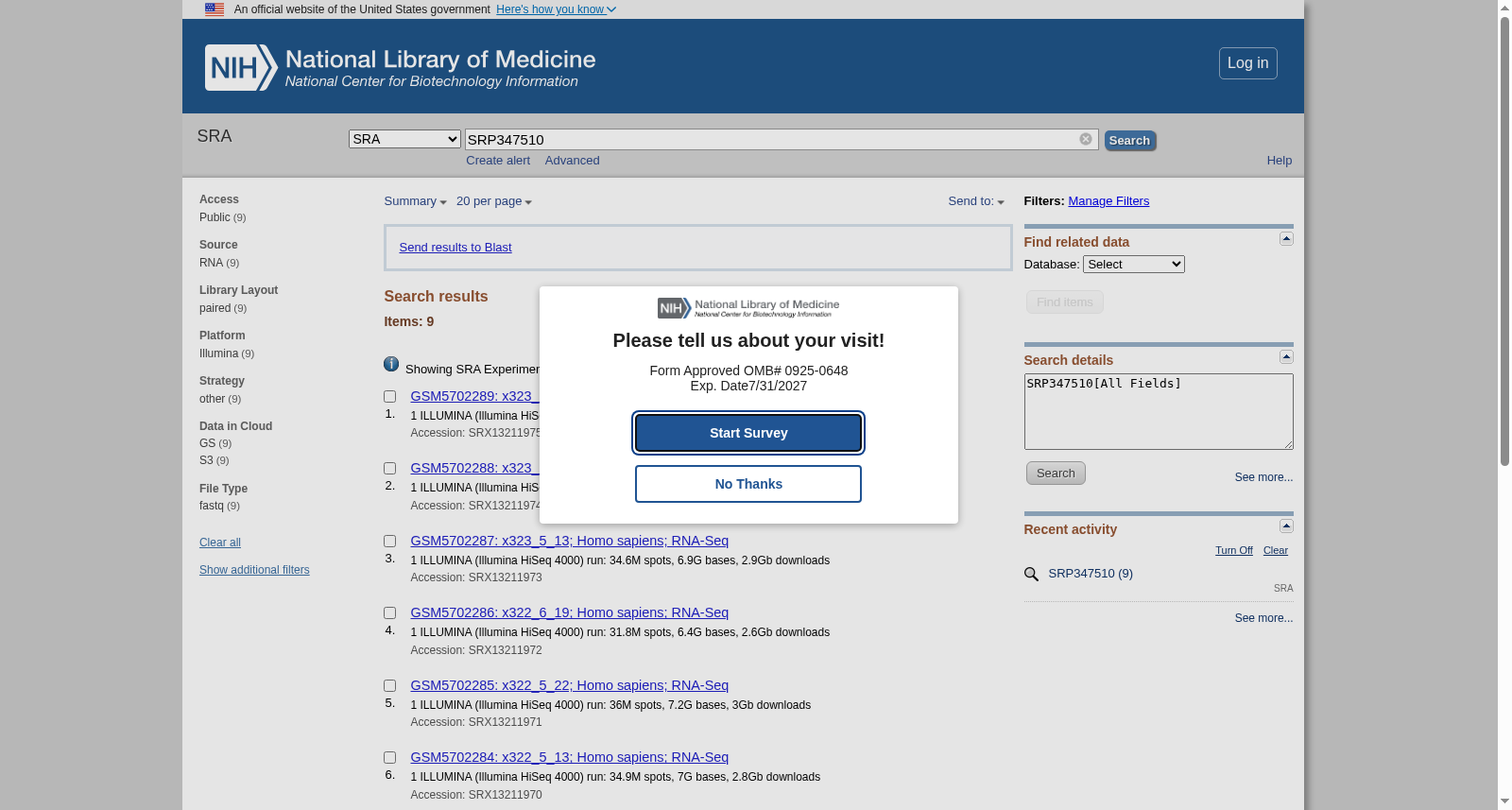
该数据集是一个RNA测序研究,包含9个人类样本的配对端测序数据,使用Illumina HiSeq 4000平台生成,旨在分析HER3缺失的KatoII MET扩增癌细胞中的差异表达基因。数据以fastq格式提供,每个样本的测序量在2.6Gb至3.6Gb之间,总计约8.6G至8.7G碱基,适用于基因表达谱和生物信息学分析。
以上内容由遇见数据集搜集并总结生成

暂无相关数据集


