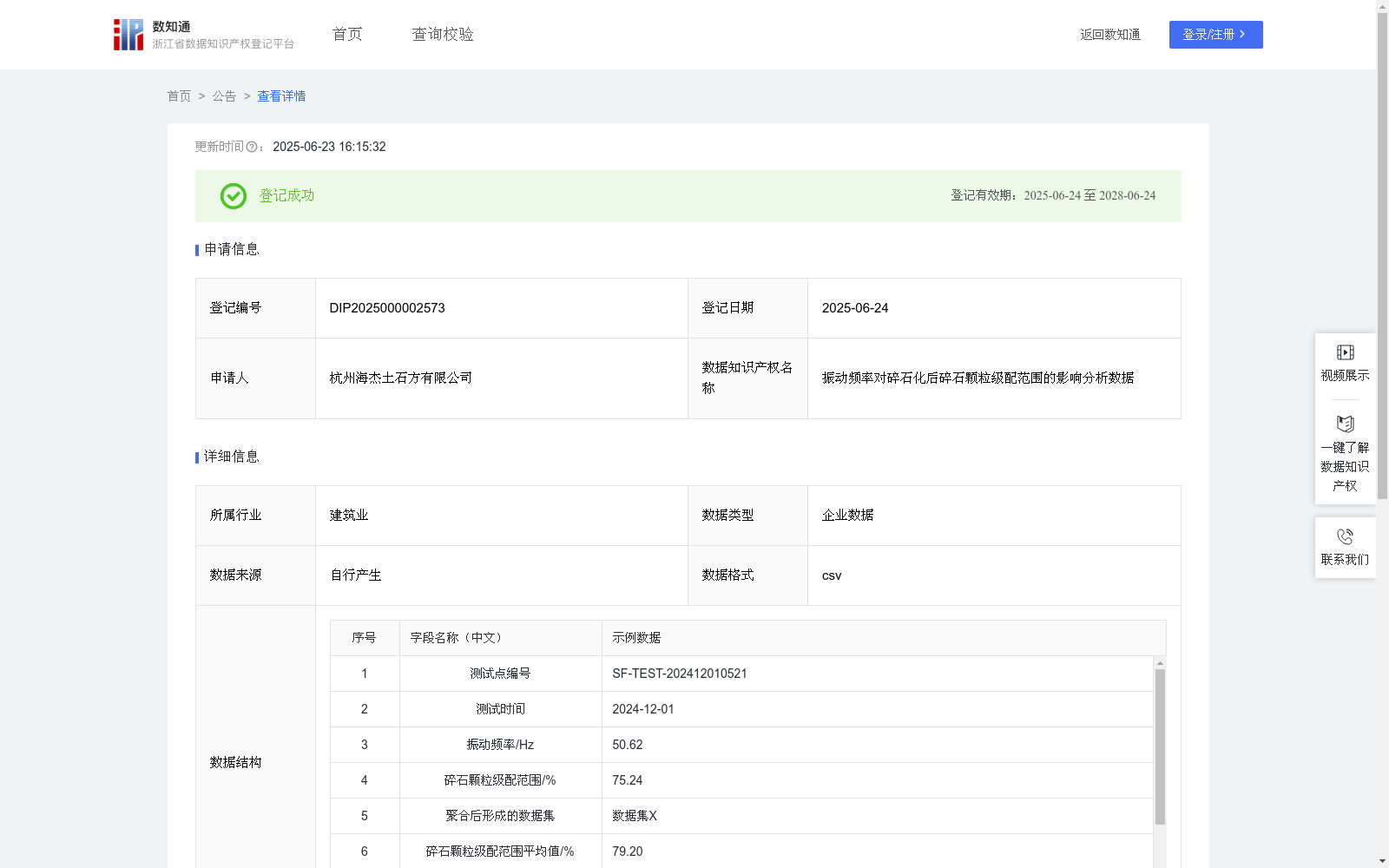
振动频率对碎石化后碎石颗粒级配范围的影响分析数据
收藏资源简介:
本数据聚焦于分析振动频率对碎石化后碎石颗粒级配范围的影响,揭示了振动频率与碎石颗粒分布特性之间的定量关系。公司可通过本数据分析不同振动频率对碎石颗粒级配范围的影响规律,精准调控破碎设备的操作参数,提升碎石施工质量,优化碎石的颗粒分布和均匀性。本数据可以给碎石施工领域的相关科研工作者、技术研发人员、工程监理人员、工程质量检验人员等使用,为他们围绕振动频率工况、碎石颗粒级配范围等角度开展碎石工程的相关预测分析、质量控制、科学研究、技术优化等工作提供支撑。1.数据采集:记录不同振动频率工况下碎石化处理后碎石颗粒的级配范围测试数据,具体包括测试点编号、测试时间、振动频率/Hz、颗粒级配范围/%等字段。 2.数据预处理:(1)对采集的数据进行去噪处理,确保数据准确性。(2)把历史采集的数据(包含本次采集)进行聚合,形成数据集X,并针对数据集X中的碎石颗粒级配范围字段,计算出其平均值。 3.计算线性回归斜率a和截距b:基于数据集X(以振动频率为自变量、颗粒级配范围为因变量),运用SLOPE函数,基于最小二乘法原理确定斜率a,运用INTERCEPT函数确定截距b。斜率a表示单位振动频率变化对颗粒级配范围的影响程度,截距b表示基准振动频率下碎石颗粒级配范围的值。 4.结果运用:(1)计算比例系数k:k=|a/颗粒级配范围平均值|×100%;(2)若k≥10%,则判定为“高影响”,若5%≤k<10%,则判定为“中影响”,若k<5%,则判定为“低影响”。
This dataset focuses on analyzing the impact of vibration frequency on the particle size gradation range of crushed aggregates after rubblization treatment, and reveals the quantitative relationship between vibration frequency and the distribution characteristics of crushed aggregate particles. Enterprises can use this dataset to analyze the influence laws of different vibration frequencies on the particle size gradation range of crushed aggregates, accurately regulate the operating parameters of crushing equipment, improve the construction quality of crushed aggregates, and optimize the particle distribution and uniformity of crushed aggregates. This dataset can be used by relevant researchers, technical R&D personnel, engineering supervisors, engineering quality inspectors and other practitioners in the field of crushed aggregate construction, providing support for their work such as predictive analysis, quality control, scientific research and technical optimization of crushed aggregate engineering from the perspectives of vibration frequency working conditions and particle size gradation range of crushed aggregates. 1. Data Collection: Record the test data of the particle size gradation range of crushed aggregates after rubblization treatment under different vibration frequency working conditions. The specific fields include test point number, test time, vibration frequency (Hz), particle size gradation range (%), etc. 2. Data Preprocessing: (1) Denoise the collected data to ensure data accuracy. (2) Aggregate the historically collected data (including this collection) to form dataset X, and calculate the average value of the particle size gradation range field in dataset X. 3. Calculation of linear regression slope a and intercept b: Based on dataset X (with vibration frequency as the independent variable and particle size gradation range as the dependent variable), use the SLOPE function to determine the slope a based on the principle of least squares, and use the INTERCEPT function to determine the intercept b. The slope a represents the degree of influence of unit vibration frequency change on the particle size gradation range, and the intercept b represents the value of the particle size gradation range of crushed aggregates at the reference vibration frequency. 4. Result Application: (1) Calculate the proportional coefficient k: k = |a / average value of particle size gradation range| × 100%; (2) If k ≥ 10%, it is judged as "High Impact"; if 5% ≤ k < 10%, it is judged as "Medium Impact"; if k < 5%, it is judged as "Low Impact".