
纸箱类包装客户购买能力分析数据
收藏浙江省数据知识产权登记平台2025-12-29 更新2025-12-30 收录
下载链接:
https://www.zjip.org.cn/home/announce/trends/8420811
下载链接
链接失效反馈官方服务:
资源简介:
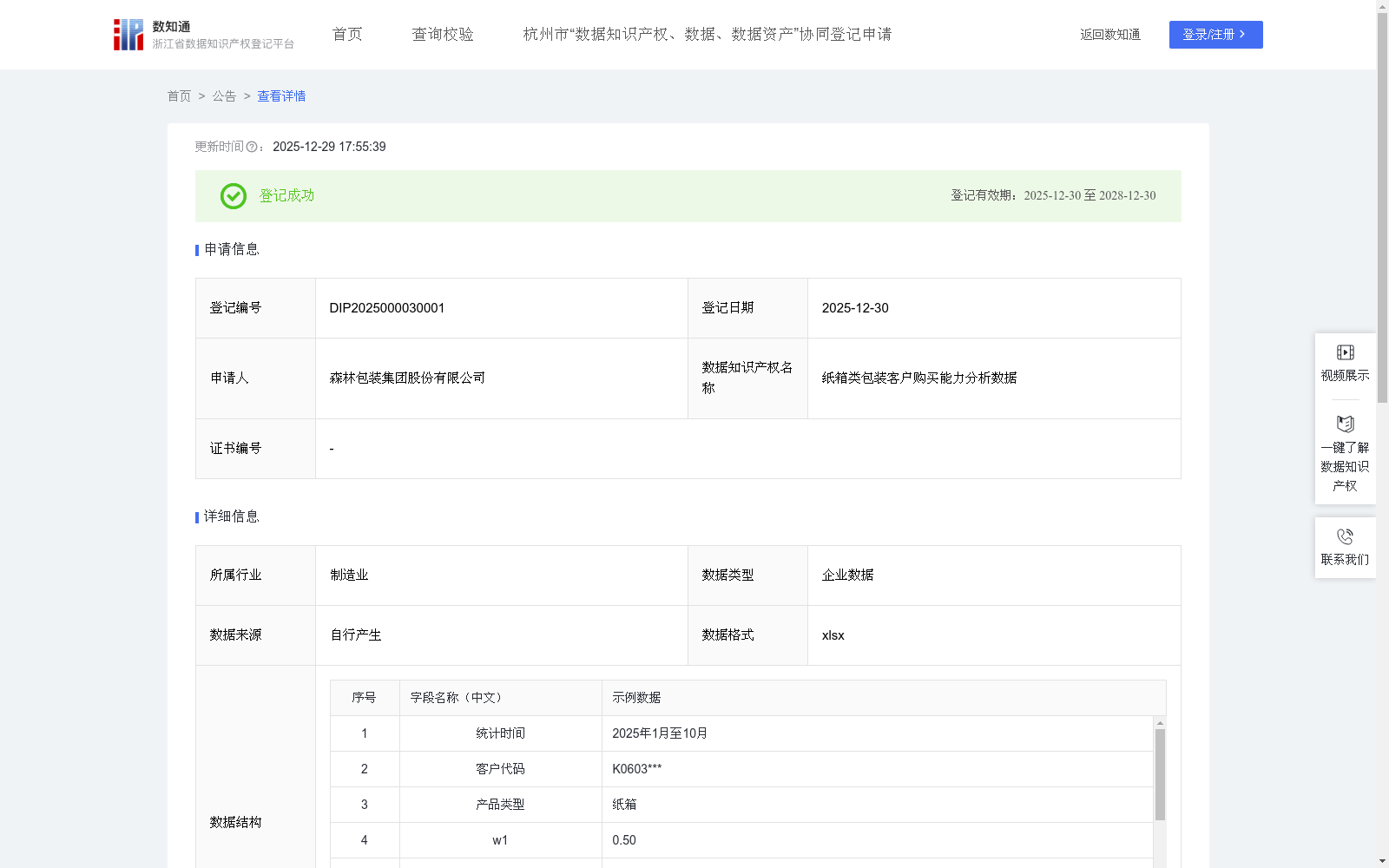
各类型包装客户的购买行为反映了其在复购倾向、订单规模、产品适配性及交付效率等方面的偏好与需求特征。本模型通过系统分析客户行为逻辑,帮助包装企业精准识别不同价值层次的客户,有效优化产能分配和资源投放。基于客户分级实施差异化服务策略,如对高价值客户提供专属生产保障和优先排单,对潜力客户推送定制化优惠方案以促进转化;同时,通过量化客户价值与需求特征,推动包装企业从“标准化生产”向“精准运营”转型,全面提升客户留存率与长期合作价值。1.数据采集:采集各个客户对纸箱类包装的订单数据并进行脱敏处理,需包含的核心字段:客户代码、产品类型、统计期间内重复采购次数(次)、该客户订单总数量(件)、总订单数量(件)、该客户订单总面积(mm²)等。
2.算法加工
客户购买能力公式:客户购买能力值=w1*客户复购率系数+w2*销量贡献系数+w3*产品需求匹配度,其中w1,w2,w3的权重值根据企业自行调整(w1+w2+w3=1)。
(1)客户复购率系数
基于该客户在统计期间内重复采购次数y:当y≤0,客户复购率系数为0;当0<y≤1,客户复购率系数为1;当1<y≤5,客户复购率系数为2;当5<y≤10,客户复购率系数为3;当10<y≤15,客户复购率系数为4;当15<y≤20,客户复购率系数为5;当20<y,客户复购率系数为6。
(2)销量贡献系数
基于该客户在统计期间内的订单占比x(x=该客户订单总数量/总订单数量×100%):
当x≤0,销量贡献系数为0;当0<x≤1%,销量贡献系数为1;当1%<x≤2%,销量贡献系数为2;当2%<x≤4%,销量贡献系数为3;当4%<x≤6%,销量贡献系数为4;当6%<x≤8%,销量贡献系数为5;当8%<x,销量贡献系数为6。
(3)产品需求匹配度
基于该客户的单面积可制作数n(n=该客户订单总数量(件)/该客户订单总面积(mm²))
当n≤0,产品需求匹配度为0;当0<n≤5,产品需求匹配度为1;当5<n≤10,产品需求匹配度为2;当10<n≤15,产品需求匹配度为3;当15<n≤20,产品需求匹配度为4;当20<n≤25,产品需求匹配度为5;当25<n,产品需求匹配度为6。
3.数据应用
通过计算得出各个客户购买能力值,根据客户购买能力值对各个客户进行分级:如客户购买能力值≥5,则该客户分级为高价值客户;如2≤客户购买能力值<5,则该客户分级为潜力客户;如客户购买能力值<2,则该客户分级为低价值客户。
The purchasing behaviors of customers in the packaging sector reflect their preferences and demand characteristics in terms of repurchase tendency, order scale, product adaptability, and delivery efficiency. This model systematically analyzes customer behavioral logic to help packaging enterprises accurately identify customers across different value tiers, and effectively optimize capacity allocation and resource investment. By implementing differentiated service strategies based on customer tiers—for example, providing exclusive production guarantees and priority scheduling for high-value customers, and delivering customized preferential plans to potential customers to boost conversion—this model also assists packaging enterprises in transitioning from "standardized production" to "precise operation" by quantifying customer value and demand characteristics, thereby comprehensively improving customer retention rate and long-term cooperative value.
1. Data Collection
Collect and anonymize carton packaging order data from all customers. The core fields to be included are: customer code, product type, number of repeat purchases during the statistical period, total order quantity of the customer (pieces), total number of orders (pieces), and total order area of the customer (mm²), etc.
2. Algorithm Processing
Customer Purchasing Power Formula: Customer Purchasing Power Value = w1 * Customer Repurchase Rate Coefficient + w2 * Sales Contribution Coefficient + w3 * Product Demand Matching Degree, where the weights w1, w2, w3 can be adjusted independently by the enterprise (w1 + w2 + w3 = 1).
(1) Customer Repurchase Rate Coefficient
Based on the number of repeat purchases y of the customer during the statistical period:
- If y ≤ 0, the customer repurchase rate coefficient is 0;
- If 0 < y ≤ 1, the coefficient is 1;
- If 1 < y ≤ 5, the coefficient is 2;
- If 5 < y ≤ 10, the coefficient is 3;
- If 10 < y ≤ 15, the coefficient is 4;
- If 15 < y ≤ 20, the coefficient is 5;
- If y > 20, the coefficient is 6.
(2) Sales Contribution Coefficient
Based on the order proportion x of the customer during the statistical period (x = (total order quantity of the customer / total number of orders) × 100%):
- If x ≤ 0, the sales contribution coefficient is 0;
- If 0 < x ≤ 1%, the coefficient is 1;
- If 1% < x ≤ 2%, the coefficient is 2;
- If 2% < x ≤ 4%, the coefficient is 3;
- If 4% < x ≤ 6%, the coefficient is 4;
- If 6% < x ≤ 8%, the coefficient is 5;
- If x > 8%, the coefficient is 6.
(3) Product Demand Matching Degree
Based on the producible units per unit area n of the customer (n = total order quantity of the customer (pieces) / total order area of the customer (mm²)):
- If n ≤ 0, the product demand matching degree is 0;
- If 0 < n ≤ 5, the degree is 1;
- If 5 < n ≤ 10, the degree is 2;
- If 10 < n ≤ 15, the degree is 3;
- If 15 < n ≤ 20, the degree is 4;
- If 20 < n ≤ 25, the degree is 5;
- If n > 25, the degree is 6.
3. Data Application
Calculate the purchasing power value for each customer, and classify customers based on their purchasing power values:
- If the customer's purchasing power value ≥ 5, the customer is classified as a high-value customer;
- If 2 ≤ purchasing power value < 5, the customer is classified as a potential customer;
- If the purchasing power value < 2, the customer is classified as a low-value customer.
提供机构:
森林包装集团股份有限公司
创建时间:
2025-11-03
搜集汇总
数据集介绍
背景与挑战
背景概述
该数据集专注于纸箱包装行业的客户购买能力分析,包含554条企业数据,通过统计客户订单信息如重复采购次数、订单数量和面积等,计算客户购买能力值并进行分级(如高价值、潜力客户)。它旨在帮助包装企业精准识别客户价值,优化资源分配和服务策略,从而提升客户留存和长期合作效率。
以上内容由遇见数据集搜集并总结生成


