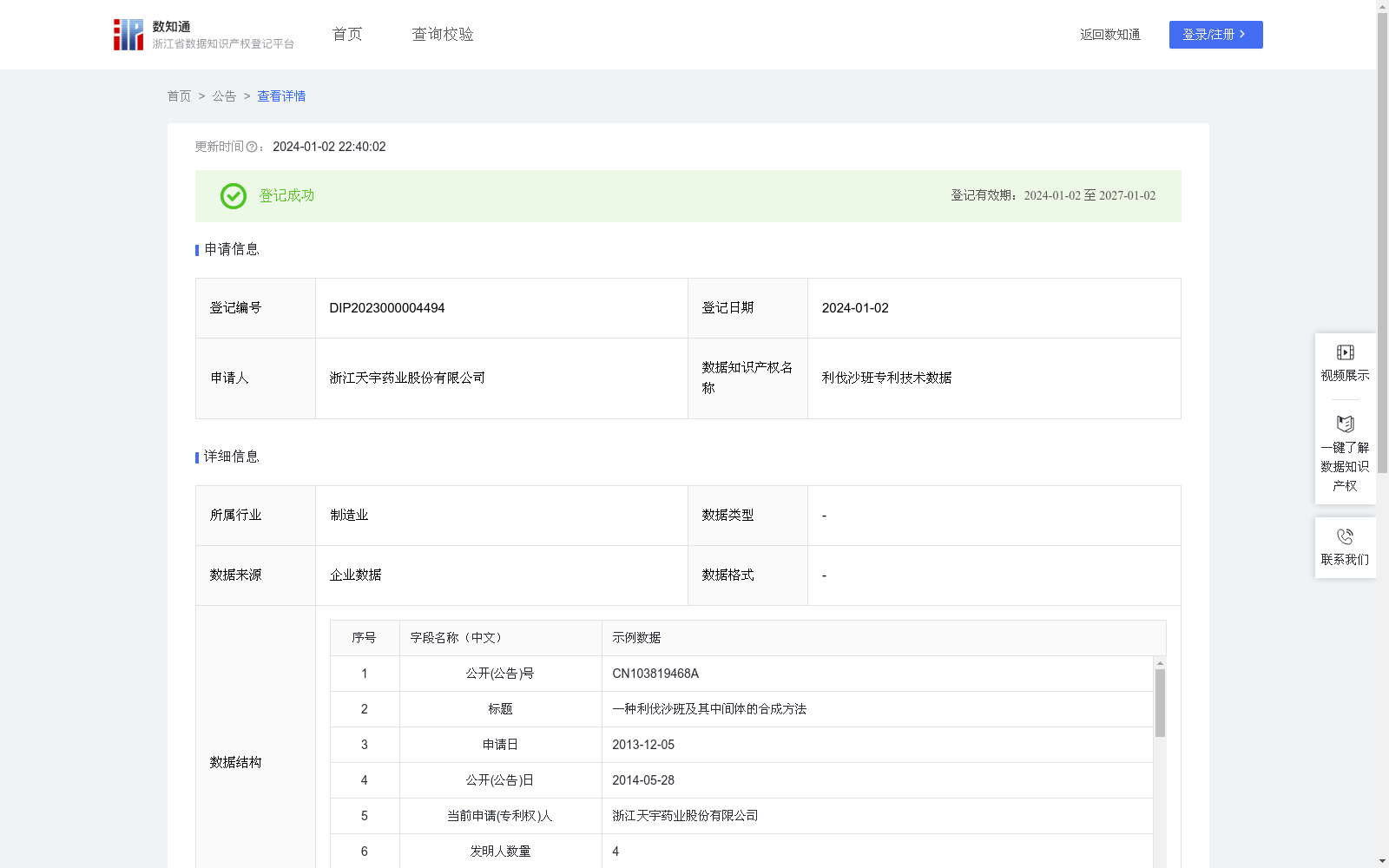
利伐沙班专利技术数据
收藏资源简介:
数据包中主要包括了全球专利数据库中有关利伐沙班的发明专利和实用新型专利数据,并根据自有算法对专利数据进行了评价和分类,可用于横向、纵向了解利伐沙班专利数据变化情况,有助于了解利伐沙班知识产权工作成果;通过对各企业/个人利伐沙班专利数据的对比,可了解各企业/个人的技术创新能力、创新水平差异;了解利伐沙班的技术发展趋势,有助于企业避免重复研发,避免企业开发的技术侵犯他人的知识产权。1、数据来源:全球专利数据库中利伐沙班相关发明专利、实用新型专利数据。2、数据采集:本数据目标层为专利技术相关性,指标层将专利技术相关性指标体系分为战略、市场、经济、技术、法律五大价值维度,检索出有关于利伐沙班的专利,指标层向下分准则层,包括:战略价值:发明人数量、简单同族专利申请数量;技术价值:IPC分类号、被引用专利数量、申请日、授权日;经济价值:诉讼案件数、质押人;法律价值:当前申请(专利权)人、预估到期日;市场价值:专利类型、许可类型。3、数据分析:本数据基于AHP层次法,采用定量与定性相结合,通过专业的专利数据库获取专利评价对应的数据指标,将技术关联性按从高到低分为(A、B、C),A为高关联性、B为一般关联性、C为较低关联性。采用综合分值法:战略价值≥50分及以上、经济价值≥20分及以上、市场价值≥50分及以上、法律价值≥60分及以上、技术价值≥30分及以上为A,战略价值40-50分(不含50分)、经济价值≥20分及以上、市场价值≥30分及以上、法律价值≥70分及以上、技术价值≥30分及以上为B,其余为C。
This dataset primarily includes invention patent and utility model patent data related to rivaroxaban from the Global Patent Database. The patent data has been evaluated and classified using a proprietary algorithm, enabling cross-sectional and longitudinal analysis of the changes in rivaroxaban-related patent data, which helps understand the achievements of rivaroxaban-related intellectual property (IP) work. By comparing the rivaroxaban patent data of different enterprises or individuals, the differences in their technological innovation capabilities and innovation levels can be identified. Additionally, understanding the technological development trends of rivaroxaban can help enterprises avoid redundant R&D and prevent their developed technologies from infringing others' intellectual property rights. 1. Data Source: Patent data related to rivaroxaban, including invention patents and utility model patents, sourced from the Global Patent Database. 2. Data Collection: The target layer of this dataset is patent technological relevance. The indicator layer categorizes the patent technological relevance indicator system into five value dimensions: strategic, market, economic, technological, and legal. Patents related to rivaroxaban are retrieved, and the indicator layer is further decomposed into the criterion layer with specific metrics as follows: - Strategic value: Number of inventors, number of simple family patent applications - Technological value: International Patent Classification (IPC) codes, number of cited patents, filing date, grant date - Economic value: Number of litigation cases, pledgee - Legal value: Current applicant/patentee, estimated expiration date - Market value: Patent type, license type 3. Data Analysis: This dataset adopts the Analytic Hierarchy Process (AHP), combining quantitative and qualitative research methods. Data indicators for patent evaluation are obtained via professional patent databases. The technological relevance is divided into three tiers from high to low: A, B, and C, where A denotes high relevance, B denotes general relevance, and C denotes low relevance. The comprehensive scoring criteria are specified as: - Tier A: Strategic score ≥ 50, economic score ≥ 20, market score ≥ 50, legal score ≥ 60, technological score ≥ 30 - Tier B: Strategic score ranging from 40 to 50 (excluding 50), economic score ≥ 20, market score ≥ 30, legal score ≥ 70, technological score ≥ 30 - Tier C: All other cases