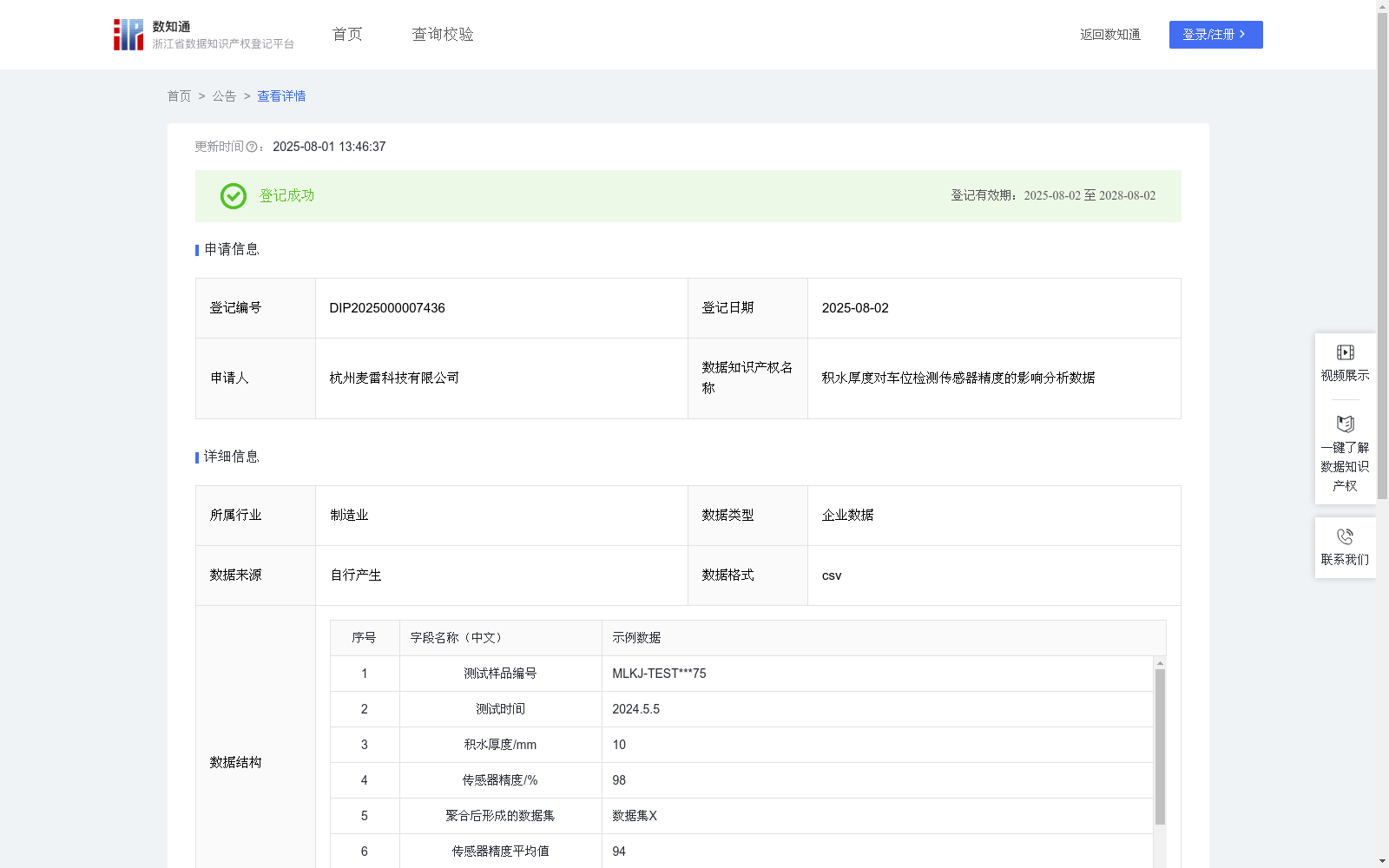
积水厚度对车位检测传感器精度的影响分析数据
收藏资源简介:
本数据聚焦于分析积水厚度对车位检测传感器测量精度的影响,揭示了水位变化与传感器信号稳定性、误报率及定位误差之间的量化关系,为公司(制造商)及外部相关方提供了关键的优化依据,具有重要的应用价值。具体体现在以下方面: 1. 增强传感器的防水与抗浸泡性能:制造商可通过研究不同积水深度下传感器的失效模式,改进密封结构设计(如IP68防护等级)或采用防水材料(如防腐蚀涂层),从而提升传感器在潮湿或淹水环境下的耐用性,减少因水浸导致的短路或信号漂移问题。 2. 优化智慧停车系统的排水与故障预警机制:该数据可为城市排水管理部门、地下车库建设方及智慧停车平台运营商提供支持,帮助其评估积水对车位检测的影响阈值,集成水位监测功能或设置动态报警策略(如积水超限时暂停计费),避免因传感器误报导致的管理混乱或用户投诉。1.数据采集:实时记录不同积水厚度下的车位检测传感器精度测试数据,包括测试样品编号、测试时间、积水厚度/mm、传感器精度/%等字段。 2.数据预处理:(1)对采集的数据进行去噪处理,确保数据准确性。(2)将历史采集的数据(包含本次采集)进行聚合,形成数据集X,并针对数据集X中的传感器精度字段,计算出其平均值。 3.计算线性回归斜率a和截距b:基于数据集X(以积水厚度为自变量、传感器精度为因变量),运用SLOPE函数,基于最小二乘法原理确定斜率a,运用INTERCEPT函数确定截距b。斜率a表示单位积水厚度变化对车位检测传感器精度的影响程度,截距b表示基准积水厚度下车位检测传感器的精度值。 4.结果运用:(1)计算比例系数k:k=|a/传感器精度平均值|×100%;(2)若k≥10%,则判定为“高影响”,若5%≤k<10%,则判定为“中影响”,若k<5%,则判定为“低影响”。
This dataset focuses on analyzing the impact of water accumulation thickness on the measurement accuracy of parking space detection sensors, and reveals the quantitative relationship between water level changes and sensor signal stability, false alarm rate, and positioning error. It provides critical optimization basis for the company (manufacturer) and external stakeholders, and has important application value. This is reflected in the following aspects: 1. Enhancing the waterproof and immersion-resistant performance of sensors: Manufacturers can study the failure modes of sensors under different water accumulation depths, improve the sealing structure design (e.g., "IP68" protection rating) or adopt waterproof materials (e.g., anti-corrosion coatings), thereby enhancing the durability of sensors in humid or flooded environments and reducing short circuits or signal drift caused by water immersion. 2. Optimizing the drainage and fault early warning mechanism of smart parking systems: This dataset can provide support for urban drainage management departments, underground garage developers, and smart parking platform operators, helping them evaluate the impact threshold of water accumulation on parking space detection, integrate water level monitoring functions, or set dynamic alarm strategies (e.g., suspend billing when water accumulation exceeds the limit), so as to avoid management chaos or user complaints caused by sensor false alarms. 1. Data Collection: Real-time recording of accuracy test data of parking space detection sensors under different water accumulation thicknesses, including fields such as test sample number, test time, water accumulation thickness/mm, and sensor accuracy/%. 2. Data Preprocessing: (1) Denoise the collected data to ensure data accuracy. (2) Aggregate the historically collected data (including this collection) to form dataset X, and calculate the average value of the sensor accuracy field in dataset X. 3. Calculation of Linear Regression Slope a and Intercept b: Based on dataset X (with water accumulation thickness as the independent variable and sensor accuracy as the dependent variable), use the SLOPE function to determine slope a based on the principle of least squares, and use the INTERCEPT function to determine intercept b. Slope a represents the degree of influence of unit water accumulation thickness change on the accuracy of parking space detection sensors, and intercept b represents the accuracy value of parking space detection sensors under the reference water accumulation thickness. 4. Result Application: (1) Calculate the proportional coefficient k: k = |a / average sensor accuracy| × 100%; (2) If k ≥ 10%, it is judged as "high impact"; if 5% ≤ k < 10%, it is judged as "medium impact"; if k < 5%, it is judged as "low impact".