
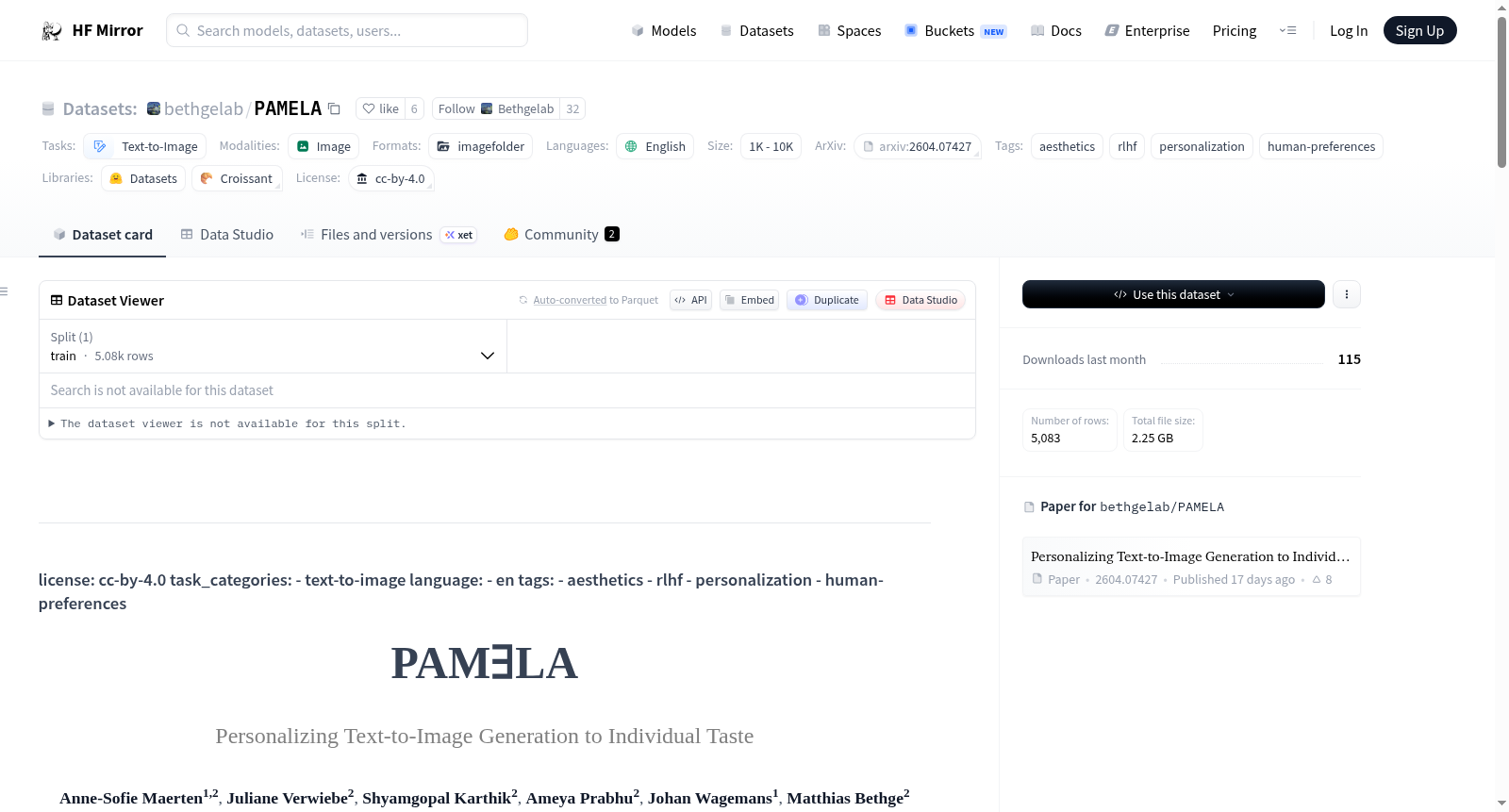
bethgelab/PAMELA
收藏Hugging Face2026-04-14 更新2026-04-12 收录
下载链接:
https://hf-mirror.com/datasets/bethgelab/PAMELA
下载链接
链接失效反馈官方服务:
资源简介:
---
license: cc-by-4.0
task_categories:
- text-to-image
language:
- en
tags:
- aesthetics
- rlhf
- personalization
- human-preferences
---
---
license: cc-by-4.0
task_categories:
- text-to-image
language:
- en
tags:
- aesthetics
- rlhf
- personalization
- human-preferences
---
<div align="center">
<h1 style="font-family: serif; font-size: 3rem; margin-bottom: 0;">PAM∃LA</h1>
<p style="font-family: serif; font-size: 1.5rem; color: gray;">Personalizing Text-to-Image Generation to Individual Taste</p>
<div style="font-family: serif; font-size: 1.1rem; margin-top: 10px;">
<strong>Anne-Sofie Maerten<sup>1,2</sup></strong>,
<strong>Juliane Verwiebe<sup>2</sup></strong>,
<strong>Shyamgopal Karthik<sup>2</sup></strong>,
<strong>Ameya Prabhu<sup>2</sup></strong>,
<strong>Johan Wagemans<sup>1</sup></strong>,
<strong>Matthias Bethge<sup>2</sup></strong>
</div>
<div style="font-family: serif; font-size: 0.95rem; color: #555; margin-top: 5px; margin-bottom: 20px; line-height: 1.5;">
<sup>1</sup>Tübingen AI Center, University of Tübingen <br>
<sup>2</sup>Department of Brain and Cognition, KU Leuven
</div>
<div style="display: flex; justify-content: center; gap: 10px;">
<a href="https://arxiv.org/abs/2604.07427"><img src="https://img.shields.io/badge/arXiv-paper-b31b1b.svg" alt="arXiv"></a>
<a href="https://pamela-bench.github.io"><img src="https://img.shields.io/badge/Project-Page-blue" alt="Project Page"></a>
<a href="https://github.com/PAMELA-bench/PAMELA_Predictor"><img src="https://img.shields.io/badge/Code-GitHub-black" alt="GitHub"></a>
</div>
</div>
---

PAM∃LA is a dataset of **AI-generated images** rated by **human participants** for aesthetic quality. It pairs each rating with rich participant demographics and image metadata, enabling research on **personalized aesthetic prediction**, demographic biases in visual preference, and aesthetic modeling for generative content.
## Dataset Statistics
| Split | # ratings | Description |
|--------------------|----------:|--------------------------------------------|
| `pamela_train` | 50,222 | Training set |
| `pamela_val_unseen`| 926 | Val — users **not** seen in training |
| `pamela_val_seen` | 6,551 | Val — seen users, unseen images |
| `pamela_test_unseen`| 2,470 | Test — users **not** seen in training |
| `pamela_test_seen` | 9,735 | Test — seen users, unseen images |
| **Total** | **69,904**| |
**Splits ending in `_seen`** evaluate model performance on **known users rating new images**.
**Splits ending in `_unseen`** evaluate generalization to **completely new users** — the harder, more realistic setting for personalization research.
### Image content
- **5,077** unique images
- **21** visual groups: *abstract, animal, architecture, automotive, cinematic, cityscape, fashion, flower painting, food, landscape (art and photorealism), lifestyle, portrait (art and photorealism), product, scene, special, sports, still life, street, travel*
- **26** art-historical styles applied to the **Art** subset (e.g., *Impressionism*, *Synthetic_Cubism*, *Art_Nouveau_Modern*, *Romanticism*, *Baroque*, *Cubism*, ...). **Photorealism** images carry no style label (`null`).
- **2** image types: `Art` (26,237 ratings) and `Photorealism` (43,667 ratings)
### Participants
- **199** unique participants
- Age range: **19–60**
- Gender: male (40,525), female (29,086), prefer not to say (293)
- **23** nationalities represented
## Dataset Structure
Each entry in the annotation JSON files has the following schema:
```json
{
"image_path": "./images/2f8e75f4-da55-4074-9328-052199f7cfb0.png",
"image_id": 1049071,
"participant_id": "p_5d2aeb40",
"image_metadata": {
"group": "landscape",
"style": "Art_Nouveau_Modern",
"category": "AI image",
"prompt": "A grand palace, rendered in muted greens and greys ...",
"type": "Art"
},
"user_demographics": {
"age": 28,
"age_binned": "twenties",
"gender": "male",
"nationality": "United States"
},
"quality_label": "good",
"original_score": 3.497
}
```
### Field reference
| Field | Type | Description |
|---|---|---|
| `image_path` | string | Relative path to the PNG file under `images/` |
| `image_id` | int | Unique numeric image ID |
| `participant_id` | string | Pseudonymous user ID (`p_*`) |
| `image_metadata.group` | string | Visual subject category (one of 19) |
| `image_metadata.style` | string | Art style label (one of 26) |
| `image_metadata.category` | string | Always `"AI image"` |
| `image_metadata.prompt` | string | Text prompt describing the image|
| `image_metadata.type` | string | `"Art"` or `"Photorealism"` |
| `user_demographics.age` | int | Participant age (19–60) |
| `user_demographics.age_binned` | string | Decade bucket (e.g., `"twenties"`) |
| `user_demographics.gender` | string | `"male"`, `"female"`, or `"prefer not to say"` |
| `user_demographics.nationality` | string | Country of origin |
| `quality_label` | string | One of: `poor`, `fair`, `good`, `great`, `excellent` |
| `original_score` | float | Continuous aesthetic rating (1.0–5.0) |
## Notes
- The participant pool (199 users, 23 nationalities) is **not** demographically representative of the global population. Aggregated scores should not be treated as universal aesthetic judgments.
- Subgroups defined by combinations of demographics (e.g., women aged 50+ from a specific country) may be very small. **Avoid claims about narrow subpopulations** without checking sample sizes.
提供机构:
bethgelab
搜集汇总
数据集介绍
构建方式
在生成式人工智能飞速发展的今天,如何使文本到图像模型精准契合个体审美偏好,已成为视觉与认知科学交叉领域的研究热点。PAMELA数据集正是在此背景下应运而生,它通过大规模人类主观评价实验,系统性地收集了参与者对AI生成图像的审美评分。数据集构建中,研究者首先利用文本到图像模型生成涵盖21个视觉类别(如抽象、动物、建筑、时装等)与26种艺术史风格的5077张独特图像;随后,邀请来自23个国籍、年龄跨度为19至60岁的199名参与者,在受控实验环境下对每张图像进行1至5分的连续审美评分及五级质量标签评定。最终,整个数据集汇聚了69,904条评分记录,每一条均与图像元数据(生成提示、风格、类型)及参与者人口统计学信息(年龄、性别、国籍)紧密关联,为个性化审美建模提供了精细的标注基础。
使用方法
PAMELA数据集为审美偏好预测与个性化图像生成研究提供了灵活的应用框架。研究者可加载JSON格式的标注文件,利用“image_path”字段关联图像文件,并基于“original_score”连续评分或“quality_label”离散标签构建回归或分类预测模型。数据集中“user_demographics”下的年龄、性别和国籍信息,可直接作为特征或上下文嵌入,驱动人口感知的个性化模型训练。针对图像侧,“image_metadata”中的视觉分组、艺术风格及生成提示,则为多模态表征学习与跨模态对齐提供了天然监督信号。更值得关注的是,数据集的完整分割体系允许模型在先验用户适配(_seen)与零样本泛化(_unseen)两类设定下公平评测,研究者可在HuggingFace页面下载完整数据,并配合Github上提供的基准代码框架快速开展实验。
背景与挑战
背景概述
PAMELA数据集由德国蒂宾根大学AI中心和比利时荷语鲁汶大学脑与认知系的Anne-Sofie Maerten、Juliane Verwiebe等研究人员于2025年创建,旨在探索文本到图像生成模型中的个性化美学偏好问题。该数据集通过收集199名参与者对5077张AI生成图像的近7万条评分,结合详细的用户人口统计学信息和图像元数据(包括21种视觉类别与26种艺术风格),为研究人类审美偏好的个性化预测及其在生成式AI中的应用提供了独特资源。作为首个聚焦于审美个性化的基准数据集,PAMELA不仅推动了文本到图像生成领域从通用美学评估向个性化适配的范式转变,也为理解人口统计学因素如何塑造视觉偏好奠定了数据基础,对计算美学、人机交互与个性化推荐系统具有重要影响力。
当前挑战
PAMELA数据集面临的挑战是多维的。在领域问题层面,传统美学评估模型难以捕捉个体间显著的审美差异,而现有生成式系统缺乏依据用户独特品味动态调整输出的能力,亟需个性化预测框架来弥合通用美学与个人偏好之间的鸿沟。在构建过程中,挑战尤为突出:首先,参与者池(199人,23国)的有限规模和地理、文化分布不均,导致亚群体统计支持薄弱,若仓促推导关于窄子人群的结论易产生偏差;其次,AI生成图像的美学评价缺乏客观金标准,依赖主观打分,关联连续分数与离散标签的标度设计需权衡粒度与一致性;最后,为模拟真实场景,数据集特意划分了仅观察用户、未见用户等子集,这要求模型在缺乏用户历史数据时仍能稳健泛化,极大增加了个性化推理的难度。
常用场景
经典使用场景
PAMELA数据集的核心使用场景在于个性化美感预测,即利用人类对AI生成图像的评分数据,结合参与者的详细人口统计学信息与图像元数据,构建能够捕捉个体审美偏好的模型。该数据集通过区分‘已知用户对新图像’与‘全新用户’两种评估设置,为研究者提供了一个严谨的基准,以探索在零样本或少样本条件下如何将复杂、主观的美学标准嵌入图像生成流程,从而推动从单一平均美感走向群体与个人偏好定向适配的文本到图像生成范式。
解决学术问题
该数据集系统性地解决了长期困扰美学计算领域的两个核心学术问题:一是如何量化和预测视觉美学偏好中普遍存在的人口统计学差异,例如不同年龄、性别或文化背景的群体对同一生成图像可能截然相反的评价;二是如何构建具备良好泛化能力的个性化模型,以应对真实应用中需要为从未见过的用户推荐或生成图像的场景。PAMELA通过高粒度的人口标签和精心设计的用户分割(seen vs. unseen),为研究审美中的分布外泛化与个性化学习提供了独特而关键的数据支撑,挑战了传统美学模型仅追求平均化的局限。
实际应用
在实际应用层面,PAMELA直接赋能了新一代可定制的文本到图像生成系统与推荐引擎。例如,其在个性化广告设计领域,能够根据目标受众的年龄、性别和文化背景动态调整生成内容的视觉风格与元素,以提升广告的吸引力和转化效率。同时,该数据集也可被用于开发交互式创意工具,允许用户通过提供少量偏好反馈,使AI系统迅速学习其潜在审美倾向,继而在人物肖像、产品设计或室内装饰等场景中生成高度符合个人口味的图像结果,从而真正弥合机器生成与人类感知之间的鸿沟。
数据集最近研究
最新研究方向
PAMELA数据集聚焦于文本到图像生成中的个性化美学预测,通过收集人类参与者对AI生成图像的美学评分,并结合丰富的用户人口统计信息,揭示了不同群体在视觉偏好上的显著差异。当前前沿研究方向包括利用该数据集训练个性化美学预测模型,探索如何将用户个体品味融入生成式AI系统,以实现更贴合用户主观感受的图像生成。此外,该数据集为研究人口统计偏见(如年龄、性别、国籍)在AI美学评估中的影响提供了宝贵资源,推动了生成式内容个性化与公平性的重要讨论。其公开的标注结构和元数据为跨学科研究(如心理学与计算机视觉交叉领域)奠定了坚实基础,对提升AI生成内容的用户接受度与个性化体验具有深远意义。
以上内容由遇见数据集搜集并总结生成



