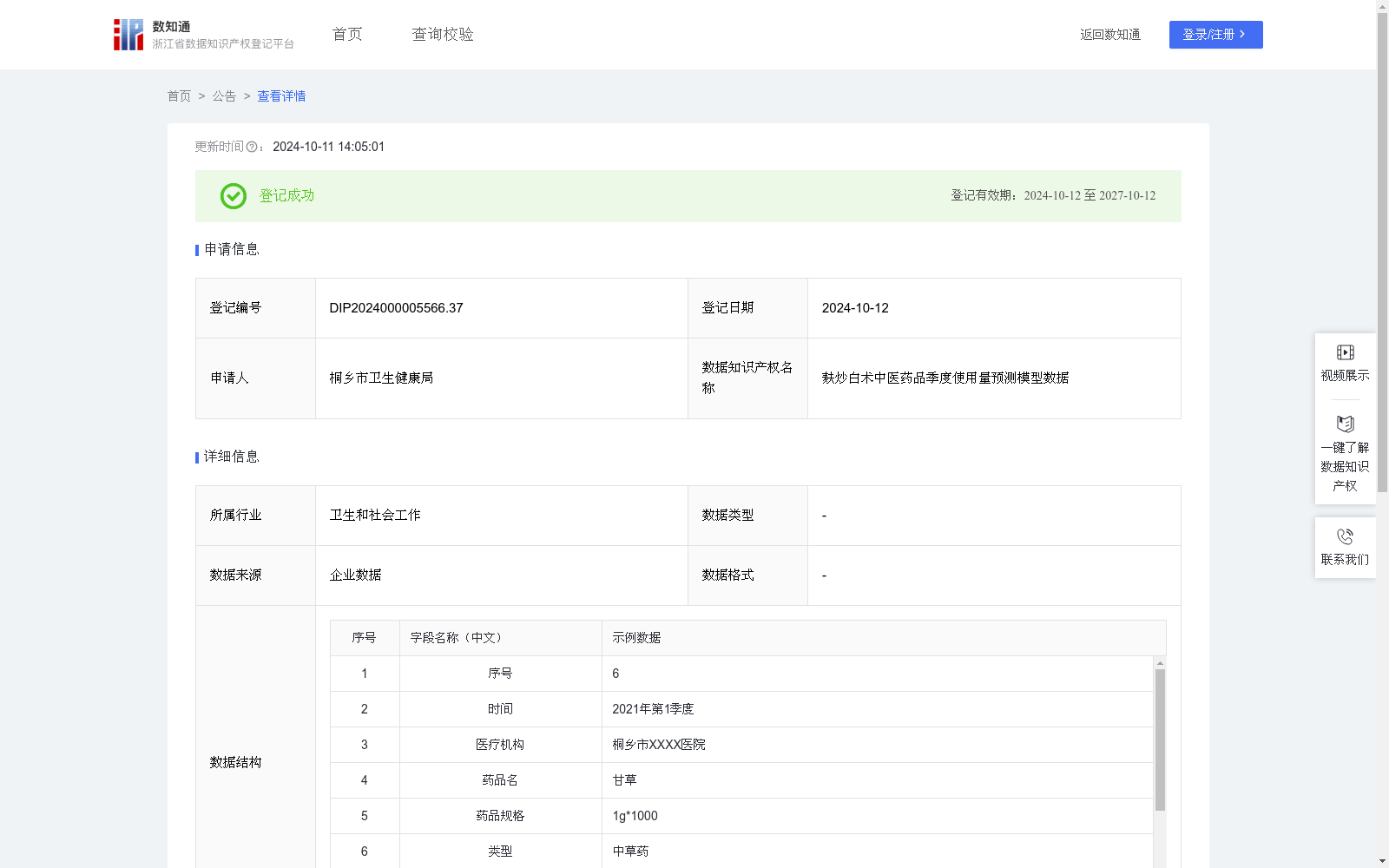
麸炒白术中医药品季度使用量预测模型数据
收藏资源简介:
通过分析桐乡市医疗机构季度麸炒白术中药材使用量,可以预测下个季度麸炒白术中药材的使用量,从而合理安排库存,避免库存积压或短缺。这有助于减少药品过期浪费,通过对医疗机构每季度中药材使用量的分析,可以了解不同地区、不同医疗机构之间中药材使用情况的差异。这有助于政府和相关部门在制定医疗资源配置政策时更加科学合理,促进医疗资源的合理配置和有效利用。 1. 数据采集:收集医疗机构的麸炒白术中药材的季度库存和使用数据,包括季度入库量、季度使用量等。 2. 数据预处理:对中药材的库存和使用数据进行清洗,去除异常值,平滑数据,以确保数据的准确性和可用性。 3. 特征工程:生成基于时间的特征,季节性变化系数SC(t),表示第t季度的使用量变化;生成计算库存周转率ITR(t) = Total_Incoming(t) / Total_Used(t),其中Total_Incoming(t)是第t季度的入库总量,Total_Used(t)是第t季度的使用总量。 4. 季节性模型构建: 季度模型: S(t)=ω1 * U(t-1) + ω2* U(t-2)+…+β1 * SC(t) +β2 * ITR(t),其中U(t-k)代表第t-k季度的实际使用量,ω1和ω2是时间序列权重,β1和β2是特征权重。 季度的模型考虑了季节性影响和历史使用数据,以及库存周转率,确保了预测的精确性和适用性。通过这种方式,医疗机构可以更精准地预测和调整中药材的库存,以保障医疗服务的连续性和效率。
By analyzing the quarterly usage volume of bran-fried Rhizoma Atractylodis Macrocephalae (a common traditional Chinese medicinal material, TCM) in medical institutions of Tongxiang City, the usage volume of this TCM in the next quarter can be predicted, so as to arrange inventory reasonably and avoid overstock or shortage. This helps reduce expired drug waste. Through the analysis of quarterly TCM usage volume in medical institutions, the differences in TCM usage patterns across different regions and medical institutions can be uncovered, which assists the government and relevant departments in formulating more scientific and rational medical resource allocation policies, and promotes the rational allocation and efficient utilization of medical resources. 1. Data Collection: Collect quarterly inventory and usage data of bran-fried Rhizoma Atractylodis Macrocephalae from medical institutions, including quarterly incoming stock volume and quarterly usage volume, etc. 2. Data Preprocessing: Clean the inventory and usage data of traditional Chinese medicinal materials, remove outliers and smooth the data to ensure the accuracy and availability of the dataset. 3. Feature Engineering: Generate time-based features: the seasonal change coefficient SC(t), which denotes the variation in usage volume in the t-th quarter; calculate the inventory turnover ratio ITR(t) = Total_Incoming(t) / Total_Used(t), where Total_Incoming(t) refers to the total incoming stock volume in the t-th quarter, and Total_Used(t) refers to the total usage volume in the t-th quarter. 4. Seasonal Model Construction: Quarterly prediction model: S(t) = ω₁ * U(t-1) + ω₂ * U(t-2) + … + β₁ * SC(t) + β₂ * ITR(t), where U(t-k) represents the actual usage volume in the (t-k)-th quarter, ω₁ and ω₂ are time series weights, and β₁ and β₂ are feature weights. The quarterly model incorporates seasonal effects, historical usage data and inventory turnover ratio, ensuring the accuracy and applicability of the prediction. Through this method, medical institutions can more accurately predict and adjust the inventory of traditional Chinese medicinal materials, thereby safeguarding the continuity and efficiency of medical services.