
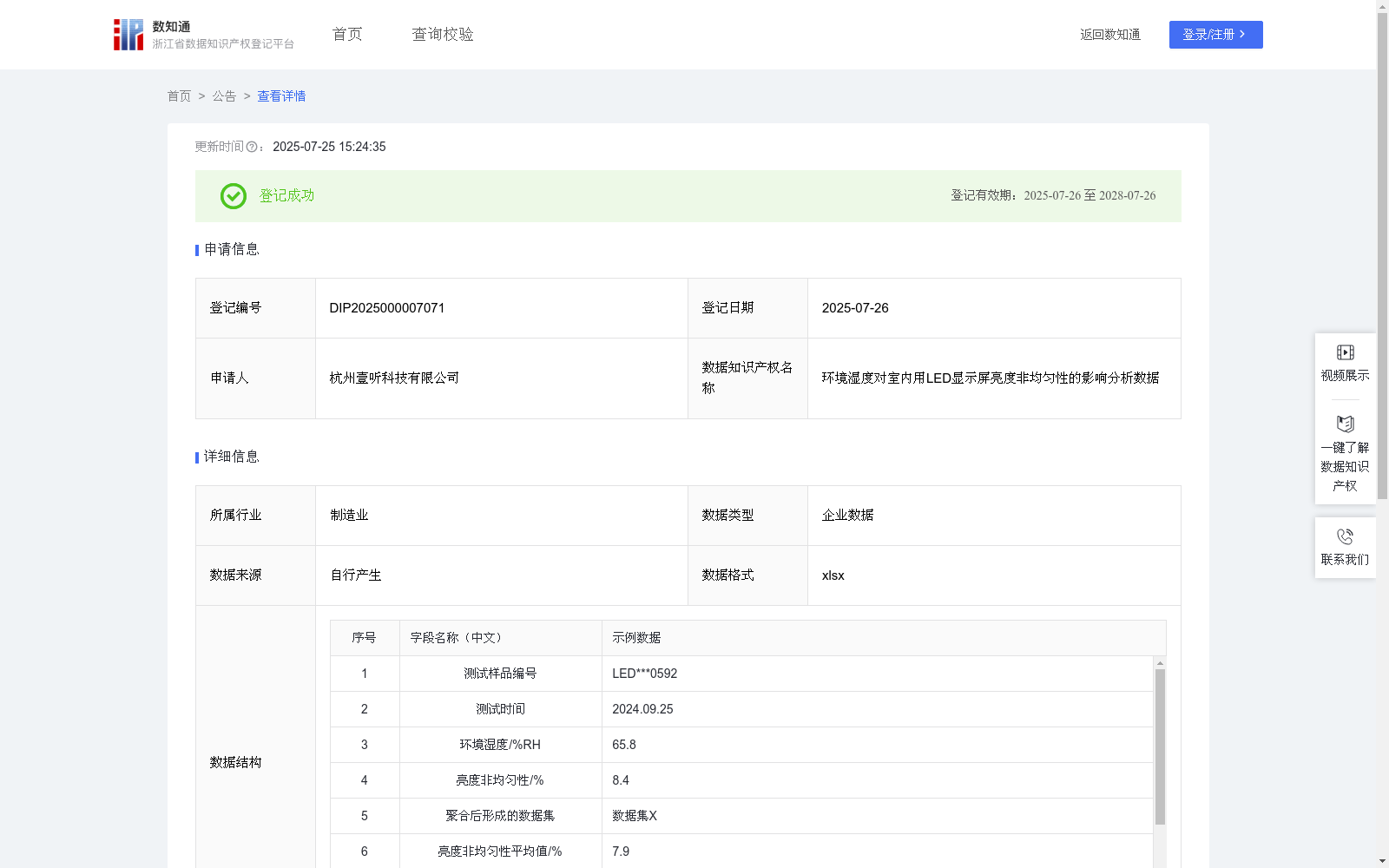
环境湿度对室内用LED显示屏亮度非均匀性的影响分析数据
收藏浙江省数据知识产权登记平台2025-07-25 更新2025-07-26 收录
下载链接:
https://www.zjip.org.cn/home/announce/trends/154870
下载链接
链接失效反馈官方服务:
资源简介:
本数据聚焦于分析环境湿度对室内用LED显示屏亮度非均匀性的影响,揭示了湿度变化与显示屏亮度一致性之间的量化关系,为显示屏制造商及运维方提供了关键决策依据,具有显著的应用价值。具体体现在以下方面:
1.优化产品防潮设计:通过分析湿度对亮度非均匀性的影响,厂商可针对性改进密封工艺和防潮材料选用,提升显示屏在高湿环境下的显示一致性。
2.指导环境控制标准制定:本数据可供显示屏安装工程师、运维人员及质检人员使用,为其制定环境湿度控制标准、预测显示质量变化趋势、优化维护方案等工作提供数据支持。1.数据采集:
实时记录不同环境湿度下的LED显示屏亮度非均匀性测试数据,包括测试样品编号、测试时间、环境湿度/%RH、亮度非均匀性/%等字段。
2.数据预处理:
(1)对采集的数据进行去噪处理,剔除异常值。
(2)将历史采集的数据(包含本次采集)进行聚合,形成数据集X,并针对数据集X中的亮度非均匀性字段,计算出其平均值。
3.计算线性回归斜率a和截距b:
(1)基于数据集X(以环境湿度为自变量、亮度非均匀性为因变量),运用SLOPE函数确定斜率a,运用INTERCEPT函数确定截距b。
(2)斜率a表示单位湿度变化对亮度非均匀性的影响程度,截距b表示基准湿度下显示屏的亮度非均匀性值。
4.结果运用:
(1)计算比例系数k:k=|a/亮度非均匀性平均值|×100%。
(2)若k≥8%,则判定为"高影响",若3%≤k<8%,则判定为"中影响",若k<3%,则判定为"低影响"。
This dataset focuses on analyzing the impact of ambient humidity on the luminance non-uniformity of indoor LED displays, revealing the quantitative relationship between humidity variations and display luminance consistency, providing critical decision-making support for display manufacturers and operation teams, and possessing significant application value. It is embodied in the following aspects:
1. Optimizing product moisture-proof design: By analyzing the impact of humidity on luminance non-uniformity, manufacturers can selectively optimize their sealing processes and select appropriate moisture-proof materials, thereby improving the display consistency of LED displays in high-humidity environments.
2. Guiding the formulation of environmental control standards: This dataset can be utilized by display installation engineers, operation and maintenance personnel, and quality inspectors, providing data support for their work such as formulating ambient humidity control standards, predicting trends in display quality changes, and optimizing maintenance plans.
1. Data Collection:
Real-time recording of luminance non-uniformity test data of LED displays under different ambient humidity levels, including fields such as test sample number, test time, ambient humidity / %RH, and luminance non-uniformity / %.
2. Data Preprocessing:
(1) Perform denoising processing on the collected data and eliminate outliers.
(2) Aggregate all historically collected data (including the data collected in this test) to form dataset X, and calculate the average value of the luminance non-uniformity field in dataset X.
3. Calculation of Linear Regression Slope a and Intercept b:
(1) Based on dataset X (taking ambient humidity as the independent variable and luminance non-uniformity as the dependent variable), use the SLOPE function to determine the slope a, and use the INTERCEPT function to determine the intercept b.
(2) The slope a represents the degree of influence of unit humidity change on luminance non-uniformity, and the intercept b represents the luminance non-uniformity value of the display under the reference humidity.
4. Result Application:
(1) Calculate the proportional coefficient k: k = |a / average luminance non-uniformity| × 100%.
(2) If k ≥ 8%, it is judged as "high impact"; if 3% ≤ k < 8%, it is judged as "medium impact"; if k < 3%, it is judged as "low impact".
提供机构:
杭州壹听科技有限公司
创建时间:
2025-06-06
搜集汇总
数据集介绍
背景与挑战
背景概述
该数据集记录了环境湿度对室内用LED显示屏亮度非均匀性的影响,包含633条数据,用于优化产品防潮设计和指导环境控制标准制定。
以上内容由遇见数据集搜集并总结生成


