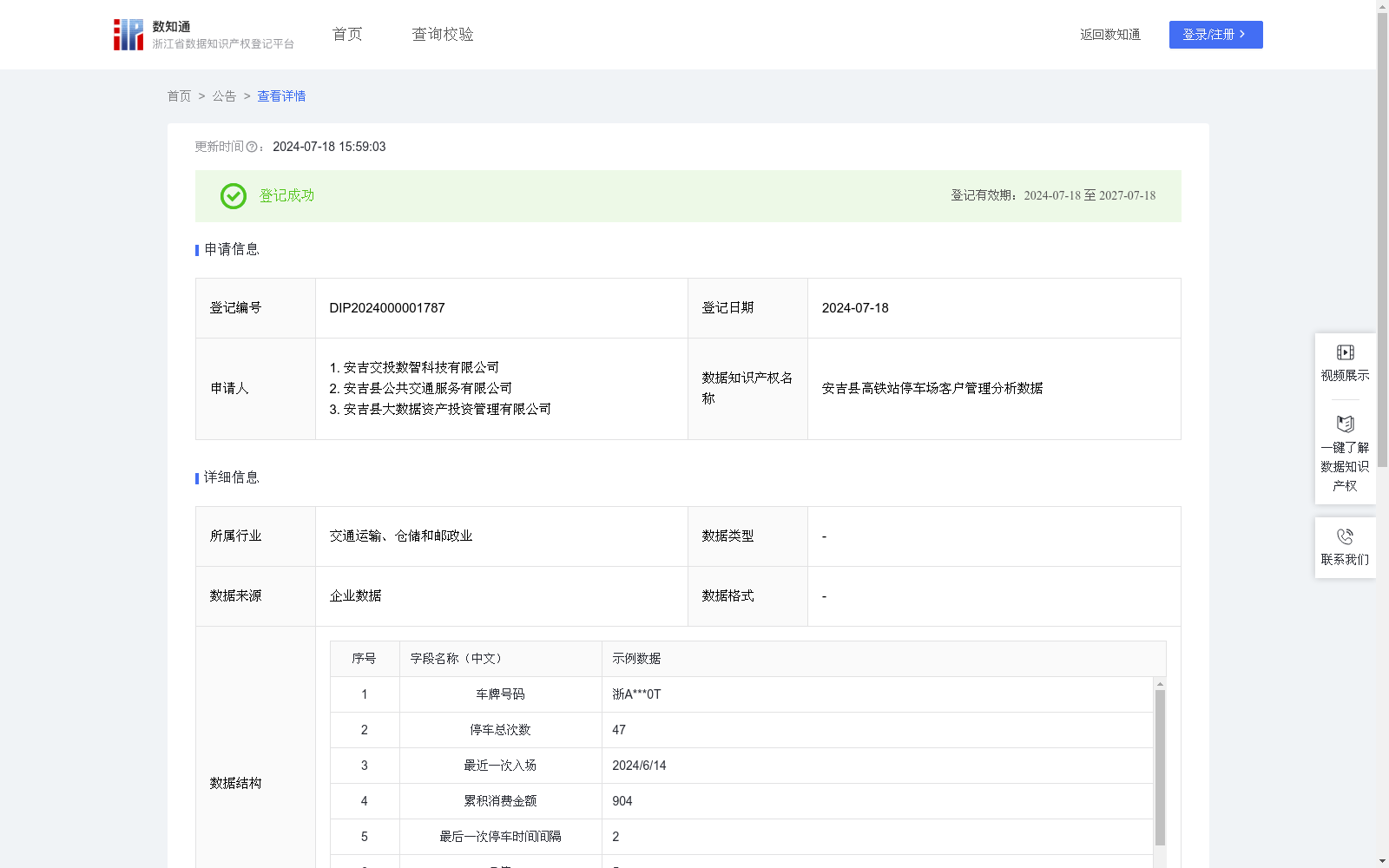
安吉县高铁站停车场客户管理分析数据
收藏资源简介:
通过停车场内停车订单基础数据:订单号,车牌号码,入场时间,出场时间,停车时长,支付金额,等字段。通过RFM模型,计算出用户综合得分,最后赋予用户标签。客户细分:RFM模型可以帮助停车场管理者将用户分为不同的类别,例如高频用户、高消费用户、新用户等,从而实现更精准的客户服务和营销策略。个性化服务:根据RFM模型的分类结果,可以为不同类别的用户提供个性化的服务,比如为高频用户提供VIP停车位,为高消费用户提供折扣优惠等。营销策略优化:通过识别高价值用户,可以针对性地设计营销活动,提高营销效率和用户满意度。收入增长:通过分析不同用户群体的消费行为,可以调整停车费率和优惠政策,以增加收入。资源优化配置:了解用户停车的高峰时段和偏好,可以帮助管理者更有效地分配停车位资源。风险管理:通过识别异常行为(如长时间占用停车位不缴费),可以及时采取措施,减少潜在的损失。客户忠诚度提升:通过提供差异化和个性化的服务,可以提高用户满意度和忠诚度。决策支持:RFM模型提供的数据洞察可以支持管理层做出更明智的业务决策等。步骤1:通过收集安吉县高铁站停车场系统订单号,车牌号码,车道,入场时间,出场时间,停车时长,支付金额等字段,通过分类聚合汇总,计算出停车总次数、累积消费金额、最后一次停车时间间隔等。1.通过最近一次入场日期,计算最后一次停车时间间隔=当前日期-最近一次入场日期 2.停车总次数:根据车牌号码分类聚合,求得累计停车次数 3.累积消费金额:根据车牌号码分类聚合,求得累积消费金额;步骤2:求得每个车牌的车辆的R值、M值、F值:根据停车总次数得到R值,停车总次数:50次5分,40次4分,30次3分,20次2分,1次1分;根据累积消费金额得到M值,累积消费金额:1000元5分,900元4分,300元3分,100元2分,6元1分;根据最后一次停车时间间隔得到F值,最后一次停车时间间隔:7天5分,15天4分,30天3分,90天2分,150天1分;步骤3:计算综合得分:综合得分=R值+F值+M值;步骤4:评价客户综合得分,分为五个等级:优质客户得分大于9分;得分7-9分之间为良好客户,得分6-7分之间为一般客户,得分小于等于5分为低质客户
This dataset utilizes basic parking order data from parking lots, including fields such as order number, license plate number, entry time, exit time, parking duration, and payment amount. The RFM model is applied to calculate users' comprehensive scores and assign user tags, with the following application scenarios: 1. Customer Segmentation: The RFM model enables parking lot managers to categorize users into different groups, such as high-frequency users, high-spending users, and new users, to deliver more precise customer services and marketing strategies. 2. Personalized Service: Based on the RFM model classification results, personalized services can be provided for different user groups. For example, "VIP parking spaces" are offered to high-frequency users, and discount benefits are provided to high-spending users. 3. Marketing Strategy Optimization: By identifying high-value users, targeted marketing campaigns can be designed to improve marketing efficiency and user satisfaction. 4. Revenue Growth: By analyzing the consumption behaviors of different user groups, parking fees and preferential policies can be adjusted to increase revenue. 5. Optimal Resource Allocation: Understanding peak parking hours and user preferences can help managers allocate parking space resources more efficiently. 6. Risk Management: By identifying abnormal behaviors (such as occupying parking spaces for a long time without paying), timely measures can be taken to reduce potential losses. 7. Customer Loyalty Enhancement: Providing differentiated and personalized services can improve user satisfaction and loyalty. 8. Decision Support: Data insights derived from the RFM model can support management in making more informed business decisions. The specific implementation steps are as follows: Step 1: Collect relevant fields from the parking lot system of Anji County High-speed Railway Station, including order number, license plate number, lane, entry time, exit time, parking duration, and payment amount. Calculate total parking times, cumulative consumption amount, and time interval since last parking via classification and aggregation: 1. Time interval since last parking = Current date - Most recent entry date 2. Total parking times: Aggregate data by license plate number to obtain cumulative parking times 3. Cumulative consumption amount: Aggregate data by license plate number to obtain total cumulative payment amount Step 2: Calculate R, F, and M scores for each vehicle (identified by license plate number): - R score (based on total parking times): 5 points for 50 times, 4 points for 40 times, 3 points for 30 times, 2 points for 20 times, 1 point for 1 time - M score (based on cumulative consumption amount): 5 points for 1000 yuan, 4 points for 900 yuan, 3 points for 300 yuan, 2 points for 100 yuan, 1 point for 6 yuan - F score (based on time interval since last parking): 5 points for 7 days, 4 points for 15 days, 3 points for 30 days, 2 points for 90 days, 1 point for 150 days Step 3: Calculate the comprehensive score: Comprehensive Score = R score + F score + M score Step 4: Classify customers into 5 tiers based on the comprehensive score: - Premium customers: Comprehensive score > 9 - Good customers: Score between 7 and 9 - General customers: Score between 6 and 7 - Low-quality customers: Comprehensive score ≤ 5
数据集概述
数据集名称
浙江省数据知识产权登记平台
数据集描述
浙江省数据知识产权登记平台是由浙江知识产权研究与服务中心推出的区块链数据知识产权登记系统。该平台支持数据知识产权登记、知识产权证书申请、原创作品登记确权、维权服务申请、维权证据出具、知识产权转让等多种场景。通过区块链技术,平台从登记、确权、维权、交易等多个维度为创作者的知识产权提供保护。
关键词
区块链、知识产权、数据存证、知识产权存证、知识产权研究与服务中心、数据知识产权登记、浙江省数据知识产权登记平台