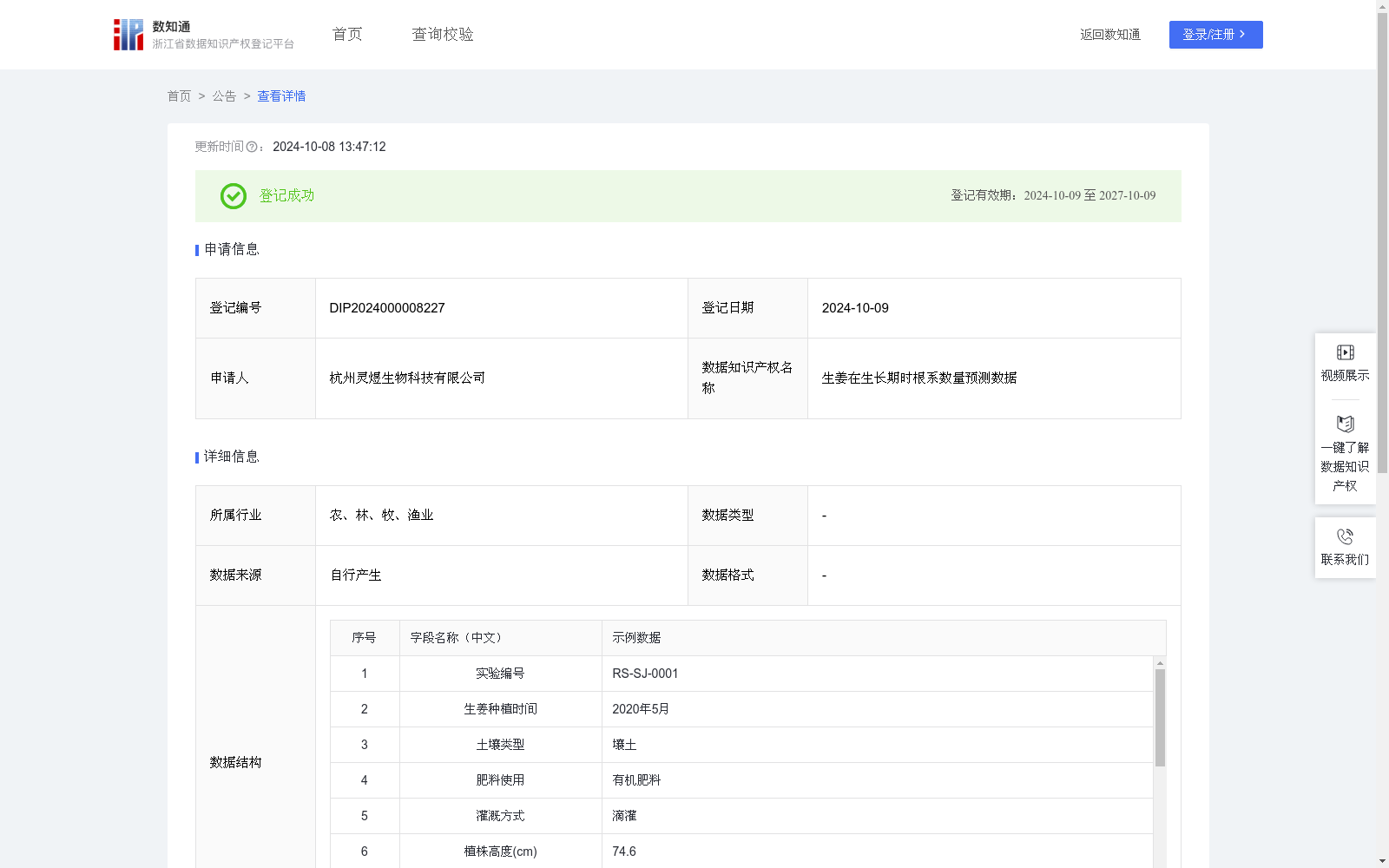
生姜在生长期时根系数量预测数据
收藏资源简介:
可以用于生姜根系数量预测,输入为土壤类型、肥料使用、灌溉方式、植株高度(cm)、生姜茎粗(cm)、叶面积指数、根系长度(cm)、生姜产量(亩产量)、根系主要分布范围(cm)、根茎长(cm)、叶绿素含量(mg/g)、叶片数量。输出为生姜根系数量预测值。该模型帮助解决了生姜根系数量和生姜状况的关系建模的问题。生姜植株的根系数量对生姜根的生长有着重要的影响,根系的健康状况(包括有根系数量)还能影响其对养分的吸收效率,从而影响作物的最终产量。因此,通过预测生姜根系的数量,可以初步判断作物的生长状况。通过调查采集生姜数据,并使用传统算法和多元线性回归算法预测生姜根系数量。该模型的输入为土壤类型、肥料使用、灌溉方式、植株高度(cm),生姜茎粗(cm),叶面积指数,根系长度(cm),生姜产量(亩产量),根系主要分布范围(cm),生姜根系数量,根茎长(cm),叶绿素含量(mg/g)。多元线性回归算法通过分析这些输入变量与生姜根系预测数量之间的线性关系,确定每个变量的权重系数,使用深度学习框架构建模型F=ω1 * U1 + ω2* U2+…ω13 * U13,其中,ω1至ω13分别是土壤类型、肥料使用、灌溉方式、植株高度、生姜茎粗、叶面积指数、根系长度、生姜产量、根系主要分布范围、根茎长、叶绿素含量、叶片数量的权重系数,同样的 U1至 U13分别是上述13个输入量的参数值,F是生姜根系数量预测值。在模型训练过程中,算法会利用生姜根系数量实际值进行优化,调整权重系数以最小化预测误差,因此上述权重系数(ω1至ω13)是会动态变化。模型通过最小二乘法等技术,根据输入的数据计算生姜根系数量预测值,从而得出最终结果。通过这样的过程,模型能够将多个输入变量综合考虑,准确预测生姜根系数量。
This dataset can be used for ginger root count prediction. Its inputs include soil type, fertilizer application, irrigation method, plant height (cm), ginger stem diameter (cm), leaf area index, root length (cm), ginger yield (per mu), main root distribution range (cm), rhizome length (cm), chlorophyll content (mg/g), and number of leaves, with the output being the predicted ginger root count. This model addresses the challenge of modeling the relationship between ginger root count and ginger growth status. The root count of ginger plants exerts a critical influence on root growth. Additionally, the health status of the root system (including root count) affects nutrient uptake efficiency, which in turn impacts the final crop yield. Therefore, predicting ginger root count allows for preliminary assessment of crop growth status. Ginger data was collected via field surveys, and traditional algorithms and multiple linear regression were used to predict ginger root count. The model's inputs consist of soil type, fertilizer application, irrigation method, plant height (cm), ginger stem diameter (cm), leaf area index, root length (cm), ginger yield (per mu), main root distribution range (cm), ginger root count, rhizome length (cm), chlorophyll content (mg/g), and number of leaves. The multiple linear regression algorithm analyzes the linear relationship between these input variables and the predicted ginger root count to determine the weight coefficient of each variable. The model is constructed using a deep learning framework as follows: $F = omega_1 U_1 + omega_2 U_2 + dots + omega_{13} U_{13}$, where $omega_1$ to $omega_{13}$ are the weight coefficients for soil type, fertilizer application, irrigation method, plant height, ginger stem diameter, leaf area index, root length, ginger yield, main root distribution range, rhizome length, chlorophyll content, and number of leaves respectively; $U_1$ to $U_{13}$ are the parameter values of the aforementioned 13 input quantities, and $F$ is the predicted ginger root count. During model training, the algorithm uses the actual values of ginger root count for optimization, adjusting the weight coefficients to minimize prediction error; thus, the aforementioned weight coefficients ($omega_1$ to $omega_{13}$) are dynamically updated. The model calculates the predicted ginger root count based on input data using techniques such as the least squares method to obtain the final result. Through this process, the model can comprehensively consider multiple input variables to accurately predict ginger root count.