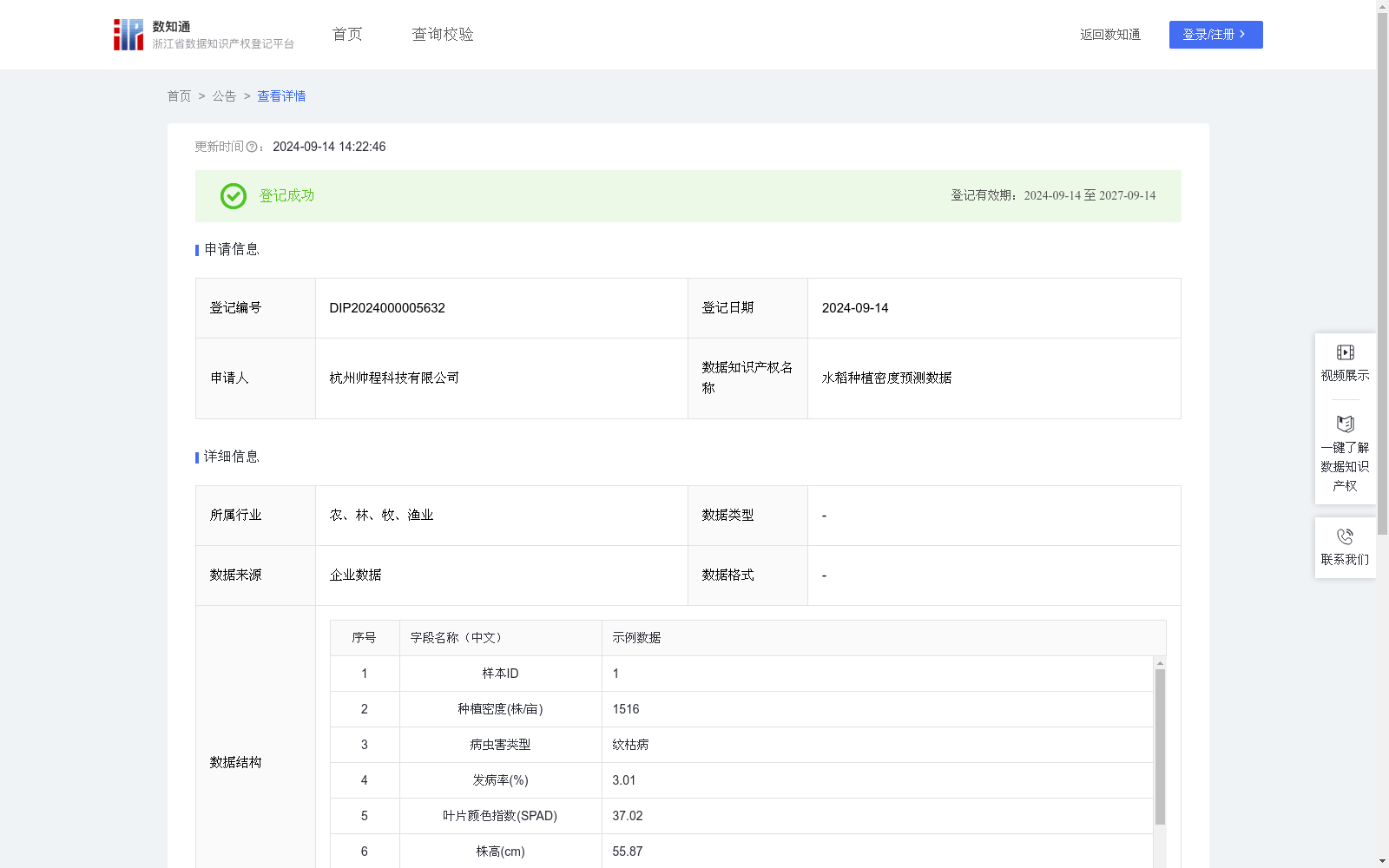
水稻种植密度预测数据
收藏资源简介:
水稻种植密度直接影响作物的生长条件、病虫害发生率以及最终产量。合理预测和调整种植密度对于提高单位面积产量、优化资源使用及减少病虫害具有重要意义。该模型解决了水稻生长状况与种植密度之间的关系。通过理化实验以及调查获取水稻的数据,首先进行数据预处理,包括数据清洗和特征选择,然后对数据进行标准化。通过输入抗病评分,发病率(%),叶片颜色指数(SPAD),株高(cm),穗长(cm),病虫害类型,生育期(天),分蘖数到支持向量机模型中, 通过调整参数如正则化系数C和核函数参数来优化模型,在支持向量机中,正则化系数C控制模型的复杂度与训练误差的平衡,而核函数参数调节数据在高维空间中的映射,以优化回归边界, 使用交叉验证确保模型的泛化能力。最终,模型被用来预测新数据的种植密度,帮助制定防治策略。
Rice planting density directly affects crop growth conditions, pest and disease incidence, and final yield. Reasonably predicting and adjusting planting density is of great significance for increasing yield per unit area, optimizing resource utilization, and reducing pests and diseases. This model explores the correlation between rice growth status and planting density. Rice data is collected through physicochemical experiments and surveys. First, data preprocessing is conducted, including data cleaning and feature selection, followed by data standardization. Features including disease resistance score, incidence rate (%), leaf color index (SPAD), plant height (cm), panicle length (cm), pest and disease type, growth period (days), and tiller number are input into the Support Vector Machine (SVM) model, and the model is optimized by adjusting parameters such as the regularization coefficient C and kernel function parameters. In SVM, the regularization coefficient C controls the balance between model complexity and training error, while kernel function parameters adjust the data mapping in high-dimensional space to optimize the regression boundary. Cross-validation is utilized to ensure the generalization capability of the model. Finally, the model is employed to predict the planting density of new datasets, aiding in the formulation of pest and disease prevention and control strategies.