
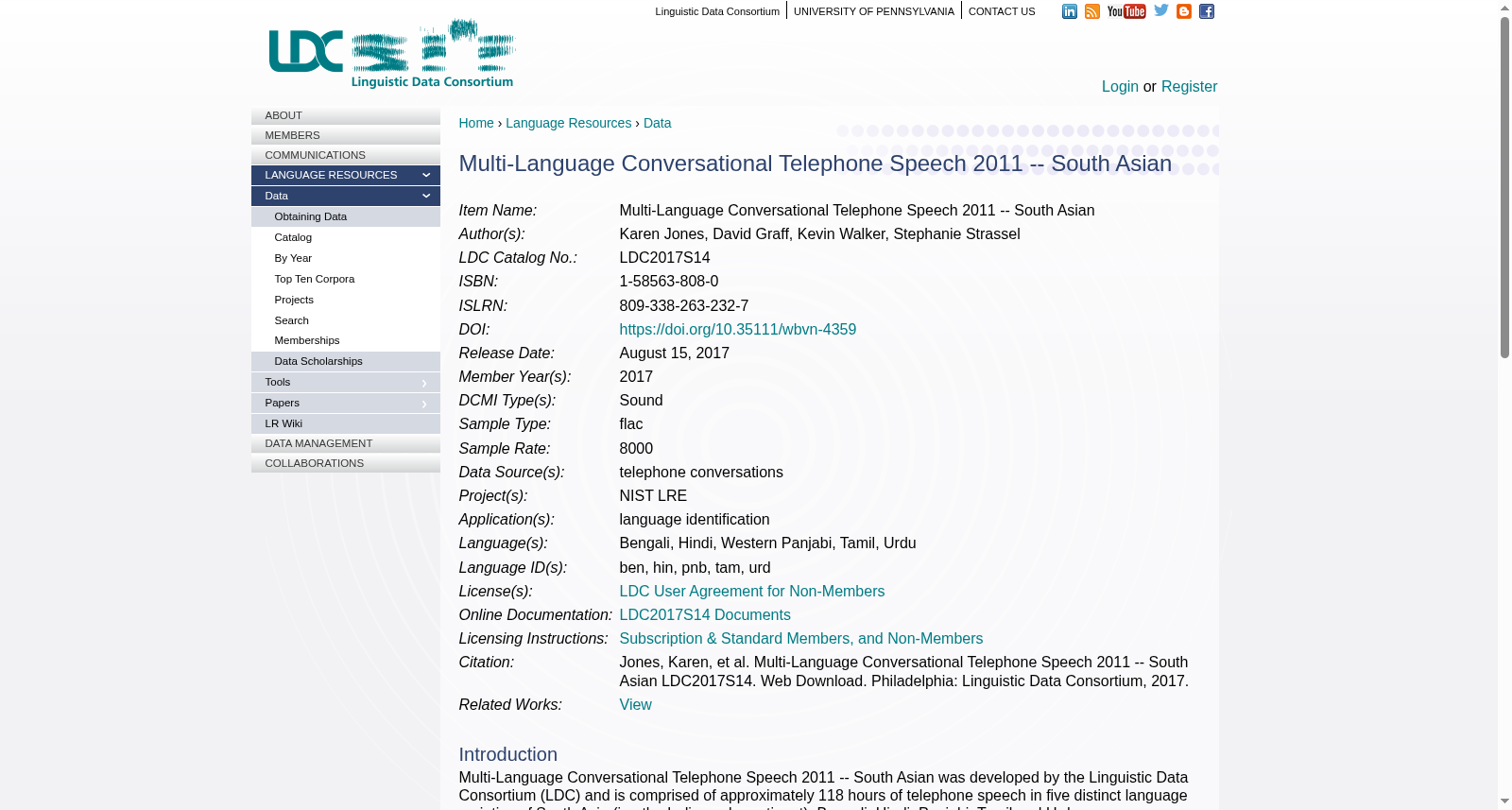
Multi-Language Conversational Telephone Speech 2011 -- South Asian
收藏DataCite Commons2021-07-01 更新2025-04-16 收录
下载链接:
https://catalog.ldc.upenn.edu/LDC2017S14
下载链接
链接失效反馈官方服务:
资源简介:
<h3>Introduction</h3><br>
<p>Multi-Language Conversational Telephone Speech 2011 -- South Asian was developed by the Linguistic Data Consortium (LDC) and is comprised of approximately 118 hours of telephone speech in five distinct language varieties of South Asia (i.e. the Indian sub-continent): Bengali, Hindi, Punjabi, Tamil and Urdu.</p><br>
<p>The data were collected primarily to support research and technology evaluation in automatic language identification, and portions of these telephone calls were used in the NIST 2011 Language Recognition Evaluation (<a href="https://www.nist.gov/itl/iad/mig/2011-language-recognition-evaluation">LRE</a>). LRE 2011 focused on language pair discrimination for 24 languages/dialects, some of which could be considered mutually intelligible or closely related.</p><br>
<p>LDC has also released the following as part of the Multi-Language Conversational Telephone Speech 2011 series:</p><br>
<ul><br>
<li>Slavic Group (<a href="../../../LDC2016S11">LDC2016S11</a>)</li><br>
<li>Turkish (<a href="../../../LDC2017S09">LDC2017S09</a>)</li><br>
<li>Central Asian (<a href="../../../LDC2018S03">LDC2018S03</a>)</li><br>
<li>Central European (<a href="../../../LDC2018S08">LDC2018S08</a>)</li><br>
<li>Spanish (<a href="../../../LDC2018S12">LDC2018S12</a>)</li><br>
<li>Arabic (<a href="../../../LDC2019S02">LDC2019S02</a>)</li><br>
<li>English (<a href="../../../LDC2019S06">LDC2019S06</a>)</li><br>
</ul><br>
<h3>Data</h3><br>
<p>Participants were recruited by native speakers who contacted acquaintances in their social network. Those native speakers made one call, up to 15 minutes, to each acquaintance. The data was collected using <a href="https://www.ldc.upenn.edu/about/facilities/human-subjects-collection">LDC's telephone collection infrastructure</a>, comprised of three computer telephony systems. Human auditors labeled calls for callee gender, dialect type and noise. Demographic information about the participants was not collected.</p><br>
<p>All audio data are presented in FLAC-compressed MS-WAV (RIFF) file format (*.flac); when uncompressed, each file is 2 channels, recorded at 8000 samples/second with samples stored as 16-bit signed integers, representing a lossless conversion from the original mu-law sample data as captured digitally from the public telephone network. The following table summarizes the total number of calls, total number of hours of recorded audio, and the total size of compressed data:</p><br>
<table border="1" cellpadding="5"><br>
<tbody><br>
<tr><br>
<td>group</td><br>
<td>lng</td><br>
<td>#calls</td><br>
<td>#hours</td><br>
<td>#MB</td><br>
</tr><br>
<tr><br>
<td>s_asian</td><br>
<td>ben</td><br>
<td>118</td><br>
<td>26.6</td><br>
<td>1374</td><br>
</tr><br>
<tr><br>
<td>s_asian</td><br>
<td>hin</td><br>
<td>37</td><br>
<td>7.4</td><br>
<td>383</td><br>
</tr><br>
<tr><br>
<td>s_asian</td><br>
<td>pnb</td><br>
<td>207</td><br>
<td>38.8</td><br>
<td>1921</td><br>
</tr><br>
<tr><br>
<td>s_asian</td><br>
<td>tam</td><br>
<td>101</td><br>
<td>22.9</td><br>
<td>1140</td><br>
</tr><br>
<tr><br>
<td>s_asian</td><br>
<td>urd</td><br>
<td>116</td><br>
<td>22.9</td><br>
<td>1140</td><br>
</tr><br>
<tr><br>
<td>s_asian</td><br>
<td>Totals</td><br>
<td>579</td><br>
<td>118.3</td><br>
<td>5913</td><br>
</tr><br>
</tbody><br>
</table><br>
<h3>Samples</h3><br>
<p>Please listen to this <a href="desc/addenda/LDC2017S14.flac">sample</a>.</p><br>
<h3>Updates</h3><br>
<p>None at this time.</p></br>
Portions © 2017 Trustees of the University of Pennsylvania
<h3>引言</h3><br><p>2011年多语言会话电话语音数据集——南亚语种由语言数据联盟(Linguistic Data Consortium, LDC)开发,包含约118小时的南亚(即印度次大陆)五种独立语言变体的电话语音数据,具体为孟加拉语、印地语、旁遮普语、泰米尔语与乌尔都语。</p><br><p>本数据集的采集初衷主要为支持自动语言识别领域的研究与技术评测,其中部分通话数据曾应用于美国国家标准与技术研究院(National Institute of Standards and Technology, NIST)2011年语言识别评测(Language Recognition Evaluation, LRE)。2011年LRE的核心任务为针对24种语言/方言开展语言对判别,其中部分语言/方言可被视为相互可理解或亲缘关系紧密。</p><br><p>语言数据联盟还作为2011年多语言会话电话语音数据集系列的一部分,发布了以下子数据集:</p><br><ul><br><li>斯拉夫语族(LDC2016S11)</li><br><li>土耳其语(LDC2017S09)</li><br><li>中亚语种(LDC2018S03)</li><br><li>中欧语种(LDC2018S08)</li><br><li>西班牙语(LDC2018S12)</li><br><li>阿拉伯语(LDC2019S02)</li><br><li>英语(LDC2019S06)</li><br></ul><br><h3>数据概况</h3><br><p>参与者由母语者招募,这些母语者联系其社交网络中的熟人,并向每位熟人拨打单次通话,时长不超过15分钟。数据采集采用语言数据联盟的电话采集基础设施,该系统由三套计算机电话系统组成。人工审核员会对通话进行标注,标注内容包括被叫方性别、方言类型与背景噪音。本次采集未收集参与者的人口统计学信息。</p><br><p>所有音频数据均采用FLAC压缩的MS-WAV(RIFF)文件格式(文件扩展名为*.flac);解压后,每个音频文件包含2个声道,采样率为8000样本/秒,样本以16位有符号整数存储,该格式可无损还原从公共电话网络数字化采集的原始mu-law采样数据。下表汇总了总通话数、总录音时长与压缩数据总大小:</p><br><table border="1" cellpadding="5"><br><tbody><br><tr><br><td>分组</td><br><td>语言代码</td><br><td>通话数量</td><br><td>总时长(小时)</td><br><td>压缩数据大小(MB)</td><br></tr><br><tr><br><td>s_asian</td><br><td>ben</td><br><td>118</td><br><td>26.6</td><br><td>1374</td><br></tr><br><tr><br><td>s_asian</td><br><td>hin</td><br><td>37</td><br><td>7.4</td><br><td>383</td><br></tr><br><tr><br><td>s_asian</td><br><td>pnb</td><br><td>207</td><br><td>38.8</td><br><td>1921</td><br></tr><br><tr><br><td>s_asian</td><br><td>tam</td><br><td>101</td><br><td>22.9</td><br><td>1140</td><br></tr><br><tr><br><td>s_asian</td><br><td>urd</td><br><td>116</td><br><td>22.9</td><br><td>1140</td><br></tr><br><tr><br><td>s_asian</td><br><td>总计</td><br><td>579</td><br><td>118.3</td><br><td>5913</td><br></tr><br></tbody><br></table><br><h3>样本示例</h3><br><p>请收听此<a href="desc/addenda/LDC2017S14.flac">示例音频</a>。</p><br><h3>更新记录</h3><br><p>暂无当前更新记录。</p><br><p>部分内容 © 2017 宾夕法尼亚大学理事会</p>
创建时间:
2020-11-30
搜集汇总
数据集介绍
背景与挑战
背景概述
该数据集是Linguistic Data Consortium发布的'Multi-Language Conversational Telephone Speech 2011'系列的一部分,专注于南亚地区语言,包含约118小时的电话语音,覆盖孟加拉语、印地语、旁遮普语、泰米尔语和乌尔都语五种语言。它主要用于支持自动语言识别的研究和技术评估,特别是为NIST 2011语言识别评估提供数据,音频以FLAC格式存储,采样率为8000 Hz。
以上内容由遇见数据集搜集并总结生成


