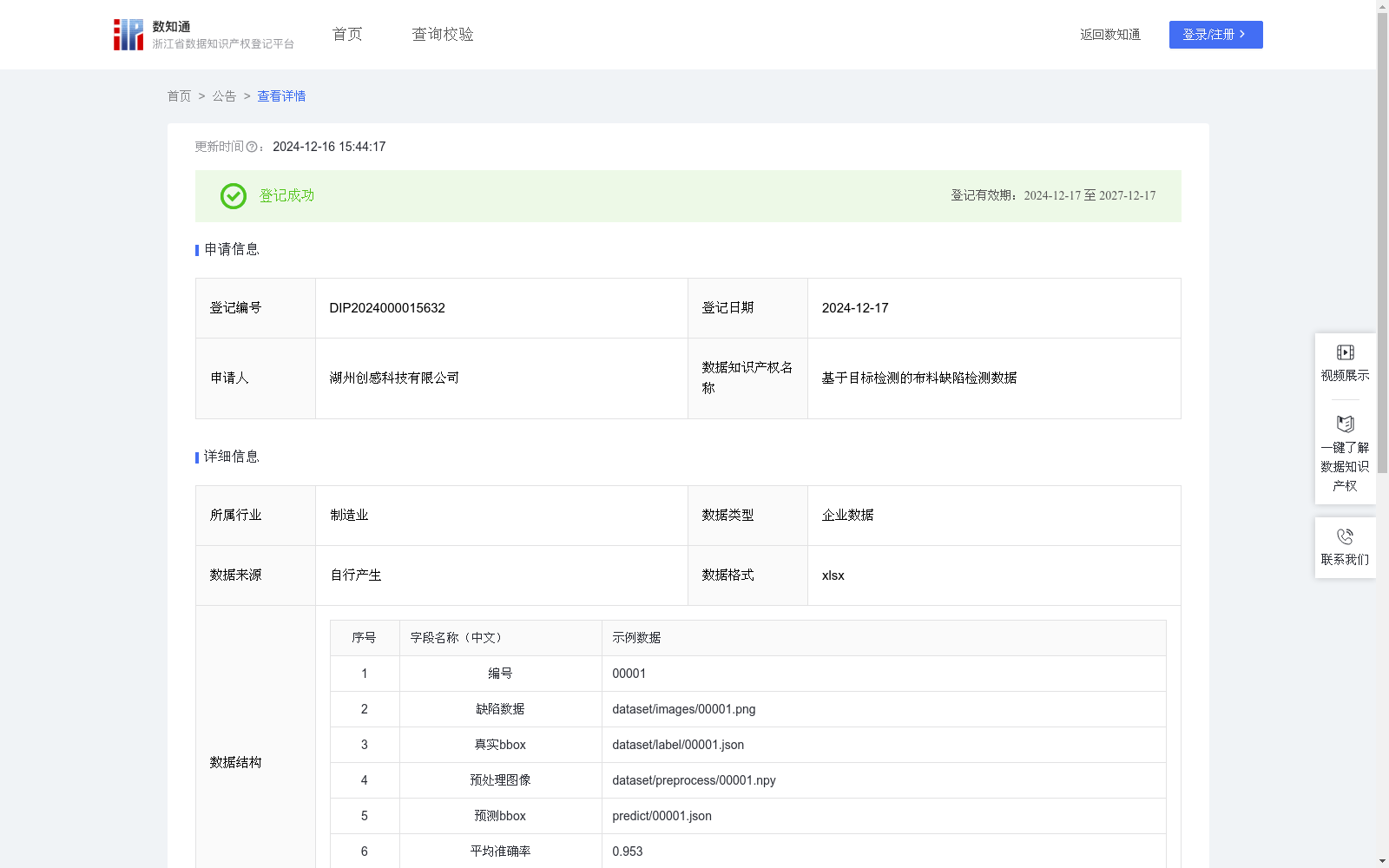
基于目标检测的布料缺陷检测数据
收藏资源简介:
基于目标检测的布料缺陷检测技术在纺织制造业中具有显著应用价值。通过目标检测算法对布料图像中的缺陷区域进行标记,可以快速识别和定位织物上的常见缺陷,例如断纱、污点和织疵。这项技术能有效替代人工检测,适用于生产线上的实时检测与质量控制,提高生产效率和成品质量一致性,减少人为误差。数据收集:在该算法中,收集布料缺陷图像及其对应的缺陷边界框(bbox)作为训练和验证数据集的基础。每个样本包含:缺陷数据图像(.png格式文件)和真实缺陷边界框标签(.json格式),用于记录缺陷的具体位置和范围,作为目标检测模型的监督数据。 数据预处理:对原始布料图像进行预处理,包括缩放、归一化等操作,使图像符合神经网络的输入要求。预处理后生成的图像数据(.npy格式)包含了结构化信息,便于模型从中提取有效特征,以提升缺陷检测的准确性。 模型构建:利用基于目标检测的卷积神经网络对布料缺陷进行检测。网络输入为预处理后的图像数据,输出为预测的缺陷边界框(bbox)。模型包含特征提取器和边界框生成器两个部分,分别用于提取图像特征和生成缺陷位置标记。具体算法公式如下:F=Encoder_features(I),P=Detector_bbox(F)。其中,Encoder_features用于从预处理图像I中提取高维特征F,Detector_bbox生成预测分割标签P通过这种方式,模型能够准确定位并分割布料中的缺陷区域。检测结果使用平均准确率和平均召回率进行评估,确保模型在实际应用中提供高准确率和召回率的检测效果。
Object detection-based fabric defect detection technology has significant application value in the textile manufacturing industry. By marking defective regions in fabric images via object detection algorithms, common defects on fabrics such as yarn breaks, stains, and weaving flaws can be quickly identified and located. This technology can effectively replace manual detection, and is suitable for real-time detection and quality control on production lines, improving production efficiency and the consistency of finished product quality while reducing human errors. Data Collection: In this algorithm, fabric defect images and their corresponding defect bounding boxes (bbox) are collected as the basis for the training and validation datasets. Each sample includes: a defect data image (in .png format) and ground-truth defect bounding box labels (in .json format), which record the specific position and scope of defects and serve as supervised data for object detection models. Data Preprocessing: Preprocessing operations such as scaling and normalization are performed on the original fabric images to make them meet the input requirements of neural networks. The preprocessed image data (stored in .npy format) contains structured information, making it easier for models to extract effective features and improve the accuracy of defect detection. Model Construction: A convolutional neural network (CNN) based on object detection is used to detect fabric defects. The network takes the preprocessed image data as input and outputs predicted defect bounding boxes (bbox). The model consists of two parts: a feature extractor and a bounding box generator, which are used to extract image features and generate defect position annotations respectively. The specific algorithm formulas are as follows: F=Encoder_features(I), P=Detector_bbox(F). Here, Encoder_features is used to extract high-dimensional features F from the preprocessed image I, and Detector_bbox generates predicted segmentation labels P. Through this approach, the model can accurately locate and segment defective regions in fabrics. The detection results are evaluated using mean average precision (mAP) and mean recall to ensure that the model provides detection effects with high accuracy and recall in practical applications.