nepali-nli-20k
收藏资源简介:
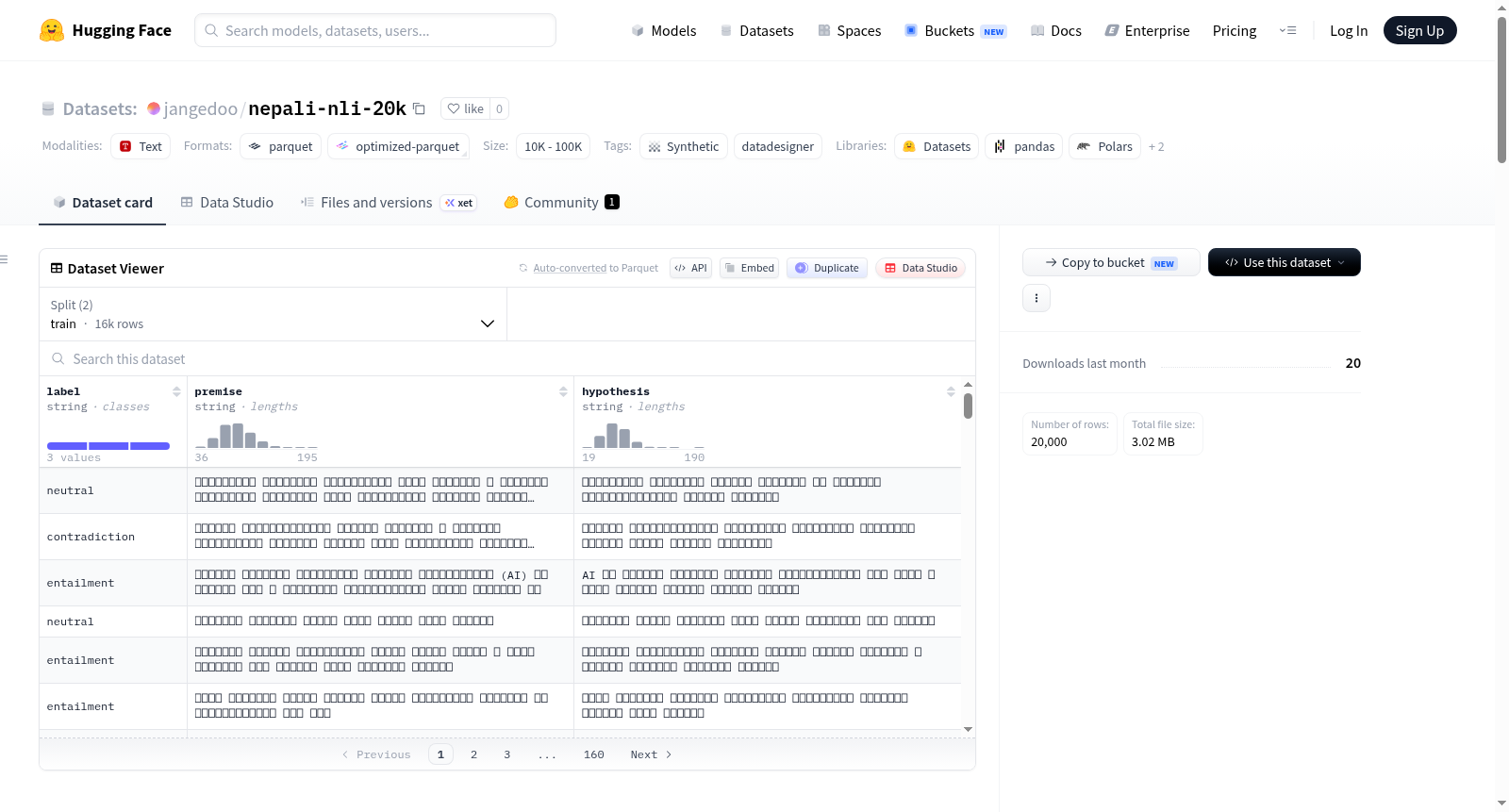
Nepali-Nli-20k 是一个合成生成的尼泊尔语自然语言推理(NLI)数据集,旨在训练和评估尼泊尔语语言理解模型,特别是句子嵌入模型、检索模型、交叉编码器以及其他需要理解尼泊尔语中语义相似性、矛盾和蕴含关系的模型。数据集包含 20,000 个样本,分为 16,000 个训练样本和 4,000 个测试样本。每个样本由三个字段组成:前提(premise)、假设(hypothesis)和标签(label)。标签遵循标准 NLI 格式,包括“蕴含”(entailment,假设从前提逻辑推导出)、“矛盾”(contradiction,假设与前提冲突)和“中性”(neutral,假设与前提相关但无法证明真伪)。数据集覆盖广泛的尼泊尔和现实世界主题,如尼泊尔文化与传统、节日仪式、地理环境、教育、健康、金融、数字支付、就业、政治、媒体、农业和技术等,旨在使样本多样化并适用于理解现实日常语境中的尼泊尔语。数据集由本地指令遵循语言模型合成生成,通过明确约束确保前提和假设均为尼泊尔语、标签关系逻辑一致、主题反映在生成文本中。由于是合成数据,可能存在逻辑关系不完美、重复句子模式、轻微语言或语法问题以及文化上合理但未经事实验证的陈述等局限性,建议在高风险应用前进行检查、过滤和验证。预期用途包括训练尼泊尔语句子嵌入模型、微调 NLI 或分类模型、训练语义匹配交叉编码器、构建检索和重排序系统、评估尼泊尔语语义理解以及创建对比学习三元组数据集。
Nepali-Nli-20k is a synthetically generated Nepali natural language inference (NLI) dataset designed to train and evaluate Nepali language understanding models, particularly sentence embedding models, retrieval models, cross-encoders, and other models that require understanding semantic similarity, contradiction, and entailment in Nepali. The dataset contains 20,000 samples, divided into 16,000 training samples and 4,000 test samples. Each sample consists of three fields: premise, hypothesis, and label. The labels follow the standard NLI format, including entailment (where the hypothesis logically follows from the premise), contradiction (where the hypothesis conflicts with the premise), and neutral (where the hypothesis is related to the premise but cannot be proven true or false). The dataset covers a wide range of Nepali and real-world topics, such as Nepali culture and traditions, festivals and rituals, geography, education, health, finance, digital payments, employment, politics, media, agriculture, and technology, aiming to diversify samples and make them applicable to understanding Nepali in real-world daily contexts. The dataset is synthetically generated using a local instruction-following language model, with explicit constraints to ensure that both premise and hypothesis are in Nepali, label relationships are logically consistent, and topics are reflected in the generated text. Due to its synthetic nature, there may be limitations such as imperfect logical relationships, repetitive sentence patterns, minor language or grammatical issues, and culturally plausible but factually unverified statements; it is recommended to check, filter, and validate before high-risk applications. Intended uses include training Nepali sentence embedding models, fine-tuning NLI or classification models, training semantic matching cross-encoders, building retrieval and reranking systems, evaluating Nepali semantic understanding, and creating contrastive learning triplet datasets.
数据集概述:Nepali-Nli-20k
Nepali Natural Language Inference Dataset 是一个合成生成的尼泊尔语自然语言推理(NLI)数据集,包含 20,000 个样本,用于训练和评估尼泊尔语语义理解模型。
数据集信息
- 规模:10,000 < 样本数 < 100,000(实际 20,000 个样本)
- 数据划分:
- 训练集:16,000 个样本
- 测试集:4,000 个样本
- 数据集大小:约 9.16 MB(下载大小约 3.00 MB)
- 特征字段:
premise(前提):尼泊尔语文本hypothesis(假设):尼泊尔语文本label(标签):字符串类型(entailment、contradiction、neutral)
标签含义
entailment:假设逻辑上从前提推出。contradiction:假设与前提冲突。neutral:假设与前提相关,但无法确定真伪。
覆盖主题
涵盖尼泊尔文化、节日习俗、地理环境、教育、健康、数字支付、就业、政治、农业、技术与AI等广泛现实主题。
预期用途
- 训练尼泊尔语句子嵌入模型
- 微调NLI或分类模型
- 训练交叉编码器进行语义匹配
- 构建检索与重排序系统
- 评估尼泊尔语语义理解能力
- 创建对比学习的三元组数据集
- 改进尼泊尔语问答与搜索系统
数据集创建
使用本地指令跟随语言模型合成生成,针对每个样本采样主题和NLI标签,生成对应的前提与假设对,并确保逻辑一致性与结构规范性。
局限性
- 合成数据可能包含不完美的逻辑关系、重复模式、轻微语法问题
- 场景简化,部分事实未经验证
推荐处理步骤
- 去重前提-假设对
- 使用独立模型或人工审查验证标签一致性
- 过滤短或低质量样本
- 平衡各标签样本数量
- 可额外划分验证集
- 可选将标签转换为句子对或三元组格式
快速加载(Python)
python from datasets import load_dataset dataset = load_dataset("jangedoo/nepali-nli-20k", "data", split="train") df = dataset.to_pandas()
引用格式
bibtex @dataset{subedi_nepali_nli_dataset, author = {Subedi, Sanjaya}, title = {Nepali Natural Language Inference Dataset}, year = {2026}, publisher = {Hugging Face}, url = {https://huggingface.co/datasets/jangedoo/nepali-nli-20k} }