刺梨原粉营养成分检测数据集合
收藏资源简介:
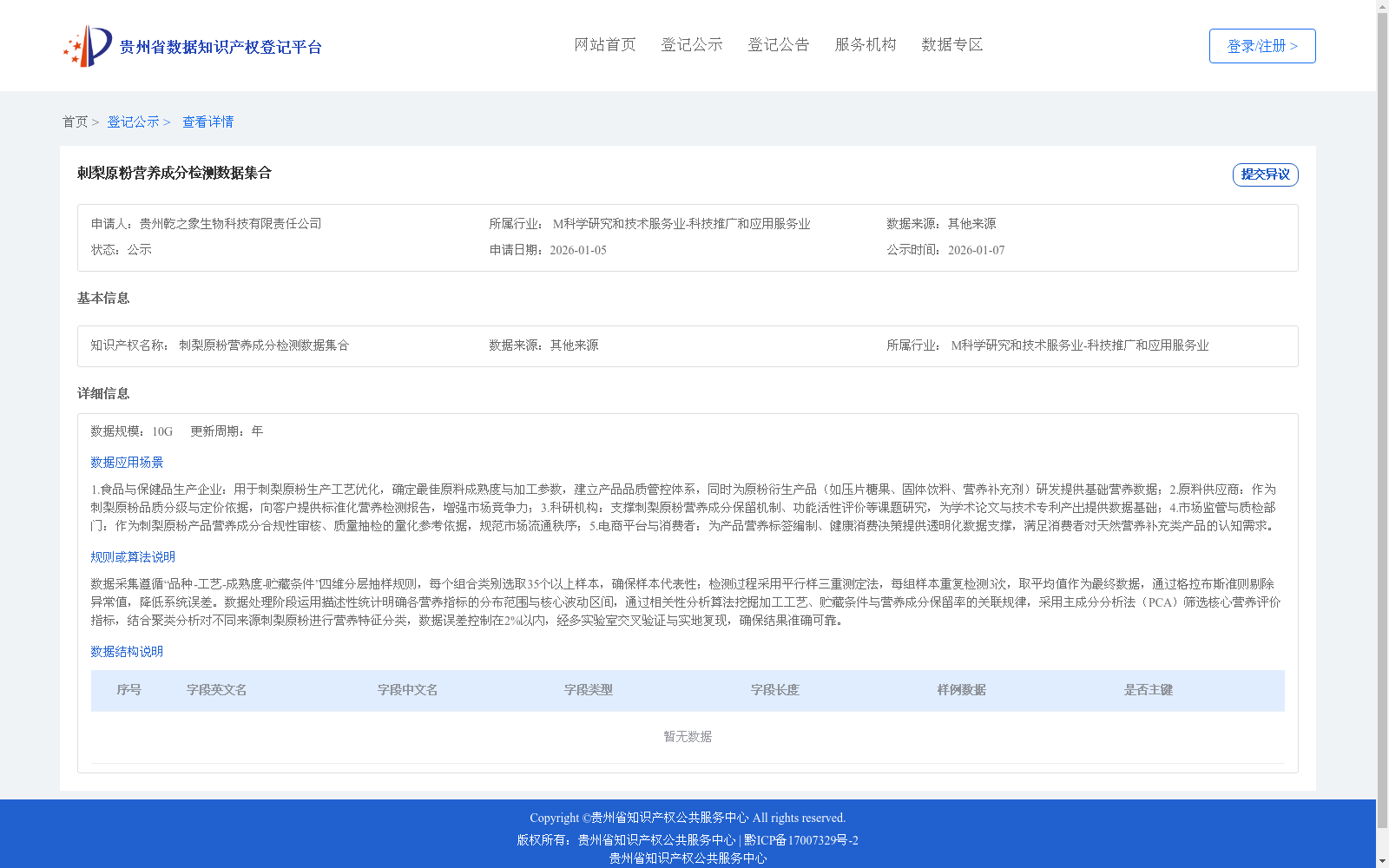
数据采集遵循“品种-工艺-成熟度-贮藏条件”四维分层抽样规则,每个组合类别选取35个以上样本,确保样本代表性;检测过程采用平行样三重测定法,每组样本重复检测3次,取平均值作为最终数据,通过格拉布斯准则剔除异常值,降低系统误差。数据处理阶段运用描述性统计明确各营养指标的分布范围与核心波动区间,通过相关性分析算法挖掘加工工艺、贮藏条件与营养成分保留率的关联规律,采用主成分分析法(PCA)筛选核心营养评价指标,结合聚类分析对不同来源刺梨原粉进行营养特征分类,数据误差控制在2%以内,经多实验室交叉验证与实地复现,确保结果准确可靠。
Data collection follows a four-dimensional stratified sampling framework based on the four dimensions of "variety - processing technology - maturity - storage conditions". More than 35 samples were selected for each combination category to ensure the representativeness of the sample set. The parallel sample triplicate determination method was adopted during the detection process: each group of samples was tested three times repeatedly, and the average value was taken as the final experimental data. Outliers were eliminated using the Grubbs' test to mitigate systematic errors. In the data processing stage, descriptive statistics were employed to clarify the distribution range and core fluctuation interval of each nutritional indicator. Correlation analysis algorithms were applied to explore the correlation patterns between processing technology, storage conditions and the retention rate of nutritional components. Principal Component Analysis (PCA) was adopted to screen core nutritional evaluation indicators. Cluster analysis was combined to classify the nutritional characteristics of Rosa roxburghii raw powder from different sources. The data error was controlled within 2%, and multi-laboratory cross-validation and field reproduction experiments were conducted to ensure the accuracy and reliability of the results.