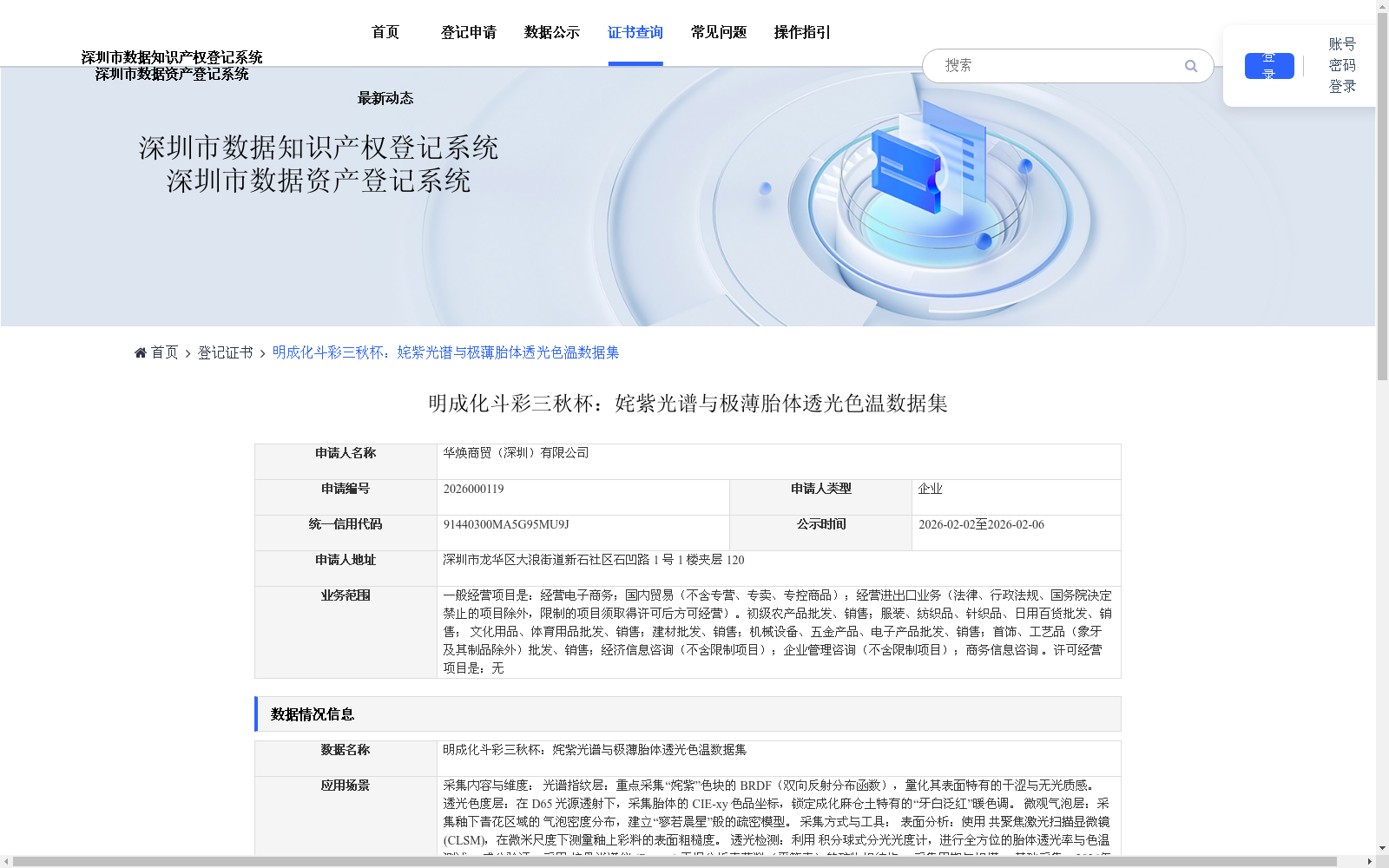
明成化斗彩三秋杯:姹紫光谱与极薄胎体透光色温数据集
收藏资源简介:
采集内容与维度: 光谱指纹层:重点采集“姹紫”色块的 BRDF(双向反射分布函数),量化其表面特有的干涩与无光质感。 透光色度层:在 D65 光源透射下,采集胎体的 CIE-xy 色品坐标,锁定成化麻仓土特有的“牙白泛红”暖色调。 微观气泡层:采集釉下青花区域的 气泡密度分布,建立“寥若晨星”般的疏密模型。 采集方式与工具: 表面分析:使用 共聚焦激光扫描显微镜 (CLSM),在微米尺度下测量釉上彩料的表面粗糙度。 透光检测:利用 积分球式分光光度计,进行全方位的胎体透光率与色温测试。 成分验证:采用 拉曼光谱仪 (Raman) 无损分析青花料(平等青)的矿物相结构。 采集周期与规模: 基础采集:2026年1月8日完成双杯的全维物理信号提取,建立“成化极薄胎”基准数据库。 增量生成:针对市面上“化学强化瓷”仿薄胎技术,算法生成针对性的光谱鉴别模型。 数据规模:包含 2 个核心物理锚点(Cup A/B),裂变生成 20 行 核心样本及关联的 16,500 条微观特征数据,数据总量 1.8TB。
Collection Content and Dimensions: Spectral Fingerprint Layer: Focus on collecting the Bidirectional Reflectance Distribution Function (BRDF) of the 'Chazi' purplish-red color patch, quantifying its unique dry and matte surface texture. Transmissive Chromaticity Layer: Under D65 light source transmission, collect the CIE-xy chromaticity coordinates of the porcelain body to lock in the unique warm tone of "off-white with reddish tinge" characteristic of Chenghua-period Makeng clay. Microscopic Bubble Layer: Collect the bubble density distribution in the underglaze blue-and-white area, establishing a sparse-dense model described as "sparse as morning stars". Collection Methods and Tools: Surface Analysis: Use a Confocal Laser Scanning Microscope (CLSM) to measure the surface roughness of overglaze color pigments at the micrometer scale. Transmissivity Detection: Utilize an integrating sphere spectrophotometer to conduct comprehensive tests on the porcelain body's transmissivity and color temperature. Composition Verification: Adopt a Raman spectrometer (Raman) for non-destructive analysis of the mineral phase structure of the blue-and-white pigment (Pingdengqing). Collection Cycle and Scale: Basic Collection: Complete full-dimensional physical signal extraction for the two cups on January 8, 2026, establishing the benchmark database for "Chenghua ultra-thin porcelain body". Incremental Generation: Targeting the "chemically strengthened porcelain" thin-body imitation technology available on the market, develop targeted spectral discrimination models via algorithms. Data Scale: Contains 2 core physical anchor points (Cup A/B), which generate 20 core samples and 16,500 associated microscopic feature data entries, with a total data volume of 1.8 TB.