
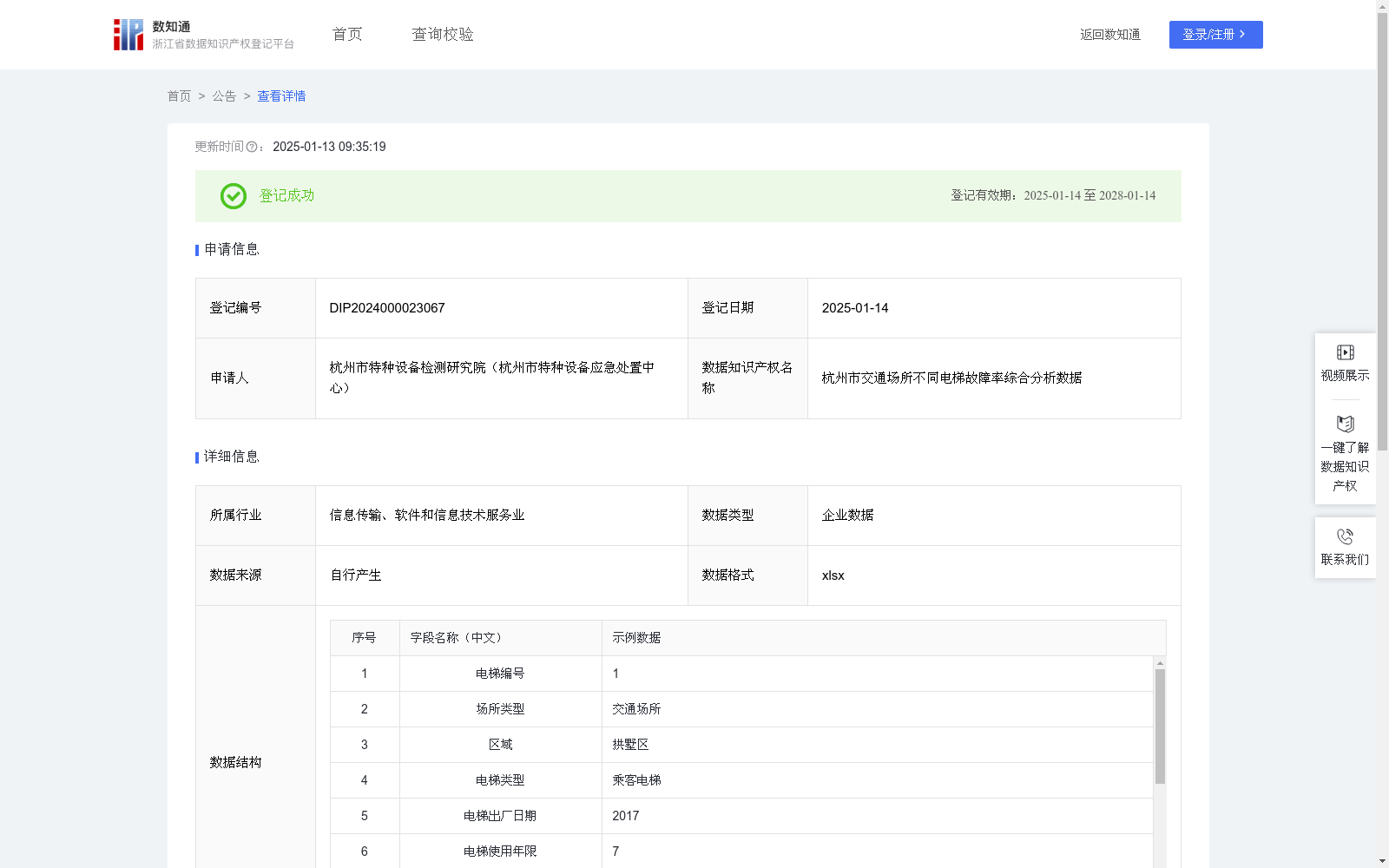
杭州市交通场所不同电梯故障率综合分析数据
收藏浙江省数据知识产权登记平台2025-01-13 更新2025-01-14 收录
下载链接:
https://www.zjip.org.cn/home/announce/trends/110928
下载链接
链接失效反馈官方服务:
资源简介:
采集和统计杭州市交通场所电梯出现故障的情况,分析不同类型的电梯故障率。不同类型的电梯维保重点各不相同,本数据可应用于帮助各维保单位优化安全管理作业人员配置;加强监管,提高日常维护频率,精准加强维保内容,减少电梯安全隐患,协助政府对民生基础设施这一重要组成部分进行统筹。不同场所下电梯的种类数量各不相同,其维保重点具有差异,因此数据以不同场所分类。1、数据采集:通过电梯物联网设备和接警平台,采集杭州市交通场所电梯发生故障的情况。 2、数据处理:对采集到的原始数据进行清洗、分析、整理等方式,获取所需要的数据:电梯类型,出厂日期,使用年限,故障数量,故障名称。3.系统通过IF函数以及SUM公式进行数据计算,IF(杭州市,交通场所),满足则对机器进行编号录入,出现1次故障则数量记1,累加计算,未出现故障则记0。杭州市交通场所电梯故障总数量=∑交通场所全部序号电梯故障数量(∑为求和公式符号,非字段代称),杭州市交通场所某类型电梯故障率=杭州市交通场所某类型电梯故障数量/ 杭州市交通场所电梯故障总数量。4、数据分析:通过Finereport等软件将故障发生情况制作成可视化图表,直观反应各类型电梯的故障率,0≤故障率≤5%记为“关注维持”,5%<故障率≤100%记为“关注预警”。对“关注维持”的电梯种类继续沿用既往监管模式,对“关注预警”的电梯类型相关负责人进行示警通知,督促维保单位加强监管。(不同场所下电梯的种类数量各不相同,其维保重点具有差异,因此数据以不同场所分类:例如住宅区多客梯,商场常用扶梯等;统计日期为数据包提取进行算法应用的时间,整体时间跨度为第一台电梯投入使用至今,单纯以“某一年”进行限定与数据情况不符,因此字段名称不出现具体年份集合的限定;数据包每年更新,叠加覆盖计算构建动态大数据模型)
This dataset collects and statistically analyzes elevator fault conditions in transportation venues in Hangzhou, and calculates the failure rates of different types of elevators. Maintenance priorities vary across different elevator types. This dataset can help maintenance units optimize the allocation of safety management personnel, strengthen supervision, increase daily maintenance frequency, precisely enhance maintenance content, reduce elevator safety hazards, and assist the government in overall planning for this important component of people's livelihood infrastructure. The types and quantities of elevators differ across various venues, and their maintenance priorities are distinct, so the data is classified by venue.
1. Data Collection: Collect fault occurrence data of elevators in Hangzhou's transportation venues via elevator IoT devices and alarm receiving platforms.
2. Data Processing: Clean, analyze, organize and process the collected raw data to obtain required datasets including elevator type, manufacturing date, service life, number of faults, and fault name.
3. Data Calculation: The system performs data calculation using the IF function and SUM formula. The condition `IF(Hangzhou, Transportation Venue)` is applied: if the condition is satisfied, the machine is numbered and recorded; each fault occurrence is counted as 1 for cumulative calculation, and 0 is recorded if no fault occurs. The total number of elevator faults in Hangzhou's transportation venues = ∑ (number of faults of all numbered elevators in transportation venues, where ∑ refers to the summation formula symbol rather than a field alias). The failure rate of a specific type of elevator in Hangzhou's transportation venues = (number of faults of that type of elevator in Hangzhou's transportation venues) / (total number of elevator faults in Hangzhou's transportation venues).
4. Data Analysis: Use software such as Finereport to generate visualized charts of fault occurrences, which intuitively reflect the failure rates of various elevator types. The interval 0 ≤ failure rate ≤ 5% is categorized as "Monitor and Maintain", while 5% < failure rate ≤ 100% is categorized as "Monitor and Alert". For elevator types labeled "Monitor and Maintain", the existing supervision mode will be retained; for relevant persons in charge of elevator types labeled "Monitor and Alert", warning notifications will be issued to urge maintenance units to strengthen supervision.
(Note: The types and quantities of elevators vary across different venues, and their maintenance priorities differ, so the data is classified by venue: for example, residential areas have more passenger elevators, while shopping malls commonly use escalators, etc. The statistical date is the time when the data package is extracted for algorithm application, and the overall time span spans from the commissioning of the first elevator to the present. Limiting the data to a single "certain year" is inconsistent with the actual data scenario, so no specific year range restrictions will be included in the field names. The data package is updated annually, and overlay calculation is adopted to construct a dynamic big data model.)
提供机构:
杭州市特种设备检验科学研究院(杭州市特种设备应急处置中心)
创建时间:
2024-12-13
搜集汇总
数据集介绍
特点
该数据集包含杭州市交通场所电梯的故障率分析数据,涵盖多种电梯类型和故障信息,用于优化维保管理和政府监管。数据规模655条,每年更新,应用场景聚焦于电梯安全维护和故障预防。
以上内容由遇见数据集搜集并总结生成



