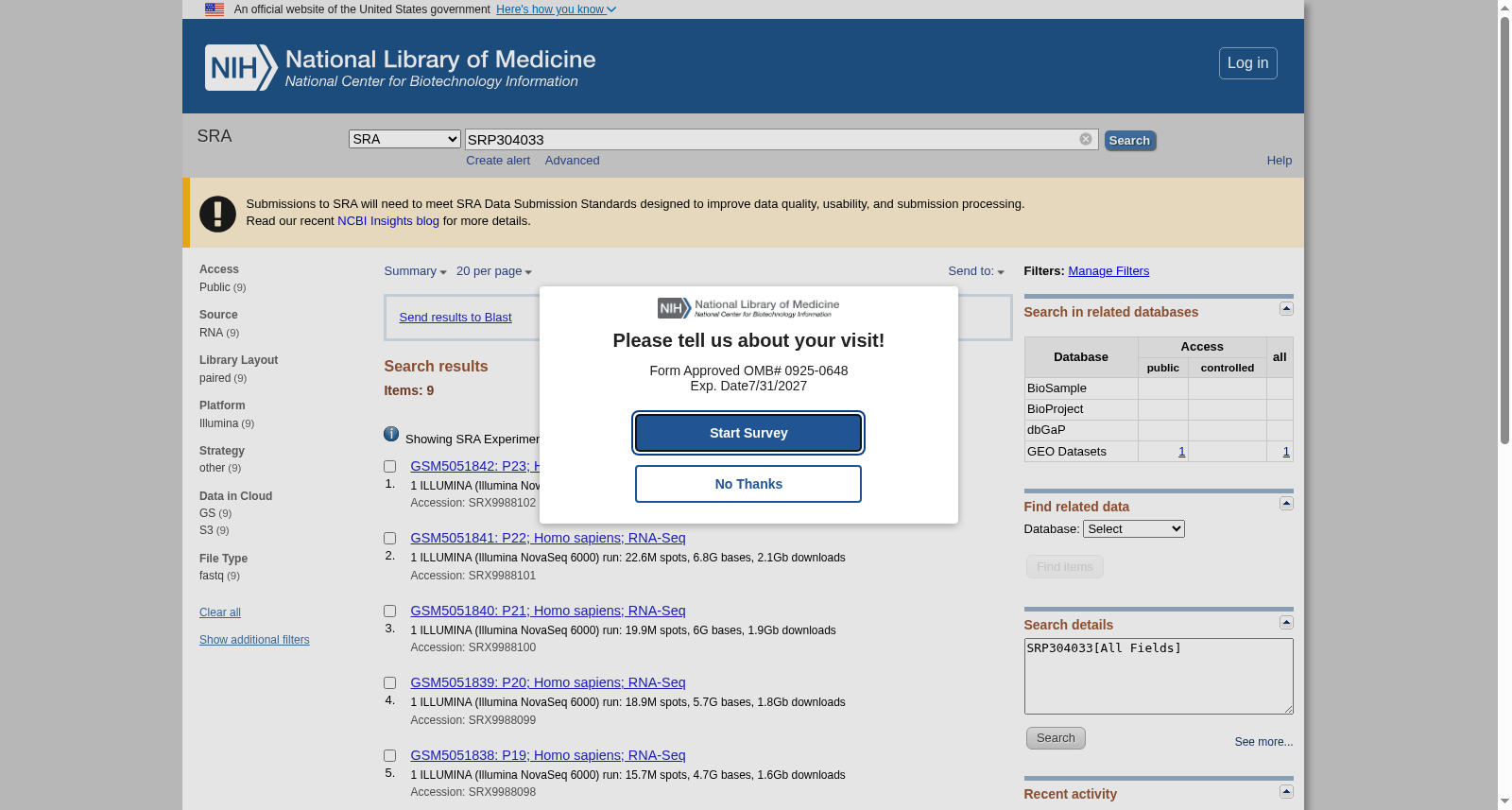
Bulk RNA-seq of aplastic anemia (AA) and healthy donors
收藏资源简介:
Bulk RNA-seq data of Lin-CD34+ hematopoietic stem and progenitor cells derived from bone marrow of healthy donors and untreated aplastic anemia patients Overall design: Mononuclear cells from 3 healthy donors and untreated aplastic anemia patients' bone marrow aspirates were isolated using Ficoll density gradient separation and cryopreserved in 90% FBS/ 10% DMSO for storage in liquid nitrogen. The thawing frozen cells were stained with human antibodies including lineage cocktail (CD3, CD14, CD16, CD19, CD20, CD56) (BV510, Biolegend) and CD34 (APC, Clone 581, BD Biosciences) antibodies. Lin-CD34+ HSPCs (cell count ranges from 130 to 2000) were sorted directly into cell lysis buffer on a BD FACSAria III. The reverse transcription and template switch steps were performed following the full-length Smart-seq2 protocol with some modifications. Concentration of oligd(T30VN) and template switch oligo (TSO) primers used for mRNA reverse transcription were double. The cDNA was fragmented using Covaris S220 instead of Tn5 transposase. The processes of end repair, polyA-tailing, adaptor ligation and library amplification were using KAPA Hyper Prep Kits (Kapa Biosystems, Cat# KK8504) and NEBNext Multiplex Oligos for Illumina (Index Primers Set 1) (NEB, Cat# E7335L).The 150bp paired-end reads were generated from Illumina NovaSeq6000 platform. For data processing, TSO primer, polyA tail, adaptor, and low-quality sequence (N > 10%) were trimmed using Trimmomatic (version 0.36). Clean reads were aligned against the human GRCh38 genome using STAR (version 2.7)). Duplicate reads were identified and removed by using Picard(version 2.17.6). MATS(version 4.0.2) and DaPars(version 0.9.0) to perform alternative splicing and alternative polyadenylation analysis, respectively. Gene quantification was using HTSeq (version 0.9.1).
本数据集为健康供者与未治疗型再生障碍性贫血患者骨髓来源的Lin-CD34+造血干祖细胞(hematopoietic stem and progenitor cells,HSPCs)的批量RNA测序(bulk RNA-seq)数据。 整体实验设计:从3名健康供者及未治疗型再生障碍性贫血患者的骨髓穿刺液中分离单个核细胞,采用Ficoll密度梯度离心法进行分离,随后以90%胎牛血清(FBS)+10%二甲基亚砜(DMSO)重悬并冻存于液氮中。复苏冻存细胞后,使用人源抗体进行染色,包括谱系标记鸡尾酒(lineage cocktail)(CD3、CD14、CD16、CD19、CD20、CD56)抗体(BV510标记,购自Biolegend)以及CD34抗体(APC标记,克隆号581,购自BD Biosciences)。随后在BD FACSAria III流式细胞仪上直接将Lin-CD34+ HSPCs(细胞数量范围为130~2000个)分选至细胞裂解液中。 按照改良的全长Smart-seq2实验流程开展反转录与模板跳转步骤:将用于mRNA反转录的oligod(T30VN)与模板跳转寡核苷酸(template switch oligo,TSO)引物浓度加倍。采用Covaris S220超声破碎仪进行cDNA片段化,替代传统的Tn5转座酶法。后续的末端修复、polyA加尾、接头连接及文库扩增步骤均使用KAPA Hyper Prep试剂盒(Kapa Biosystems,货号KK8504)以及适配Illumina测序平台的NEBNext多重寡核苷酸(索引引物套装1)(NEB,货号E7335L)完成。最终在Illumina NovaSeq6000测序平台上生成150bp双端测序读段。 测序数据预处理阶段,使用Trimmomatic(版本0.36)去除TSO引物序列、polyA尾、接头序列以及低质量序列(N碱基占比>10%)。将过滤后的clean reads比对至人类GRCh38参考基因组,比对工具为STAR(版本2.7)。使用Picard(版本2.17.6)识别并移除重复读段。分别采用MATS(版本4.0.2)与DaPars(版本0.9.0)进行可变剪接与可变多聚腺苷酸化分析。基因定量分析使用HTSeq(版本0.9.1)完成。