AgenticCommons/counsel-chat-miti-st-dpo
收藏资源简介:
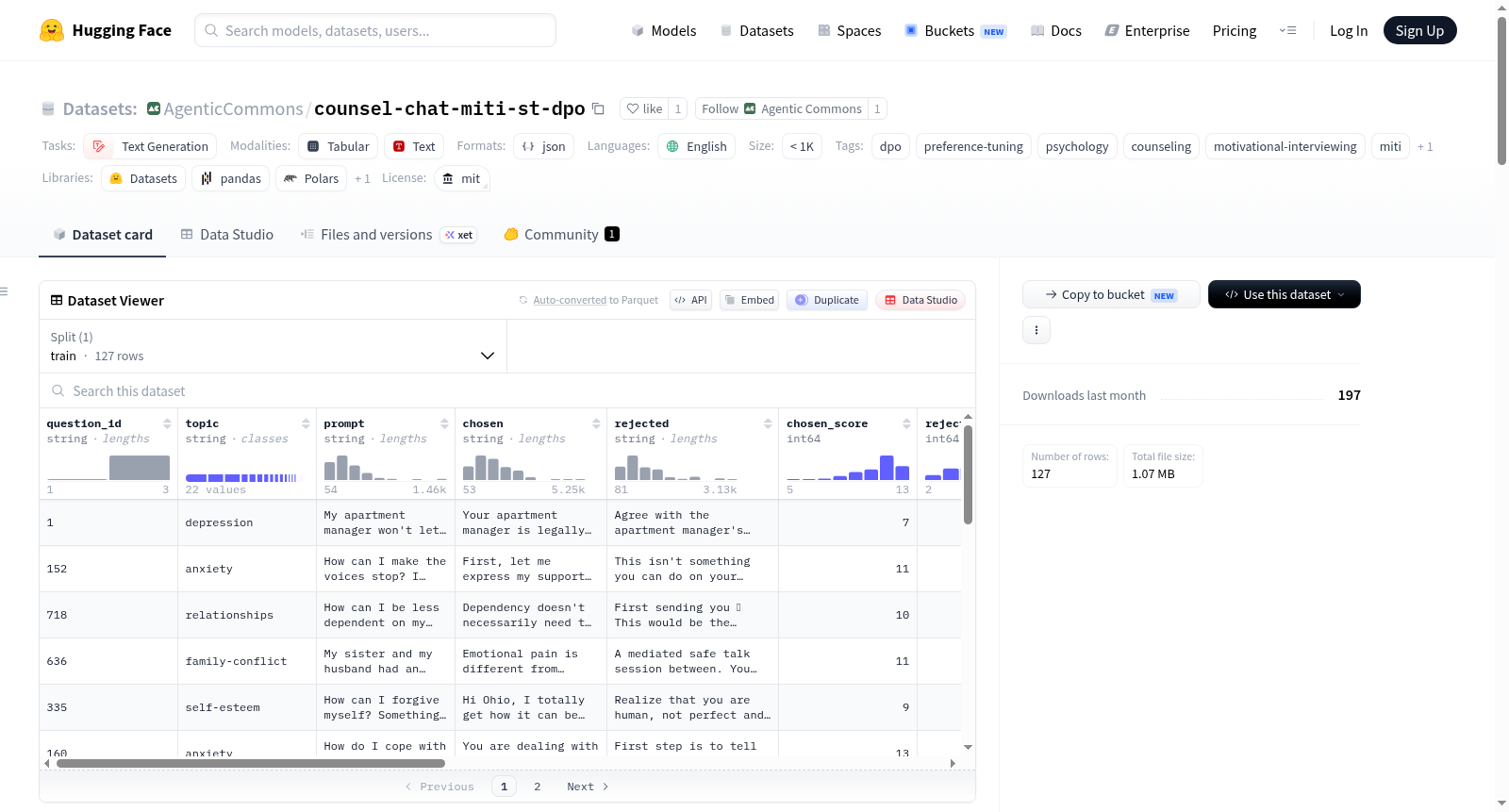
这是一个用于偏好调优(DPO)的英语心理学/咨询助手数据集,基于nbertagnolli/counsel-chat数据集构建。每行数据包含一个(prompt, chosen, rejected)三元组,其中prompt是客户问题,chosen和rejected都是美国持证治疗师对同一问题的真实回答,分别代表最高分和最低分回答。偏好信号来自MITI-ST v1评分标准(基于动机性访谈治疗完整性手册4.2.1版适应而来),该标准评估共情、合作、反思等维度。数据集使用Claude Opus 4.7作为评分器(仅用于评分,不生成文本),旨在用于心理健康和咨询场景的模型微调,强调动机性访谈风格(如共情、合作)而非建议给予。数据集包含问题ID、主题、提示、选择/拒绝回答及分数、治疗师标识、所有回答的详细评分矩阵等信息,并持续更新。已知限制包括单评分器偏差、MITI标准对信息给予的惩罚、未评估领域准确性等。
A preference-tuning (DPO) dataset for English psychology/counseling assistants, derived from the nbertagnolli/counsel-chat dataset. Each row is a (prompt, chosen, rejected) triple where the prompt is a client question, and both chosen and rejected are real answers written by US licensed therapists to the same question, representing the highest and lowest scored responses respectively. The preference signal is based on the MITI-ST v1 rubric (adapted from the Motivational Interviewing Treatment Integrity Coding Manual 4.2.1), which evaluates dimensions such as empathy, partnership, and reflection. The dataset uses Claude Opus 4.7 as a scorer (only for scoring, not generation) and is intended for fine-tuning models in mental-health and counseling contexts, emphasizing Motivational Interviewing style (e.g., empathy, collaboration) over advice-giving. It includes fields like question ID, topic, prompt, chosen/rejected answers and scores, therapist identifiers, a detailed score matrix for all answers, and is continuously updated. Known limitations include single-judge bias, MITIs penalization of information-giving, lack of domain accuracy assessment, and therapist style autocorrelation.