AIRI-Institute/genatator-gene-finding-dataset
收藏资源简介:
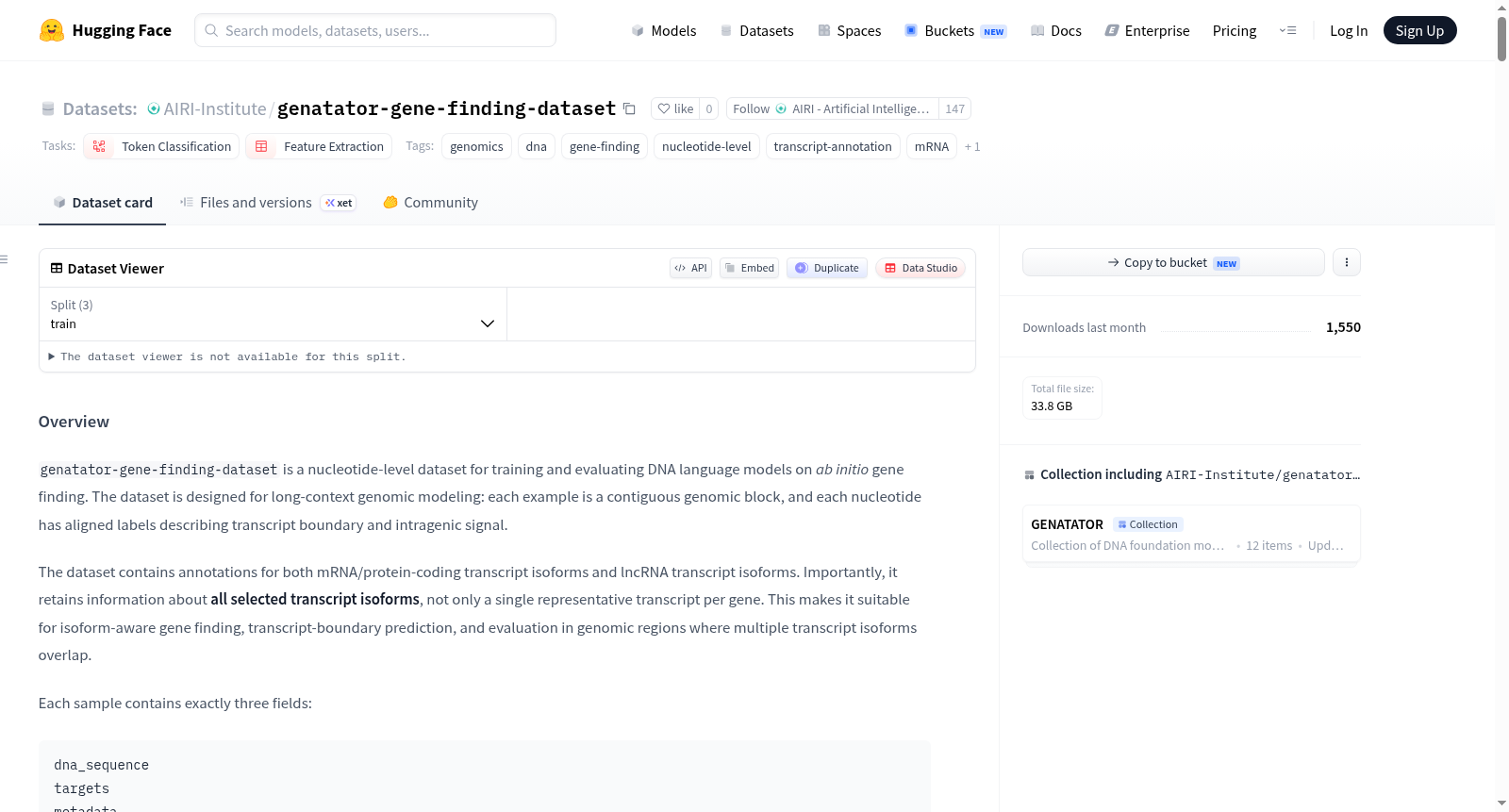
genatator-gene-finding-dataset是一个核苷酸级别的数据集,用于训练和评估DNA语言模型进行从头基因发现。该数据集专为长上下文基因组建模设计:每个样本是一个连续的基因组块,每个核苷酸都有对齐的标签,描述转录本边界和基因内信号。数据集包含mRNA/蛋白质编码转录本异构体和lncRNA转录本异构体的注释,并保留了所有选定转录本异构体的信息,而不仅仅是每个基因的单个代表性转录本。这使得它适用于异构体感知的基因发现、转录本边界预测以及在多个转录本异构体重叠的基因组区域中的评估。每个样本包含三个字段:dna_sequence(DNA序列)、targets(目标矩阵)和metadata(元数据)。数据集分为训练集、验证集和测试集:训练集包含多物种训练数据(人类训练染色体和其他哺乳动物基因组),验证集包含人类保留验证染色体,测试集包含完整的T2T人类基因组测试分割。每个样本是一个基因组块,最大长度为10,000,000个核苷酸,目标矩阵包含12个核苷酸级别通道,前6个通道用于所有选定转录本异构体,后6个通道仅用于mRNA/蛋白质编码异构体。数据集还提供了详细的统计信息、多物种覆盖范围(包括39个哺乳动物组装)以及加载和使用示例。
genatator-gene-finding-dataset is a nucleotide-level dataset for training and evaluating DNA language models on ab initio gene finding. The dataset is designed for long-context genomic modeling: each example is a contiguous genomic block, and each nucleotide has aligned labels describing transcript boundary and intragenic signal. The dataset contains annotations for both mRNA/protein-coding transcript isoforms and lncRNA transcript isoforms. Importantly, it retains information about all selected transcript isoforms, not only a single representative transcript per gene. This makes it suitable for isoform-aware gene finding, transcript-boundary prediction, and evaluation in genomic regions where multiple transcript isoforms overlap. Each sample contains exactly three fields: dna_sequence, targets, and metadata. The dataset is organized into three splits: train (multispecies training data including human training chromosomes and additional mammalian genomes), validation (human held-out validation chromosomes), and test (complete T2T human genome test split). Each sample is a genomic block with a maximum length of 10,000,000 nucleotides. The target matrix includes 12 nucleotide-level channels: the first six channels are for all selected transcript isoforms (combined mRNA/protein-coding and lncRNA), and the last six channels are for mRNA/protein-coding isoforms only. The dataset also provides detailed statistics, multispecies coverage (including 39 mammalian assemblies), and examples for loading and usage.