
纺织成果转化库内常见缺陷检测数据
收藏浙江省数据知识产权登记平台2024-10-12 更新2024-10-14 收录
下载链接:
https://www.zjip.org.cn/home/announce/trends/70474
下载链接
链接失效反馈官方服务:
资源简介:
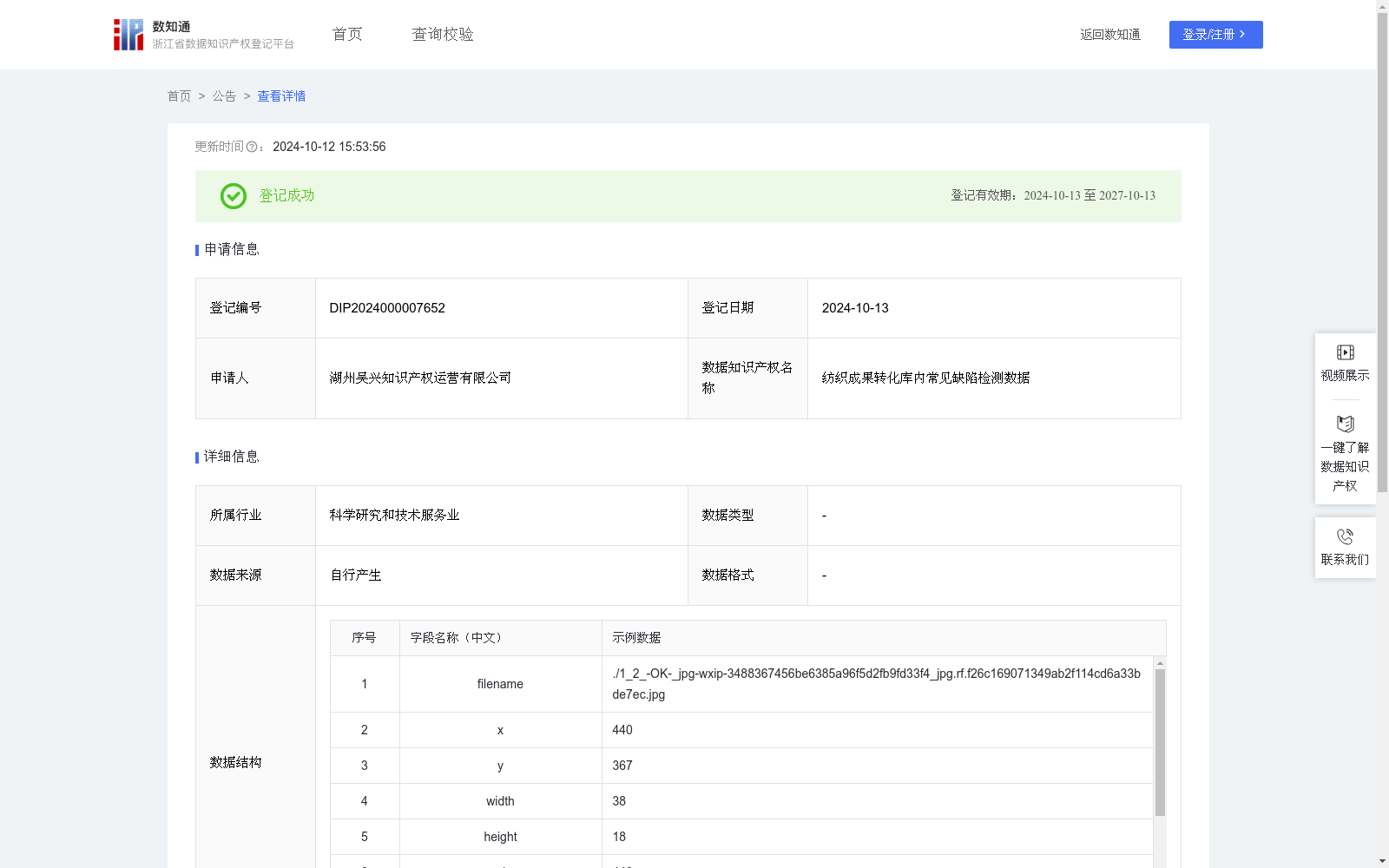
数据包括不同类型的织物(如棉、麻、丝绸、合成纤维等)、不同生产阶段(如织造、染色、后整理等)和不同光照条件和织物颜色下的图像,可用于纺织品质量控制和自动化检测相关的目标检测模型训练。训练好的模型可以集成到纺织品的自动化生产线中,实现实时、高效的缺陷检测。这不仅可以减少人工检测的成本和错误率,还可以提高生产线的运行效率和灵活性。数据采集与标注阶段使用由AI模型生成的多类纺织品缺陷图像。图像预处理考虑纺织品缺陷检测特性,采用亮度调整-对比度调整-随机旋转-随机裁剪-随机水平和垂直翻转对图像进行增强。为增强模型对纺织品纹理的感知能力,在图像增强后引入纹理增强模块(TEM)。该模块首先对原始图像应用高斯滤波,然后将滤波后的图像与原图像进行比较,得到纹理差异。最后,将这个纹理差异与原图像进行融合,融合程度由增强系数(本例中为0.3)控制。从而突出纺织品的纹理特征,有助于模型更好地区分缺陷和正常纹理。采用COCO格式包围框(x, y, width, height)进行精确定位,并进行多类别目标检测标注,使用COCO标注过程采用LabelImg工具。 将COCO格式转换为CSV格式: x1 = x, y1 = y, x2 = x + width, y2 = y + height, cls ∈ {"defect1", "defect2", "defect3", "defect4"},分别对应"划破", "划痕", "划洞", "开线"。 filenam为图像,x1,y1,x2,y2是坐标,cls为类别。
The dataset comprises images collected under various conditions: different textile fabric types (e.g., cotton, flax, silk, synthetic fibers, etc.), different production stages (e.g., weaving, dyeing, finishing, etc.), varying lighting conditions, and different fabric colors. It can be used for training object detection models related to textile quality control and automated inspection. Trained models can be integrated into automated textile production lines to enable real-time and efficient defect detection. This not only reduces labor costs and error rates of manual inspection but also improves the operational efficiency and flexibility of production lines. During the data collection and annotation stage, multi-class textile defect images generated by AI models are utilized. Considering the characteristics of textile defect detection, image preprocessing adopts a series of augmentation operations including brightness adjustment, contrast adjustment, random rotation, random cropping, and random horizontal and vertical flipping to enhance the images. To enhance the model's perception of textile textures, a Texture Enhancement Module (TEM) is introduced after image augmentation. This module first applies Gaussian filtering to the original image, then compares the filtered image with the original one to obtain texture differences. Finally, the texture differences are fused with the original image, with the fusion degree controlled by an enhancement coefficient (set to 0.3 in this case). This process highlights the texture features of textiles, helping the model better distinguish defects from normal textures. Precise positioning is conducted using COCO-format bounding boxes (x, y, width, height), and multi-class object detection annotation is performed. The COCO-style annotation process is implemented with the LabelImg tool. COCO format is converted to CSV format as follows: x1 = x, y1 = y, x2 = x + width, y2 = y + height, where cls ∈ {"defect1", "defect2", "defect3", "defect4"}, corresponding to "tear", "scratch", "hole", and "unraveled seam" respectively. The CSV file contains filename, x1, y1, x2, y2, and cls (category).
提供机构:
湖州吴兴知识产权运营有限公司
创建时间:
2024-09-03
搜集汇总
数据集介绍
特点
该数据集包含4765条纺织品缺陷检测数据,涵盖四种常见缺陷类型,适用于纺织品质量控制和自动化检测模型的训练。数据经过图像增强和纹理增强处理,标注格式为COCO转CSV,旨在提高生产线缺陷检测的效率和准确性。
以上内容由遇见数据集搜集并总结生成



