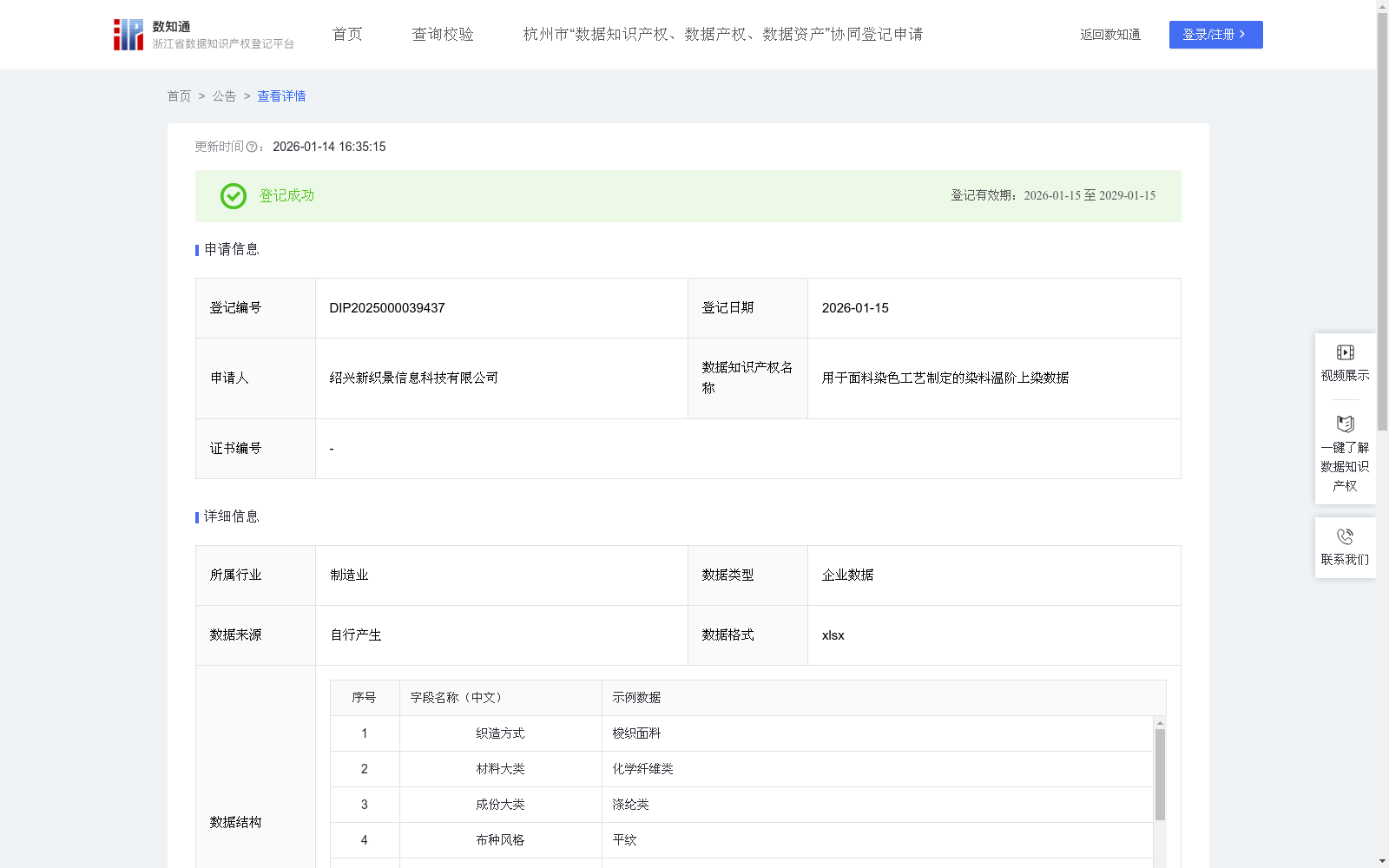
用于面料染色工艺制定的染料温阶上染数据
收藏资源简介:
纺织面料的染料温阶试验数据是纺织印染行业中染料选型、染色工艺参数优化的核心依据,直接决定面料染色后的匀染性及生产稳定性。 通过对不同面料、不同染料在不同梯度温度下的打样实验,获得染色上染结果数据,可用于如下多场景: (1)当前应用场景:为印染企业优化各种颜色在不同面料下合理的染料组合,设定预优化染料组合的敏感染色温度区间工艺,防止因该敏感温度下的升温速率不当导致的色花、色牢度不达标问题。 (2)预期应用场景:帮助外部染料供应商验证产品在不同面料材质上的适用性,优化染料配方;还可以进一步为行业制定染色工艺标准提供实证数据,降低试产成本。数据采集:按试验批次维护基础信息(坯布大类、染料型号、染料浓度)、采集温阶参数(起始温度、梯度间隔、最高温度),确保每组数据与 “面料 - 染料 - 温度” 组合唯一对应。 数据应用: 计算不同染料在同一面料上的 “温阶适应性指数Vm”,用于量化单一染料在指定面料上的温度适应范围。Vm字段无量纲,数值越高代表染料在目标面料上从低温到高温的适配性越强,染色工艺温度调整空间越广,为染料选型提供量化依据。具体公式如下: 温阶适应性指数Vm = (Te-50)/V。式中: Te = f₃(Ks, T) —— 有效上染临界温度,单位:℃,指上染率达到稳定值90%时对应的最低温度。 V = f₄(Ks, T) —— 上染率温度敏感性系数,无单位,通过线性拟合Ks-T曲线的斜率绝对值得出,系数越大表示上染率随温度变化越剧烈。 其中: T:染色温度,取值区间60~130℃,按10℃间隔选取检测点,如60℃、70℃...130℃。 Ks:对应各温度点T的染料上染率,单位:%。对应表格中数据字段:60°KS值、70°KS值、80°KS值、90°KS值、100°KS值、110°KS值、120°KS值、130°KS值。 常数“50”:为基准参考温度(单位:℃,适配多数面料染色的最低安全温度区间,可根据面料类型微调)。 上传数据中,根据坯布大类、染料编码、染料浓度(%)确定一条数据,代表这个坯布大类使用某种染料在某个浓度时的染料温阶上染数据。工程应用时,可以根据面料的实际染料对应所属浓度区间来应用。
Dye temperature-gradient test data of textile fabrics serves as a core basis for dye selection and optimization of dyeing process parameters in the textile printing and dyeing industry, and directly dictates the level dyeing uniformity and production stability of dyed fabrics. Through proofing tests of different fabrics and dyes under gradient temperature conditions, dye uptake result data can be obtained, which can be applied in multiple scenarios as follows: (1) Current application scenarios: For printing and dyeing enterprises to optimize reasonable dye combinations for various colors on different fabrics, and set the sensitive dyeing temperature range process for pre-optimized dye combinations, so as to avoid issues such as color streaks and non-compliant color fastness caused by improper heating rates within this sensitive temperature range. (2) Expected application scenarios: Assist external dye suppliers in verifying the applicability of their products on different fabric materials and optimizing dye formulas; further provide empirical data for the industry to formulate dyeing process standards, thereby reducing trial production costs. Data Collection: Basic information (grey fabric category, dye model, dye concentration) shall be maintained per test batch, and temperature-gradient parameters (starting temperature, gradient interval, maximum temperature) shall be collected, ensuring that each dataset uniquely corresponds to the "fabric - dye - temperature" combination. Data Application: Calculate the "temperature-gradient adaptability index Vm" for different dyes on the same fabric, which is used to quantify the temperature adaptation range of a single dye on a specified fabric. The Vm field is dimensionless; a higher value indicates stronger adaptability of the dye across the low-to-high temperature range on the target fabric, and a wider adjustment margin for dyeing process temperatures, providing a quantitative basis for dye selection. The specific formula is as follows: Temperature-gradient adaptability index Vm = (Te - 50)/V. Where: Te = f₃(Ks, T) —— Effective dyeing critical temperature, unit: ℃, referring to the lowest temperature at which the dye uptake rate reaches 90% of its stable value. V = f₄(Ks, T) —— Temperature sensitivity coefficient of dye uptake rate, dimensionless, derived from the absolute value of the slope of the linearly fitted Ks-T curve. A larger coefficient signifies more drastic changes in dye uptake rate with varying temperature. Wherein: T: Dyeing temperature, ranging from 60℃ to 130℃, with detection points selected at 10℃ intervals, e.g., 60℃, 70℃, ..., 130℃. Ks: Dye uptake rate corresponding to each temperature point T, unit: %. Corresponding data fields in the table: 60°KS value, 70°KS value, 80°KS value, 90°KS value, 100°KS value, 110°KS value, 120°KS value, 130°KS value. The constant "50": Reference benchmark temperature (unit: ℃, adapted to the minimum safe temperature range for most fabric dyeing, and can be fine-tuned based on fabric type). In the uploaded dataset, one data record is determined by the grey fabric category, dye code and dye concentration (%), representing the dye temperature-gradient dye uptake data of a specific dye at a given concentration used for this grey fabric category. In engineering applications, the dataset can be applied according to the actual concentration range corresponding to the dye used on the fabric.