
Physical properties of sea ice cores from site BGC1 measured on legs 1 to 3 of the MOSAiC expedition
收藏Mendeley Data2023-05-26 更新2024-06-30 收录
下载链接:
https://doi.pangaea.de/10.1594/PANGAEA.943768
下载链接
链接失效反馈官方服务:
资源简介:
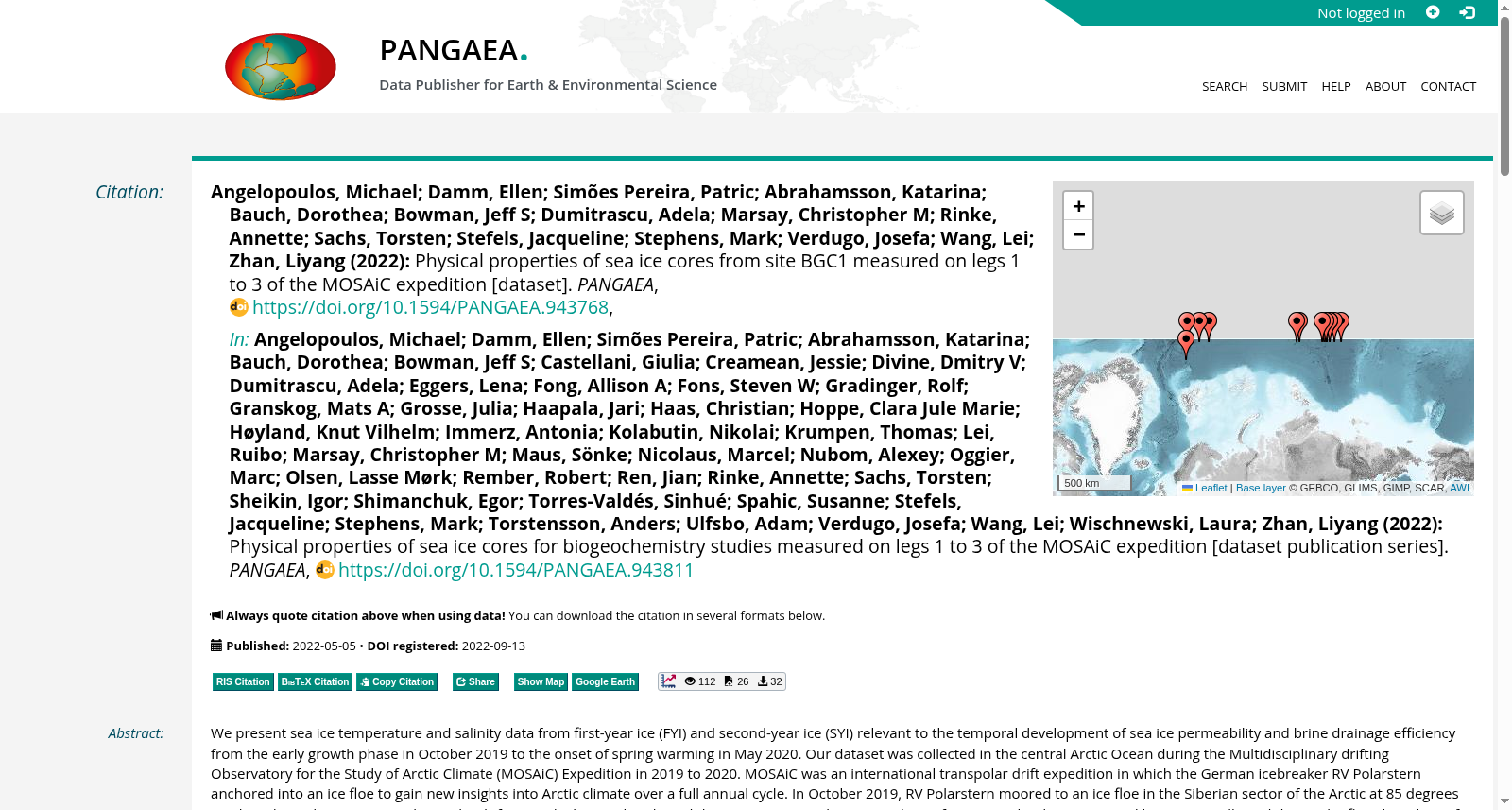
We present sea ice temperature and salinity data from first-year ice (FYI) and second-year ice (SYI) relevant to the temporal development of sea ice permeability and brine drainage efficiency from the early growth phase in October 2019 to the onset of spring warming in May 2020. Our dataset was collected in the central Arctic Ocean during the Multidisciplinary drifting Observatory for the Study of Arctic Climate (MOSAiC) Expedition in 2019 to 2020. MOSAiC was an international transpolar drift expedition in which the German icebreaker RV Polarstern anchored into an ice floe to gain new insights into Arctic climate over a full annual cycle. In October 2019, RV Polarstern moored to an ice floe in the Siberian sector of the Arctic at 85 degrees north and 137 degrees east to begin the drift towards the North Pole and the Fram Strait via the Transpolar Drift Stream. The data presented here were collected during the first three legs of the expedition, so all the coring activities took place on the same floe. The end dates of legs 1, 2, and 3 were 13 December, 24 February, and 4 June, respectively. The dataset contributed to a baseline study entitled, Deciphering the properties of different Arctic ice types during the growth phase of the MOSAiC floes: Implications for future studies. The study highlights downward directed gas pathways in FYI and SYI by inferring sea ice permeability and potential brine release from several time series of temperature and salinity measurements. The physical properties presented in this paper lay the foundation for subsequent analyses on actual gas contents measured in the ice cores, as well as air-ice and ice-ocean gas fluxes. Sea ice cores were collected with a Kovacs Mark II 9 cm diameter corer. To measure ice temperatures, about 4.5 cm deep holes were drilled into the core (intervals varied by site and leg) . The temperatures were measured by a digital thermometer within minutes after the cores were retrieved. The ice cores were placed into pre-labelled plastic sleeves sealed at the bottom end. The ice cores were transported to RV Polarstern and stored in a -20 degrees Celsius freezer. Each of the cores was sub-sampled, melted at room temperature, and processed for salinity within one or two days. The practical salinity was estimated by measuring the electrical conductivity and temperature of the melted samples using a WTW Cond 3151 salinometer equipped with a Tetra-Con 325 four-electrode conductivity cell. The practical salinity represents the the salinity estimated from the electrical conductivity of the solution. The dataset also contains derived variables, including sea ice density, brine volume fraction, and the Rayleigh number.
本研究发布了取自一年海冰(first-year ice, FYI)与二年海冰(second-year ice, SYI)的海冰温度与盐度数据,相关研究覆盖2019年10月海冰早期生长阶段至2020年5月春季升温启动期间,海冰渗透率与卤水排泄效率的时间演化过程。本数据集采集于2019至2020年的北极气候多学科漂流观测站(Multidisciplinary drifting Observatory for the Study of Arctic Climate, MOSAiC)科考期间,采样地点位于北冰洋中部。MOSAiC是一项国际跨极漂流科考项目,德国破冰船RV Polarstern锚定在一块浮冰上,以期全面解析北极气候一整个年度循环的变化规律。2019年10月,RV Polarstern在北极西伯利亚海域北纬85度、东经137度处锚定一块浮冰,随后借助跨极漂流洋流,向着北极点与弗拉姆海峡开展漂流科考。本次发布的数据采集自科考任务的前三个航段,所有取芯作业均在同一块浮冰上完成。第1、2、3航段的结束日期分别为2019年12月13日、2020年2月24日与2020年6月4日。本数据集支撑了一项题为《解析MOSAiC浮冰生长阶段不同北极海冰类型的特性:对后续研究的启示》的基准研究。该研究通过多组温度与盐度实测时间序列反演海冰渗透率与潜在卤水释放量,揭示了一年海冰与二年海冰中存在向下延伸的气体通道。本文发布的物理特性数据,为后续开展海冰岩芯实测气体含量、气-冰与冰-海气体通量相关分析奠定了基础。海冰岩芯采用直径9厘米的Kovacs Mark II型取芯器采集。为测量冰温,研究人员在岩芯上钻取约4.5厘米深的钻孔(钻孔间距随采样地点与航段不同有所变化)。岩芯取回后数分钟内,研究人员使用数字温度计完成温度测量。采集后的海冰岩芯被装入预先标注好的底端密封塑料套管中。随后海冰岩芯被运送至RV Polarstern号科考船,储存在-20℃的低温冰柜中。每根岩芯均被分样,在室温下融化,并在1至2天内完成盐度检测流程。实用盐度通过测量融化样品的电导率与温度计算得到,所用仪器为搭载Tetra-Con 325型四电极电导池的WTW Cond 3151型盐度计。实用盐度指通过溶液电导率估算得到的盐度值。本数据集同时包含衍生变量,涵盖海冰密度、卤水体积分数与瑞利数(Rayleigh number)。
创建时间:
2023-05-26
搜集汇总
数据集介绍
背景与挑战
背景概述
该数据集提供了2019年10月至2020年5月期间,在MOSAiC(北极气候多学科漂流观测站)考察中,于北极中央海域BGC1站点采集的海冰岩心的物理性质数据,重点关注第一年冰和第二年冰的温度与盐度,旨在分析海冰渗透性和卤水排放效率的时间演变。数据集包含原始测量数据(如盐度、温度)以及衍生变量(如海冰密度、卤水体积分数和瑞利数),覆盖了从早期生长阶段到春季变暖开始的时间范围,为研究北极海冰的生物地球化学过程提供了基础物理参数。
以上内容由遇见数据集搜集并总结生成


