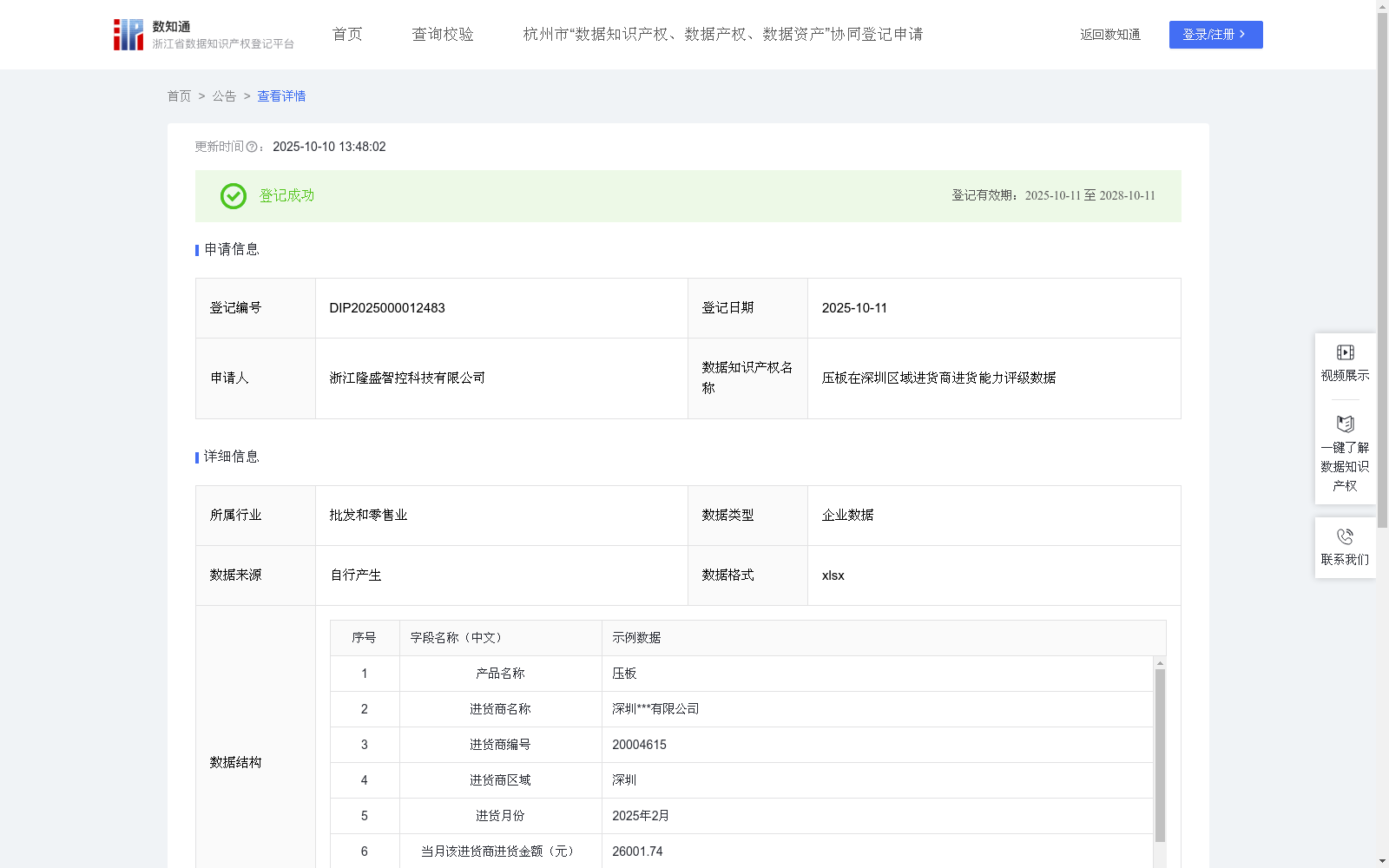
压板在深圳区域进货商进货能力评级数据
收藏资源简介:
压板是压缩机电磁离合器的关键部件之一,其主要作用在于控制压缩机的运转与停止,从而调节制冷系统的制冷量。通过统计分析每个月深圳区域进货商进货压板的金额数据,从而对进货商进行分类级别,为新能源汽车零部件生产企业针对该产品的需求制定方案提供数据支持,例如可加大生产“一级进货商”进货的规格产品产量,保持好“二级进货商”进货的规格产品产量,减少生产“三级进货商”进货的规格产品产量。1、数据采集:采集当月进货商进货压板的金额数据。2、算法规则:当月区域进货商进货总金额为深圳区域本企业销售的金额之和,该进货商的进货占比=当月该进货商进货金额/当月区域进货商进货总金额*100%。3、数据应用:对不同的进货商分类运用分级法,对占比≥10%以上的,给予“一级进货商”分类;对3%<占比<10%区间的,则给予“二级进货商”分类;对0%≤占比≤3%区间,则给予“三级进货商”分类,例如可加大生产“一级进货商”进货的规格产品产量,保持好“二级进货商”进货的规格产品产量,减少生产“三级进货商”进货的规格产品产量。
As one of the key components of compressor electromagnetic clutches, the pressure plate primarily functions to control the operation and shutdown of the compressor, thereby regulating the cooling capacity of the refrigeration system. By statistically analyzing the monthly purchase amount data of pressure plates from distributors in the Shenzhen region, distributors can be classified into different tiers, providing data support for new energy vehicle component manufacturers to formulate production plans for this product. For instance, enterprises can increase the production of products matching the purchase specifications of "Tier 1 distributors", maintain the production volume for "Tier 2 distributors", and reduce production for "Tier 3 distributors". 1. Data Collection: Collect the monthly purchase amount data of pressure plates from each distributor. 2. Algorithm Rules: The total purchase amount of distributors in the Shenzhen region in a given month refers to the sum of the sales amount of this enterprise's pressure plates in the region. The purchase proportion of a distributor is calculated as: (the distributor's monthly purchase amount / the total monthly purchase amount of all distributors in the region) × 100%. 3. Data Application: Classify distributors using the tiering method: Distributors with a purchase proportion ≥10% are categorized as "Tier 1 distributors"; those with a purchase proportion in the interval 3% < proportion < 10% are categorized as "Tier 2 distributors"; and those with a purchase proportion in the interval 0% ≤ proportion ≤ 3% are categorized as "Tier 3 distributors". As previously noted, this classification can support production planning, such as increasing production for products supplied by Tier 1 distributors, maintaining production volumes for Tier 2 distributors, and reducing production for Tier 3 distributors.