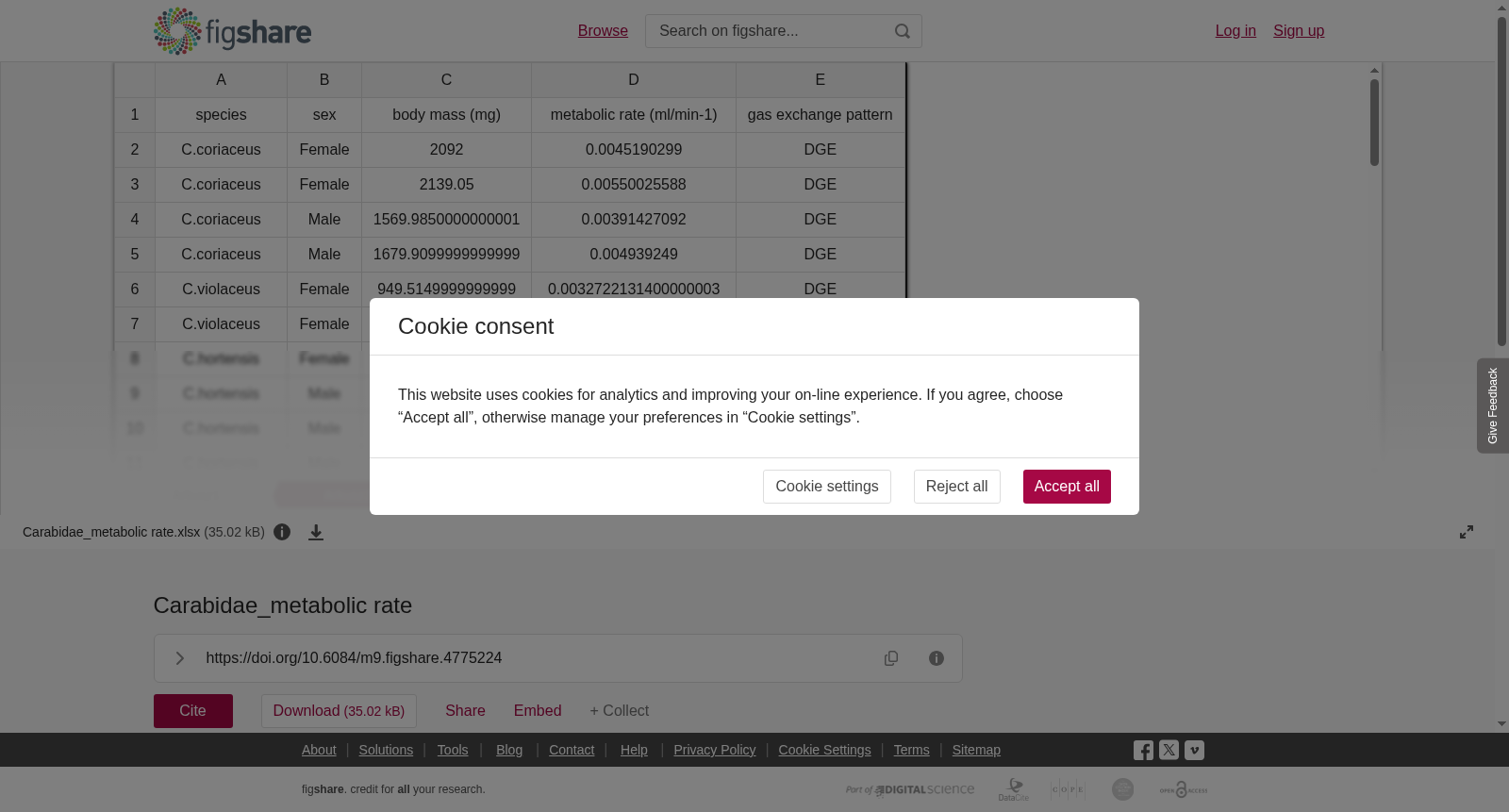
Carabidae_metabolic rate
收藏资源简介:
The origin of the allometric relationship between the standard metabolic rate (MR) and body mass (M), often described as MR=<i>a</i>M<i><sup>b</sup></i>, remains puzzling. Much effort has been directed at determining the mass-scaling exponent, <i>b</i>, however, the conclusions depend on the methodological approach. We investigated the mass scaling of MRs within and between species of Carabidae beetles. We used ordinary least squares (OLS) regression, phylogenetically generalized least squares (PGLS) regression and standardized major axis (SMA) regression to explore the effects of different model-fitting methods and data clustering caused by phylogenetic clades (shift grade) and gas exchange patterns (discontinuous (DGE), cyclic and continuous). At the interspecific level, the relationship between MR and M was either negatively allometric (b<1) or isometric (b=1), depending on the fitting method. At the intraspecific level, the relationship either did not exist or it was isometric or positively allometric (b>1) and it was significantly improved after the analysed dataset was split to gas exchange patterns. The studied species originated from two distinct phylogenetic clades that had different intercepts but a common scaling exponent (OLS, 0.61) that was much shallower than the scaling exponent for the combined dataset for all species (OLS, 0.71). The best scaling exponent estimates were obtained by applying OLS while accounting for grade shifts or applying PGLS. Overall, our findings warn that conclusions about a relationship between MR and M in insects can depend heavily on the model fitting method, the structure of phylogenetic non-independence and ecological factors that elicit different modes of gas exchange.
标准代谢率(standard metabolic rate, MR)与体重(body mass, M)之间的异速生长关系通常可表述为$MR=aM^b$,其起源至今仍是学界未解之谜。此前学界已投入大量精力用于确定该关系的质量缩放指数$b$,但相关结论往往依赖于所采用的研究方法。本研究以步甲科(Carabidae)甲虫的不同物种为对象,探究了其种内与种间的代谢率质量缩放规律。我们分别采用普通最小二乘(ordinary least squares, OLS)回归、系统发育广义最小二乘(phylogenetically generalized least squares, PGLS)回归以及标准化主轴(standardized major axis, SMA)回归,分析不同模型拟合方法、系统发育支系与等级偏移引发的数据聚类,以及气体交换模式(间断式气体交换(discontinuous gas exchange, DGE)、循环式与连续式)对分析结果的影响。在种间水平上,MR与M的关系根据拟合方法的不同,可表现为负异速生长($b<1$)或等速生长($b=1$)。在种内水平上,二者的关系或不存在,或表现为等速生长乃至正异速生长($b>1$);且在将数据集按气体交换模式分组后,分析结果的显著性得到显著提升。本次研究的物种源自两个独立的系统发育支系,二者具有不同的截距,但共享一个统一的缩放指数(OLS法下为0.61),该指数远低于所有物种合并数据集得到的缩放指数(OLS法下为0.71)。通过考虑等级偏移的OLS回归或PGLS回归,可获得最准确的缩放指数估计结果。综上,本研究结果警示:针对昆虫体内MR与M之间关系的研究结论,在很大程度上取决于模型拟合方法、系统发育非独立性结构以及诱发不同气体交换模式的生态因素。