
Dataset of Ballet Jumping Experiment
收藏DataCite Commons2025-03-28 更新2025-04-16 收录
下载链接:
https://tudatalib.ulb.tu-darmstadt.de/handle/tudatalib/4519
下载链接
链接失效反馈官方服务:
资源简介:
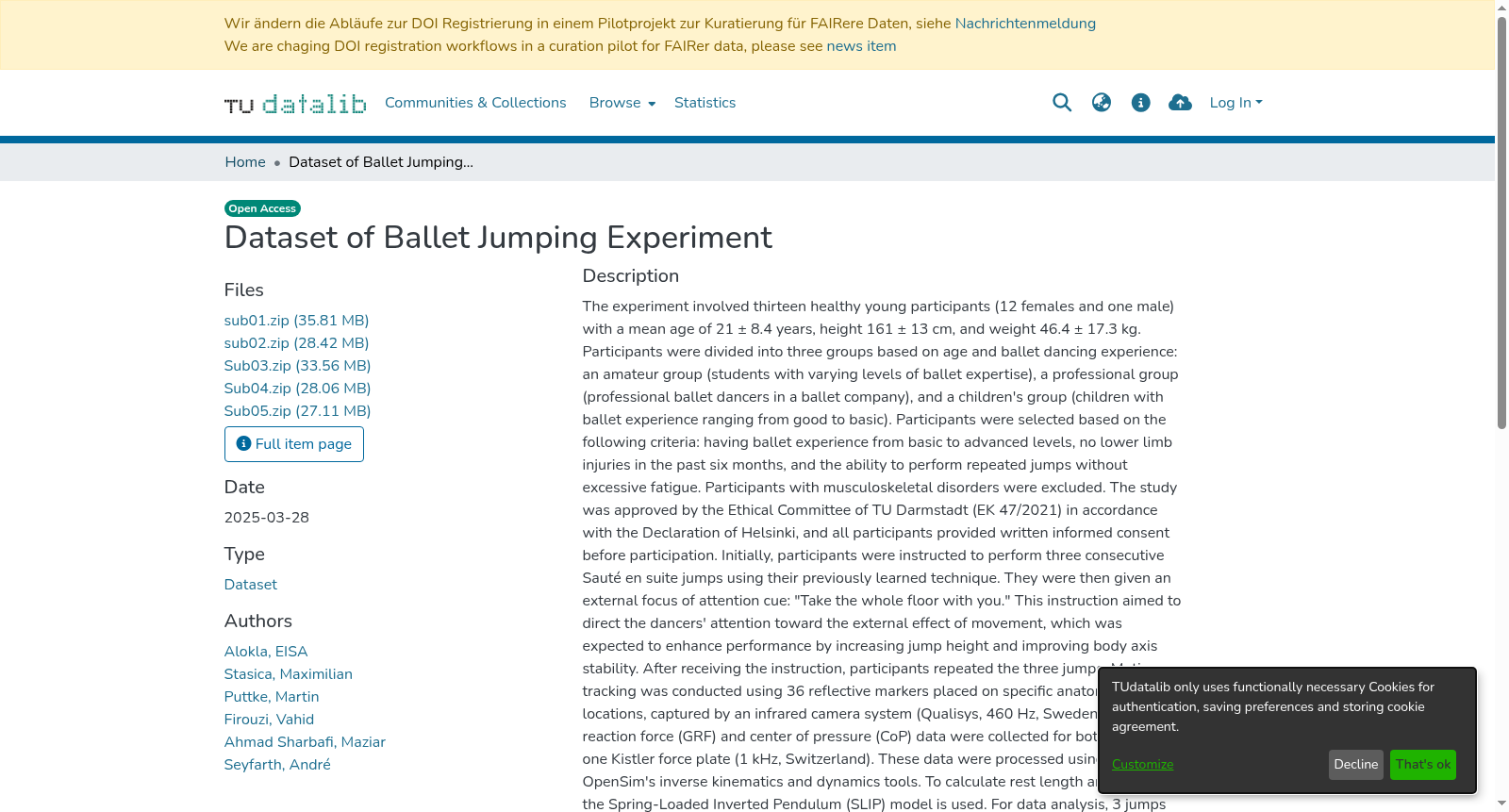
The experiment involved thirteen healthy young participants (12 females and one male) with a mean age of 21 ± 8.4 years, height 161 ± 13 cm, and weight 46.4 ± 17.3 kg. Participants were divided into three groups based on age and ballet dancing experience: an amateur group (students with varying levels of ballet expertise), a professional group (professional ballet dancers in a ballet company), and a children's group (children from a local ballet school with ballet experience ranging from good to basic). Participants were selected based on the following criteria: having ballet experience from basic to advanced levels, no lower limb injuries in the past six months, and the ability to perform repeated jumps without excessive fatigue. Participants with musculoskeletal disorders were excluded. The study was approved by the Ethical Committee of TU Darmstadt (EK 47/2021) in accordance with the Declaration of Helsinki, and all participants provided written informed consent before participation. Initially, participants were instructed to perform three consecutive Sauté en suite jumps using their previously learned technique. They were then given an external focus of attention cue: "Take the whole floor with you." This instruction aimed to direct the dancers' attention toward the external effect of movement, which was expected to enhance performance by increasing jump height and improving body axis stability. After receiving the instruction, participants repeated the three jumps. Motion tracking was conducted using 36 reflective markers placed on specific anatomical locations, captured by an infrared camera system (Qualisys, 460 Hz, Sweden). Ground reaction force (GRF) and center of pressure (CoP) data were collected for both legs using one Kistler force plate (1 kHz, Switzerland). These data were processed using OpenSim's inverse kinematics and dynamics tools. To calculate rest length and stiffness, the Spring-Loaded Inverted Pendulum (SLIP) model is used. For data analysis, 3 jumps were selected per participant.
本实验共招募13名健康青年受试者(12名女性、1名男性),其平均年龄为21±8.4岁,身高161±13 cm,体重46.4±17.3 kg。研究人员按年龄与芭蕾舞舞蹈经验将受试者分为三组:业余组(具备不同层级芭蕾舞专业技能的学生)、职业组(芭蕾舞团在职职业芭蕾舞者)以及儿童组(来自当地芭蕾舞学校、芭蕾经验从良好至基础不等的儿童)。受试者入选标准如下:芭蕾经验覆盖基础至高级水平、过去6个月内无下肢损伤、能够完成重复跳跃且无过度疲劳;同时排除存在肌肉骨骼疾病的受试者。本研究经达姆施塔特工业大学(TU Darmstadt)伦理委员会批准(批准号EK 47/2021),符合《赫尔辛基宣言》相关要求,所有受试者在参与实验前均签署了书面知情同意书。实验初始阶段,要求受试者运用此前习得的技术完成3次连续原地起跳(Sauté en suite)动作;随后为受试者提供外部注意力提示:"以全身接触地面"。该提示旨在引导舞者将注意力聚焦于动作的外部效应,预期通过提升跳跃高度、优化身体轴稳定性来改善运动表现。接收该提示后,受试者重复完成3次跳跃动作。运动追踪阶段,将36个反光标记点安置于特定解剖位置,通过红外相机系统(Qualisys,460 Hz,瑞典)采集相关数据。使用1台采样频率为1 kHz的瑞士产Kistler测力台,采集双侧下肢的地面反作用力(ground reaction force, GRF)与压力中心(center of pressure, CoP)数据。后续数据处理环节,采用OpenSim的逆运动学与动力学工具对采集到的数据进行处理。为计算静息长度与刚度,本研究采用弹簧负载倒立摆(Spring-Loaded Inverted Pendulum, SLIP)模型。数据分析阶段,为每位受试者选取3次跳跃动作作为有效分析样本。
提供机构:
Technical University of Darmstadt
创建时间:
2025-03-28
搜集汇总
数据集介绍
背景与挑战
背景概述
该数据集记录了13名不同芭蕾经验参与者的跳跃实验数据,包括运动轨迹、地面反作用力和压力中心数据,使用SLIP模型计算休息长度和刚度,旨在研究外部注意力提示对跳跃表现的影响。
以上内容由遇见数据集搜集并总结生成



