vlm-psychophysics-classic-t1-t3
收藏资源简介:
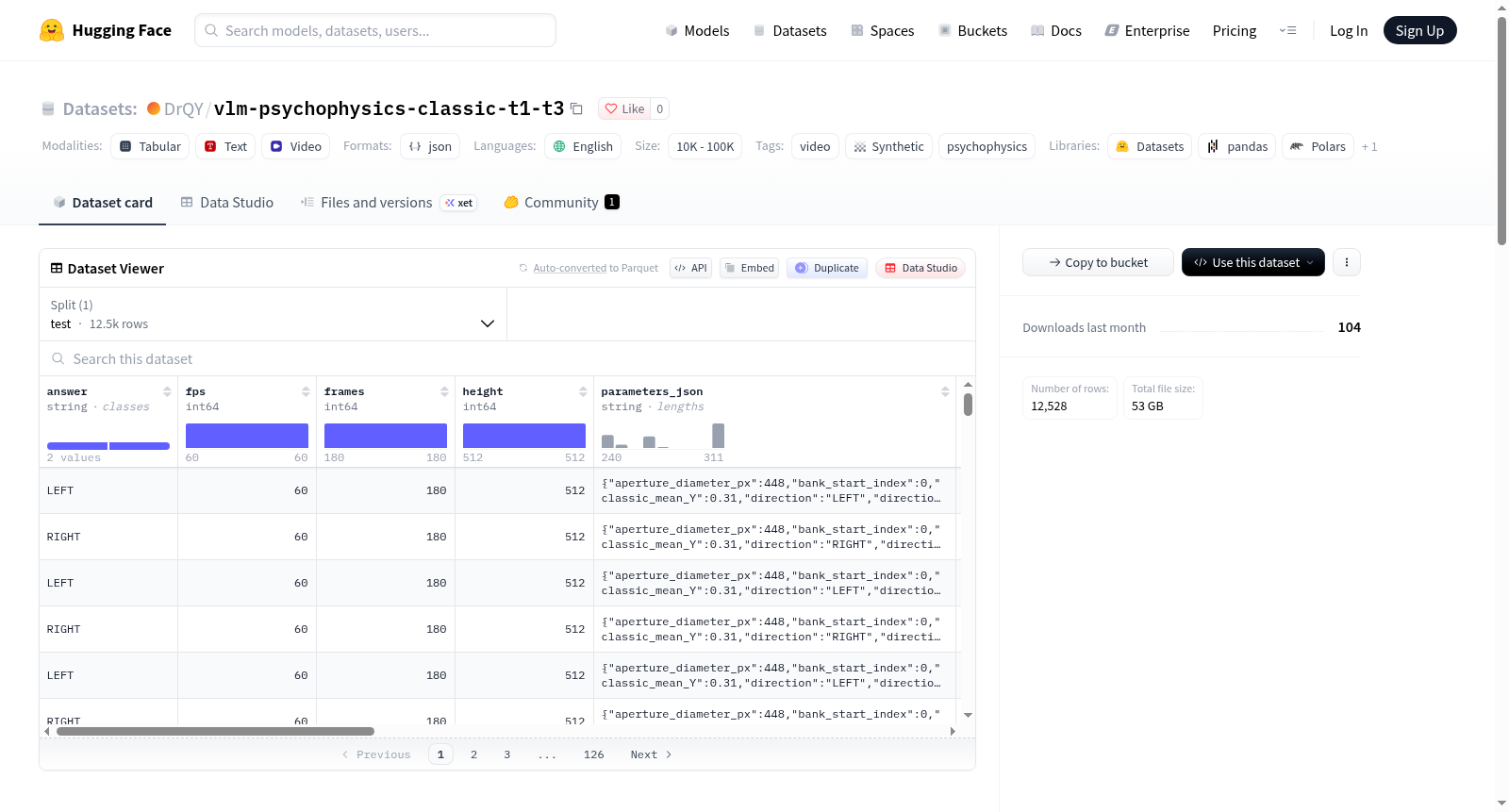
Visual Psychophysics 是一个用于评测视觉语言模型在运动方向、亮度变化和朝向辨别任务上表现的可控合成视频数据集。数据集包含 12,528 个源视频,覆盖三类任务:T1 为左右光栅运动方向辨别,共有 3,840 个源视频;T2 为判断哪个点短暂变亮,共有 5,760 个源视频;T3 为判断哪根条更接近垂直,共有 2,928 个源视频。当前 Cosmos X 主范围从中选择 9,456 个视频,其中 T1 使用全部 3,840 个,T2 使用 2,880 个,T3 使用 2,736 个。每个源视频为 768×512 分辨率、180 帧、60 fps、时长 3 秒,并以 FFV1/MKV 保存无损 16 位 RGB 源像素。Cosmos X 使用官方 OpenCV 视频读取器,将这些源解码为 uint8;其输入为全部 180 帧,并在引擎和请求范围内禁用原生缩放与处理器帧采样。X 主范围使用全部 T1 视频、仅 T2 的 30 帧/500 ms 曝光,以及除辅助 1.75°/2.25° 条件外的 T3 角度;所有被排除的视频仍然可用。精确的主 ID 列表位于 protocols/cosmos-x-20261028.json,用于独立于模型回答固定该范围。数据集提供 metadata.jsonl 标准 Hugging Face 表,包含问题、答案和源设置;dataset-index.json 提供完整稳定 ID 查找、源几何以及文件与解码流身份;protocols/cosmos-x-20261028.json 提供当前 9,456 视频选择及源绑定;validation/source-index-cosmos-x-20261028.json 是用于封存 X 的精确科学源索引快照;validation/source-qa-v0.4-additions.jsonl 是全部 3,168 个新增源视频的原始完整问答,并附有摘要,而此前 9,360 源问答保持不变;reader/ 保留可选无损读取器和共享命名规则。数据集还包含独立的 X 运行器 reproduction/cosmos_x.py 和绑定配方 reproduction/cosmos_x.json。它们绑定官方混合 NVFP4 检查点、独立原始 tokenizer、原生文件视频路由、软件版本和生成设置。项目 GitHub 仓库目前私有;包含的入口无需仓库访问即可独立运行。从下载的数据集目录中,应使用预期的现有 Linux x86_64 Python 3.12 解释器运行复现入口,例如 show、check-index、install-command 和 run。install-command 会打印 SHA 绑定的 pip 命令但不会执行。需要准备固定运行时和 CUDA 13.0.88 工具链,获取配方中列出的精确模型和七个小型原始 tokenizer/配置文件,然后通过 run 提供数据根目录、模型目录、tokenizer 目录和输出目录。Cosmos X 完整运行于 2026-10-29 HST 完成,全部 9,456 个唯一答案、169 个条件、源/输入/声明身份以及三个真实 worker 退出均通过核对。每个视频输出、单元表、A/X 对和图表位于 results/cosmos-X-20261028。三任务准确率为:T1 1,735/3,840,45.18%;T2 2,627/2,880,91.22%;T3 2,625/2,736,95.94%。A/X 比较仅使用共享源 ID;X 还改变运行时栈和后端策略,因此并非孤立的位深效果,源数据集本身不选择运行时。独立入口的源/CPU 合约与安装元数据检查已完成;尚未执行全新安装或该独立入口的单独 GPU 重放。可读文件名编码条件和标签。模型只应接收视频和基准问题,不应将文件名、参数和答案放入模型文本。Trial01–24 遵循相位/起始库;T3 倾斜名称描述倾斜轴的上端。源图像角度、源精度和实际模型输入是分开的测量。v0.4 增加 3,168 个源视频,并保留此前发布的 9,360 个条目和媒体不变;公共索引修正继承的发布版本/父提交字段,其条目记录与保留的科学索引相同。release.json 列出所有新媒体文件和 SHA256,早期固定版本仍可复现。许可证尚未指定。
Visual Psychophysics is a controllable synthetic video dataset for evaluating vision-language models on motion direction, luminance change, and orientation discrimination tasks. The dataset contains 12,528 source videos covering three task types: T1 is left-right grating motion direction discrimination, with 3,840 source videos; T2 is judging which point briefly brightens, with 5,760 source videos; T3 is judging which bar is closer to vertical, with 2,928 source videos. The current Cosmos X main range selects 9,456 videos, of which T1 uses all 3,840, T2 uses 2,880, and T3 uses 2,736. Each source video is 768×512 resolution, 180 frames, 60 fps, 3 seconds long, and is stored as FFV1/MKV lossless 16-bit RGB source pixels. Cosmos X uses the official OpenCV video reader to decode these sources to uint8; its input is all 180 frames, and native scaling and processor frame sampling are disabled at the engine and request levels. The X main range uses all T1 videos, only T2 30-frame/500 ms exposure, and T3 angles excluding auxiliary 1.75°/2.25° conditions; all excluded videos remain available. The exact main ID list is in protocols/cosmos-x-20261028.json, fixing this range independently of model answers. The dataset provides metadata.jsonl as a standard Hugging Face table containing questions, answers, and source settings; dataset-index.json provides complete stable ID lookup, source geometry, and file and decoded-stream identity; protocols/cosmos-x-20261028.json provides the current 9,456-video selection and source bindings; validation/source-index-cosmos-x-20261028.json is the exact scientific source index snapshot used to seal X; validation/source-qa-v0.4-additions.jsonl is the raw complete Q&A for all 3,168 newly added source videos, with a summary, while the previous 9,360 source Q&A remains unchanged; reader/ keeps optional lossless readers and shared naming rules. The dataset also includes an independent X runner, reproduction/cosmos_x.py, and a binding recipe, reproduction/cosmos_x.json. They bind the official mixed NVFP4 checkpoint, independent raw tokenizer, native file video routing, software versions, and generation settings. The project GitHub repository is currently private; the included entry points can run independently without repository access. From the downloaded dataset directory, use the expected existing Linux x86_64 Python 3.12 interpreter to run reproduction entry points such as show, check-index, install-command, and run. install-command prints the SHA-bound pip command but does not execute it. A fixed runtime and CUDA 13.0.88 toolchain need to be prepared, and the exact model listed in the recipe plus seven small raw tokenizer/config files need to be obtained, then run is given the data root, model directory, tokenizer directory, and output directory. The full Cosmos X run was completed on 2026-10-29 HST, and all 9,456 unique answers, 169 conditions, source/input/claim identities, and three real worker exits passed verification. Per-video outputs, unit tables, A/X pairs, and charts are located in results/cosmos-X-20261028. The three-task accuracy is: T1 1,735/3,840, 45.18%; T2 2,627/2,880, 91.22%; T3 2,625/2,736, 95.94%. A/X comparisons use only shared source IDs; X also changes the runtime stack and backend policy, so this is not an isolated bit-depth effect, and the source dataset itself does not choose the runtime. Source/CPU contract and installation metadata checks for the independent entry point are complete; a fresh installation or a separate GPU replay of that independent entry point has not yet been performed. Readable filenames encode condition and label. The model should receive only videos and benchmark questions, and should not have filenames, parameters, or answers placed into model text. Trial01–24 follow the phase/onset library; T3 tilt names describe the upper end of the tilt axis. Source image angles, source precision, and actual model inputs are separately measured. v0.4 adds 3,168 source videos and keeps the previously released 9,360 entries and media unchanged; the public index corrects inherited release version/parent commit fields, and its entry records are the same as the retained scientific index. release.json lists all new media files and SHA256, and earlier pinned versions remain reproducible. The license has not yet been specified.
数据集概述
- 数据集页面:https://huggingface.co/datasets/DrQY/vlm-psychophysics-classic-t1-t3
- pretty_name:Visual Psychophysics — Motion, Brightness and Orientation
- 语言:en
- 标签:video、synthetic、psychophysics
- 配置:config_name 为 default;data_files 的 split 为 test,path 为 https://huggingface.co/datasets/DrQY/vlm-psychophysics-classic-t1-t3/blob/main/metadata.jsonl
数据规模与任务
该数据集包含 12,528 个受控源视频,用于测试视觉语言模型的运动方向、亮度变化和朝向辨别。当前 Cosmos X primary scope 选择其中 9,456 个视频。
| 文件夹 | 任务 | 全部源视频 | Cosmos X primary |
|---|---|---|---|
| T1 | 左/右光栅运动 | 3,840 | 3,840 |
| T2 | 哪个点短暂变亮 | 5,760 | 2,880 |
| T3 | 哪个条更接近竖直 | 2,928 | 2,736 |
视频规格与处理
- 每个源视频为 768×512,180 帧,60 fps,时长 3 秒。
- FFV1/MKV 保存无损 16-bit RGB 源像素。
- Cosmos X 使用官方 OpenCV 视频读取器,将这些源解码为 uint8。
- Cosmos X 输入为全部 180 帧,并在引擎和请求范围内禁用 native resizing 和 processor frame sampling。
- X primary scope 使用全部 T1 视频;T2 仅使用 30 帧/500 ms 曝光;T3 使用除辅助 1.75°/2.25° 条件以外的角度。
- 所有被排除的视频仍然可用。
- exact primary ID list 独立于模型答案固定范围:https://huggingface.co/datasets/DrQY/vlm-psychophysics-classic-t1-t3/blob/main/protocols/cosmos-x-20261028.json
文件与资源
- 标准 HF 表:https://huggingface.co/datasets/DrQY/vlm-psychophysics-classic-t1-t3/blob/main/metadata.jsonl
- 包含问题、答案和源设置。
- 完整稳定 ID 查询、源几何及文件/解码流身份:https://huggingface.co/datasets/DrQY/vlm-psychophysics-classic-t1-t3/blob/main/dataset-index.json
- 当前 9,456 视频选择和源绑定:https://huggingface.co/datasets/DrQY/vlm-psychophysics-classic-t1-t3/blob/main/protocols/cosmos-x-20261028.json
- 用于封存 X 的精确科学源索引快照:https://huggingface.co/datasets/DrQY/vlm-psychophysics-classic-t1-t3/blob/main/validation/source-index-cosmos-x-20261028.json
- 所有 3,168 个追加源的原始完整 QA,并附摘要;较早 9,360 源 QA 不变:https://huggingface.co/datasets/DrQY/vlm-psychophysics-classic-t1-t3/blob/main/validation/source-qa-v0.4-additions.jsonl
- 保留的可选无损读取器和共享命名规则:https://huggingface.co/datasets/DrQY/vlm-psychophysics-classic-t1-t3/tree/main/reader
复现与运行
- standalone X runner:https://huggingface.co/datasets/DrQY/vlm-psychophysics-classic-t1-t3/blob/main/reproduction/cosmos_x.py
- bound recipe:https://huggingface.co/datasets/DrQY/vlm-psychophysics-classic-t1-t3/blob/main/reproduction/cosmos_x.json
- 它们绑定官方 mixed NVFP4 checkpoint、独立原始 tokenizer、native file-video route、软件版本和生成设置。
- 项目 GitHub 仓库当前私有:https://github.com/YangQiantwx/vlm-psychophysics
- 包含的入口可独立运行,无需仓库访问。
- 从下载的数据集目录,使用预期的现有 Linux x86_64 Python 3.12 解释器。
- 提供命令模式:show;check-index --data-root <data-root>;install-command;run --data-root <data-root> --model-dir <official-nvfp4-checkpoint-dir> --tokenizer-dir <original-f543-tokenizer-dir> --output <new-output-directory>。
- install-command 打印 SHA 绑定的 pip 命令,但不运行。
- 需准备固定 runtime 和 CUDA 13.0.88 工具链,获取 recipe 中列出的 exact model 和七个小的原始 tokenizer/config 文件,然后提供其目录。
Cosmos X 完整运行与结果
- Cosmos X 完整运行完成于 2026-10-29 HST。
- 所有 9,456 个唯一答案、169 个 conditions、source/input/claim identities 和三个真实 worker exits 通过 reconciliation。
- 每个视频输出、单元格表、A/X 对和图表可用:https://huggingface.co/datasets/DrQY/vlm-psychophysics-classic-t1-t3/tree/main/results/cosmos-X-20261028
| 任务 | 正确 / 视频 | 准确率 |
|---|---|---|
| T1 | 1,735 / 3,840 | 45.18% |
| T2 | 2,627 / 2,880 | 91.22% |
| T3 | 2,625 / 2,736 | 95.94% |
- A/X 比较仅使用共享源 ID;X 还改变运行时栈和后端策略,因此这些不是孤立的位深效应。
- 源数据集本身不选择运行时。
- standalone entry 的源/CPU 契约和安装元数据检查已完成;尚未执行该 standalone entry 的全新安装或单独 GPU 重放。
使用注意事项
- 可读文件名编码条件和标签。
- 给模型仅提供视频和基准问题,保持文件名、参数和答案不在模型文本中。
- Trial01–24 遵循 phase/onset bank;T3 倾斜名称描述倾斜轴的上端。
- 源图像角度、源精度和实际模型输入是分开的测量。
版本与许可
- v0.4 追加 3,168 个源视频,并保留所有 9,360 个先前发布的条目和媒体不变。
- 公共索引修正继承的 release-version/parent-commit 字段;其 item records 与保留的科学索引相同。
- Release provenance 列出每个新媒体文件和 SHA256:https://huggingface.co/datasets/DrQY/vlm-psychophysics-classic-t1-t3/blob/main/release.json
- 较早 pinned releases 仍可复现。
- 许可尚未指定。