
缺陷检测图像数据
收藏浙江省数据知识产权登记平台2024-10-25 更新2024-10-26 收录
下载链接:
https://www.zjip.org.cn/home/announce/trends/75336
下载链接
链接失效反馈官方服务:
资源简介:
本数据集是结合若干专利运营时的测试算法的数据,构成脱敏后的目标检测数据集。对陶瓷、晶圆、金属轴承、光学镜片、半导体wafer、碳纤维复合材料、硬质合金刀具、磁性材料、玻璃纤维扫描图分别进行了统一二值化处理,并标记为4种尺度缺陷。本数据将工件柱面图像进行切分,标记,可用于非特定柱面缺陷检测的目标检测模型训练,应用到生产上,可以结合机器人和机器视觉技术,实现自动化生产线上的缺陷检测,实时检测工件表面的缺陷,确保产品质量符合标准,提高生产管理的智能化水平。数据采集与标注阶段利用高分辨率成像设备对陶瓷、晶圆、金属轴承、光学镜片、半导体wafer、碳纤维复合材料、硬质合金刀具、磁性材料和玻璃纤维等多种材料的柱面进行扫描。图像经过预处理,首先将工件柱面图像进行切分和展开,形成细长的纹理图像。之后,对增强后的图像进行统一的二值化处理,通过Otsu方法自适应计算。二值化之后,为进一步增强数据的多样性,采用随机裁剪-随机旋转-随机翻转对图像进行增强。使用labelme等标注工具基于视觉特征判断对缺陷的位置进行精确标注,使用COCO包围框(x,y,width,height)进行定位和目标检测标注,将缺陷分为裂纹/划痕、凹陷、气孔、腐蚀磨损四种尺度类别,并根据大小和深浅进行分类。
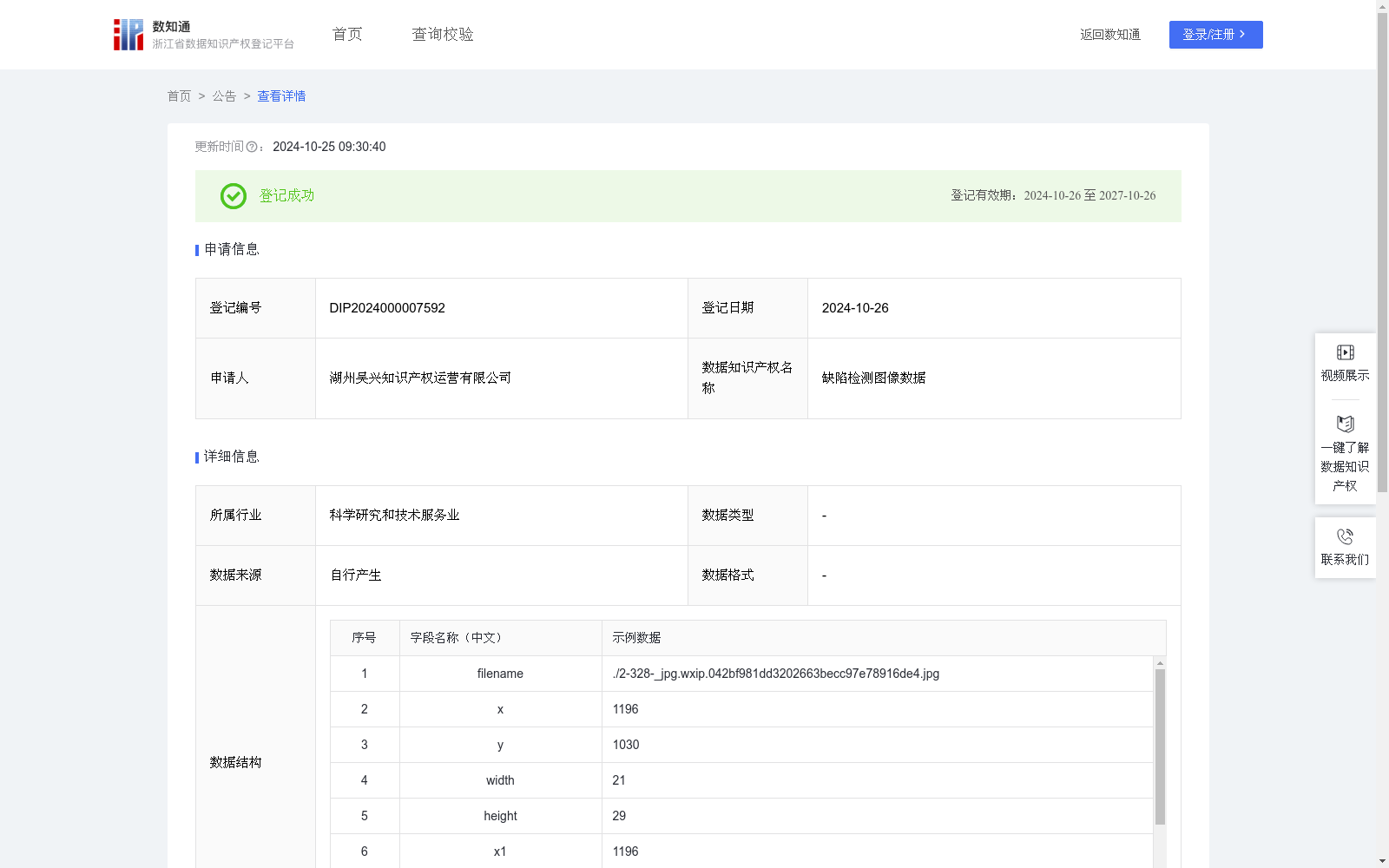
将COCO包围框转换为CSV格式。转换公式如下:x1=x,y1=y,x2=x+width,y2=y+height,cls="Defect-{1,2,3,4}"
filename为扫描图,x1,y1,x2,y2是坐标。cls是标记4种类别,分别对应裂纹/划痕、凹陷、气孔、腐蚀磨损4种情况。
This dataset is a de-identified object detection dataset built using test algorithm data from the operation of several patents. Scans of ceramics, wafers, metal bearings, optical lenses, semiconductor wafers, carbon fiber composites, cemented carbide tools, magnetic materials, and glass fibers underwent unified binarization processing and were labeled with four types of scale defects. This dataset involves segmenting and labeling cylindrical workpiece images, and can be used to train object detection models for unspecific cylindrical surface defect detection. When applied in production, it can be combined with robotics and machine vision technologies to enable defect detection on automated production lines, detect workpiece surface defects in real time, ensure product quality meets relevant standards, and improve the intelligentization level of production management. During the data collection and annotation stage, high-resolution imaging equipment was used to scan the cylindrical surfaces of various materials including ceramics, wafers, metal bearings, optical lenses, semiconductor wafers, carbon fiber composites, cemented carbide tools, magnetic materials, and glass fibers. During preprocessing, cylindrical workpiece images are first segmented and unfolded to form elongated texture images. Subsequently, unified binarization is performed on the images via adaptive threshold calculation using the Otsu's method. After binarization, to further enrich the diversity of the dataset, data augmentation is conducted via random cropping, random rotation, and random flipping. Defect positions were accurately annotated using annotation tools such as LabelMe based on visual feature recognition. COCO bounding boxes in the format (x, y, width, height) were utilized for localization and object detection annotation. Defects were categorized into four scale classes: cracks/scratches, pits, pores, and corrosive wear, and classified according to their size and depth. COCO bounding boxes were converted to CSV format. The conversion formula is as follows: x1 = x, y1 = y, x2 = x + width, y2 = y + height, cls = "Defect-{1,2,3,4}". The filename corresponds to the scan image, x1, y1, x2, y2 are the coordinate values, and cls represents the four categories, which correspond to cracks/scratches, pits, pores, and corrosive wear respectively.
提供机构:
湖州吴兴知识产权运营有限公司
创建时间:
2024-09-03
搜集汇总
数据集介绍
以上内容由遇见数据集搜集并总结生成



