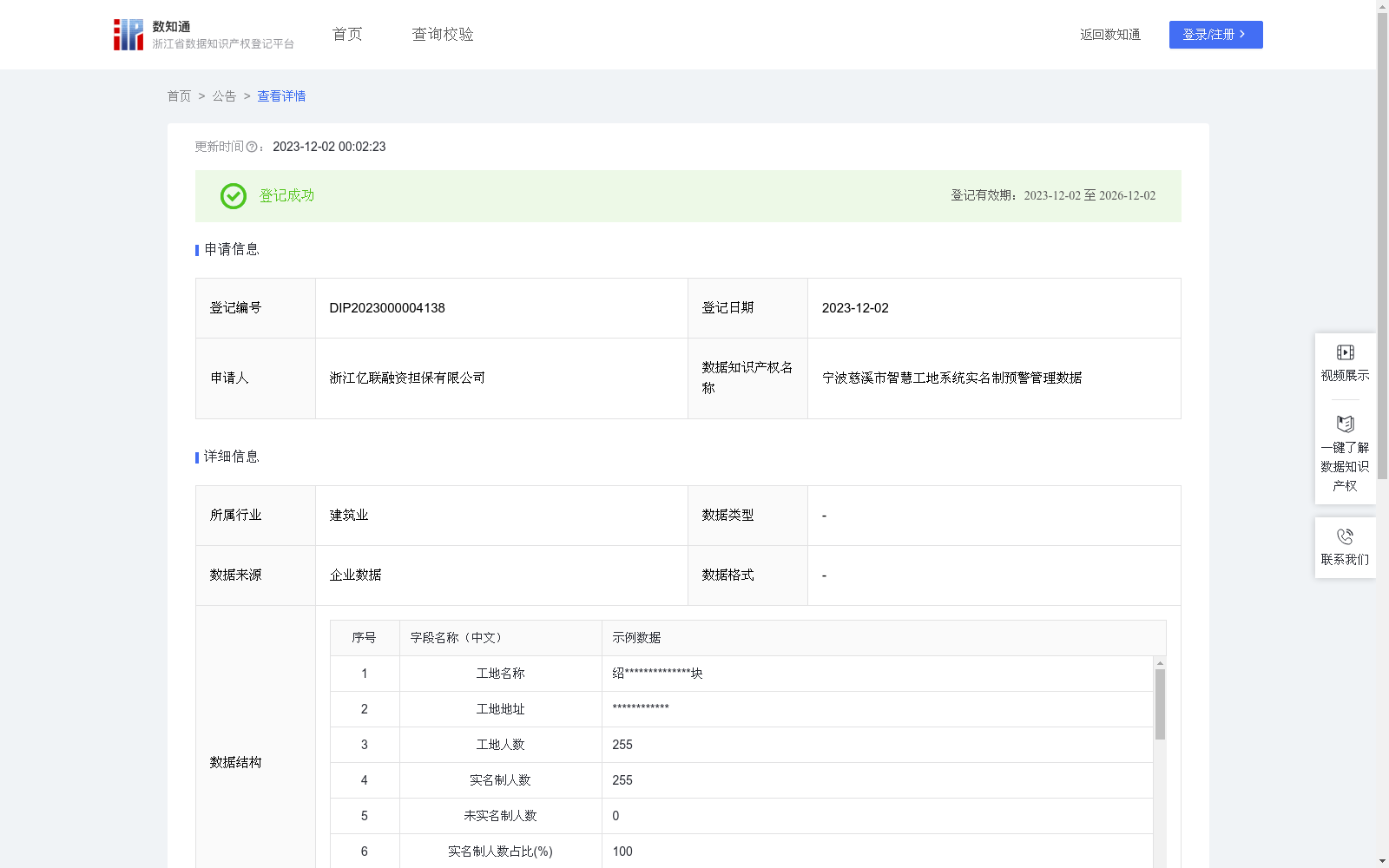
宁波慈溪市智慧工地系统实名制预警管理数据
收藏资源简介:
建筑工地在工人进场时,需要先录入到实名制信息。系统会打通公安、卫健委进行人员风险核对,系统会为企业提供用工过程中所遇到的风险及预计,比如健康情况、治安风险情况、工人年龄情况等(1)数据采集:采集宁波慈溪市范围内实名制信息线上通过系统录入的方式采集数据到数据库作为原始数据源。 (2)数据处理:首先对采集的工地确认数据进行清洗,包括工地总人数为0的或者为null的。然后对数据在项目维度按工地,区域维度按区域,进行最细级别粒度的聚合。计算得到各工地的总人量为x,实名制人数为所有已实名制人数,未实名制人数为所有未实名制人数,实名制人数占比(%)为实名制人数/x,未实名制人数占比(%)为未实名制人数/x;健康风险人数(黄码、红码)为所有黄码红码工人,健康风险占比为健康风险人数(黄码、红码)/x;治安风险人数为所有治安风险人数,治安风险人数占比(%)为治安风险人数/x;18<年龄<30数量为所有18<年龄<30的工人,18<年龄<30占比(%)为18<年龄<30数量/x;30<年龄<50数量为所有30<年龄<50的工人,30<年龄<50占比(%)为30<年龄<50数量/x;50<年龄<60数量为所有50<年龄<60的工人,50<年龄<60占比(%)为50<年龄<60数量/x;年龄>=60数量为所有年龄>=60的工人,年龄>=60占比(%)为年龄>=60数量/x;
When entering a construction site, workers are required to first submit their real-name registration information. The system will interface with public security authorities and the local health commission to conduct personnel risk verification, and provide enterprises with employment-related risks and forecasts including health status, public security risks, and worker age distribution, etc. (1) Data Collection: Collect real-name registration information submitted online through the system within the jurisdiction of Cixi City, Ningbo, and store the collected data in the database as the original data source. (2) Data Processing: First, clean the collected site-related confirmation data, specifically removing records where the total number of workers at the construction site is 0 or null. Then perform aggregation at the finest granularity: by construction site under the project dimension, and by region under the regional dimension. Calculate the following indicators: Total number of workers at each site (denoted as x), number of real-name registered workers, number of unregistered workers, proportion of real-name registered workers (%) = number of real-name registered workers / x, proportion of unregistered workers (%) = number of unregistered workers / x; Number of workers with health risks ("yellow code", "red code"), proportion of health risks (%) = number of workers with health risks ("yellow code", "red code") / x; Number of workers with public security risks, proportion of public security risks (%) = number of public security risk workers / x; Number of workers aged 18 < age < 30, proportion (%) = number of workers aged 18 < age < 30 / x; Number of workers aged 30 < age < 50, proportion (%) = number of workers aged 30 < age < 50 / x; Number of workers aged 50 < age < 60, proportion (%) = number of workers aged 50 < age < 60 / x; Number of workers aged ≥ 60, proportion (%) = number of workers aged ≥ 60 / x;