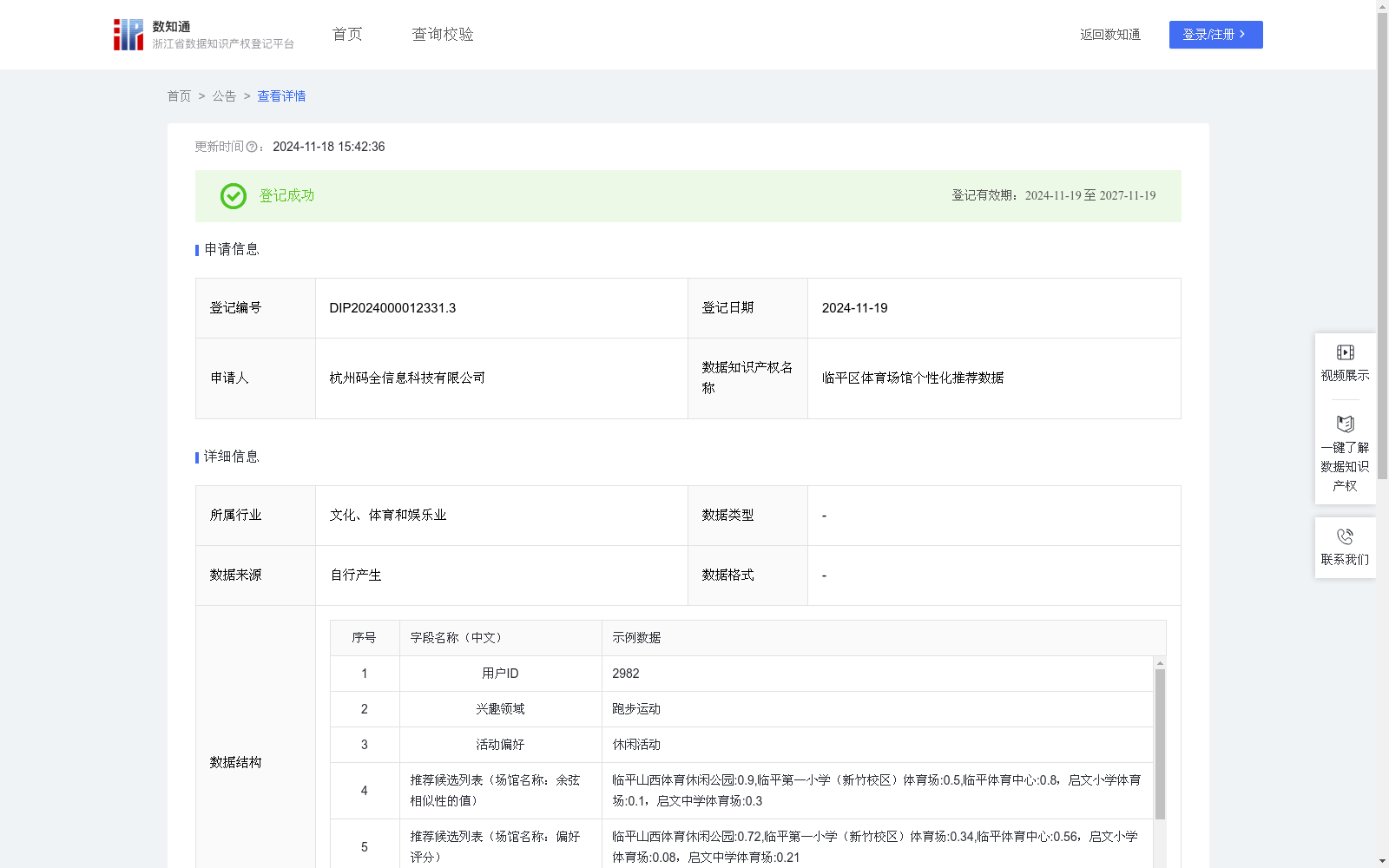
临平区体育场馆个性化推荐数据
收藏资源简介:
临平区体育场馆的个性化推荐数据能够广泛应用于健康促进、体育活动规划、场馆运营管理、体育市场营销、体育科学研究、智能运动导航、社交媒体运动内容推荐、政府公共体育服务以及体育行为数据分析等多个领域。通过算法加工,这些数据能够为用户提供个性化的体育场馆和活动推荐,提升健身体验,激发社区体育参与热情,同时帮助场馆管理者优化资源配置和运营策略,提高服务效率和经济效益。此外,这些数据还能为政府制定体育政策、企业进行市场分析和学者研究用户体育行为提供支持,从而在推动全民健身的同时,提升用户的运动参与度和满意度。1.数据收集和清洗:根据给定的用户ID访问“临平区文化活动参与者个体画像数据”数据库,获取用户的兴趣领域和活动偏好。从公司文化保障卡服务系统中抽取临平区所有体育场馆的类型特征,以及用户打卡次数的历史数据。通过数据清洗去除无效或错误记录,确保数据质量。 2.用户兴趣匹配和推荐候选生成:利用余弦相似性算法,将用户的兴趣领域和活动偏好与体育场馆的类型特征进行匹配。计算余弦相似性的值,该值代表兴趣匹配度。根据兴趣匹配结果,为用户生成一个推荐的候选场馆列表。 3.推荐候选排序:对候选场馆列表中的每个场馆,根据用户的兴趣匹配度、场馆历史打卡次数计算一个偏好评分,计算过程为:偏好评分=w1×余弦相似性(代表兴趣匹配度)+w2×场馆历史打卡次数(事先对所有场馆的历史打卡次数进行归一化处理);w1、w2是权重系数,用于调整兴趣匹配度和场馆历史打卡次数在偏好评分中的重要性。根据偏好评分,对候选场馆进行排序。 4.推荐列表生成:选择排名靠前的3个场馆,生成最终的推荐列表。
Personalized recommendation data for sports venues in Linping District can be widely applied in multiple fields including health promotion, sports activity planning, venue operation management, sports marketing, sports scientific research, intelligent sports navigation, social media sports content recommendation, government public sports services, and sports behavior data analysis. Processed via algorithms, this data can provide users with personalized sports venue and activity recommendations, enhance fitness experience, stimulate enthusiasm for community sports participation, while helping venue managers optimize resource allocation and operation strategies, and improve service efficiency and economic benefits. In addition, this data can also provide support for governments in formulating sports policies, enterprises in conducting market analysis, and scholars in researching user sports behaviors, thereby promoting the national fitness campaign while improving users' sports participation rate and satisfaction. 1. Data Collection and Cleaning: Access the "Individual Profile Data of Cultural Activity Participants in Linping District" database via the given user ID to obtain the user's interest areas and activity preferences. Extract the type characteristics of all sports venues in Linping District and the historical data of users' check-in times from the company's cultural security card service system. Remove invalid or erroneous records through data cleaning to ensure data quality. 2. User Interest Matching and Recommendation Candidate Generation: Use the cosine similarity algorithm to match the user's interest areas and activity preferences with the type characteristics of sports venues. Calculate the cosine similarity value, which represents the interest matching degree. Generate a recommended candidate venue list for the user based on the interest matching results. 3. Recommendation Candidate Ranking: For each venue in the candidate venue list, calculate a preference score based on the user's interest matching degree and the venue's historical check-in times. The calculation formula is: Preference Score = w1 × Cosine Similarity (representing interest matching degree) + w2 × Venue Historical Check-in Times (the historical check-in times of all venues are normalized in advance); w1 and w2 are weight coefficients used to adjust the importance of interest matching degree and venue historical check-in times in the preference score. Rank the candidate venues based on the preference score. 4. Recommendation List Generation: Select the top 3 venues to generate the final recommendation list.