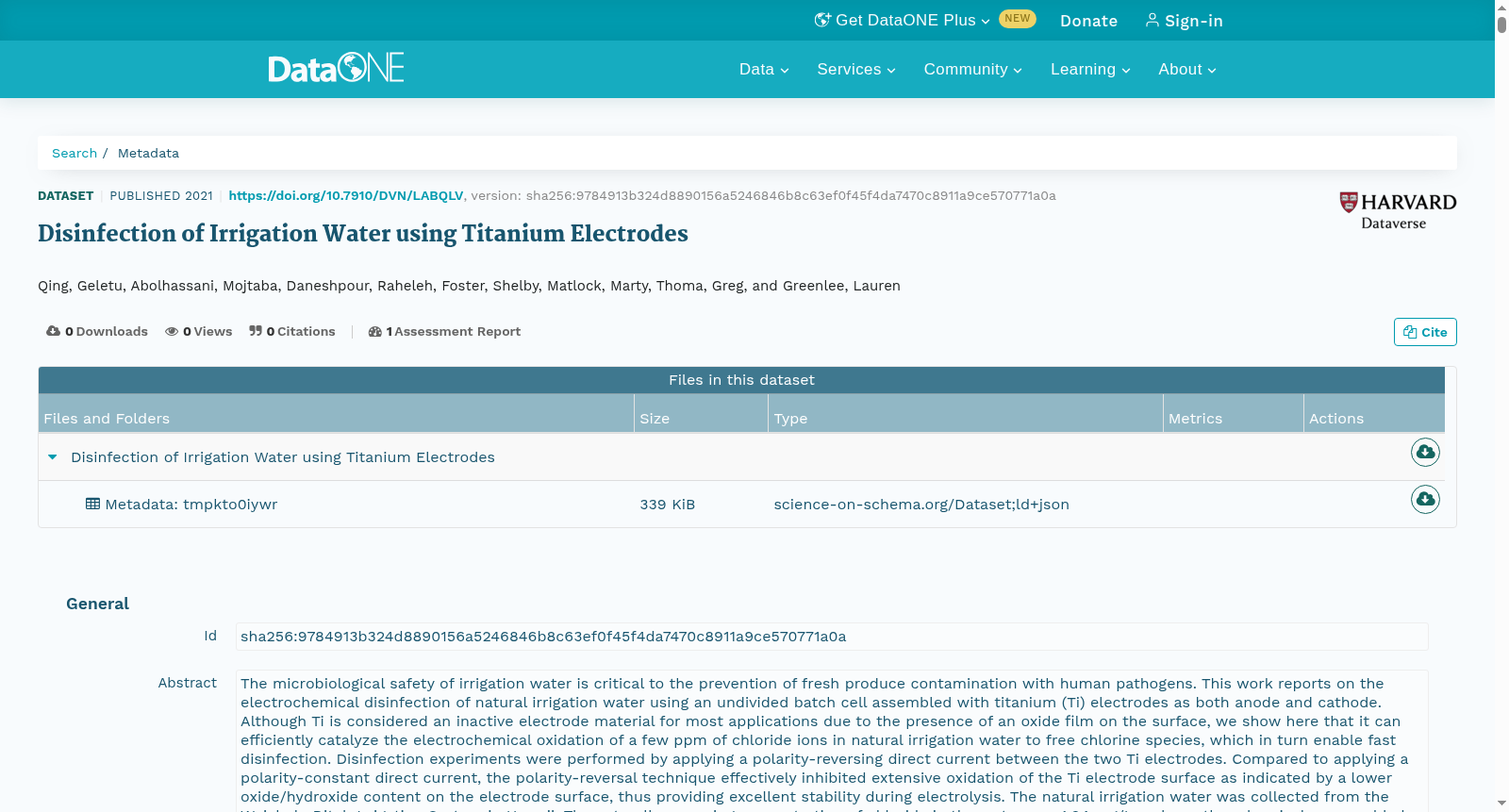
Disinfection of Irrigation Water using Titanium Electrodes
收藏资源简介:
The microbiological safety of irrigation water is critical to the prevention of fresh produce contamination with human pathogens. This work reports on the electrochemical disinfection of natural irrigation water using an undivided batch cell assembled with titanium (Ti) electrodes as both anode and cathode. Although Ti is considered an inactive electrode material for most applications due to the presence of an oxide film on the surface, we show here that it can efficiently catalyze the electrochemical oxidation of a few ppm of chloride ions in natural irrigation water to free chlorine species, which in turn enable fast disinfection. Disinfection experiments were performed by applying a polarity-reversing direct current between the two Ti electrodes. Compared to applying a polarity-constant direct current, the polarity-reversal technique effectively inhibited extensive oxidation of the Ti electrode surface as indicated by a lower oxide/hydroxide content on the electrode surface, thus providing excellent stability during electrolysis. The natural irrigation water was collected from the Waiahole Ditch Irrigation System in Hawaii. The naturally occurring concentration of chloride in the water was 1.84 mg/L and no other chemicals were added. E. coli K12 ER2738 was selected as a model bacterium to evaluate the electrochemical cell’s disinfection capability. The applied current density was varied between 0 mA/cm2 and 2 mA/cm2, and the half-period (T/2) of the polarity-reversing direct current was varied between 5 s and 60 s. The best disinfection performance was achieved at 2 mA/cm2 and T/2 = 10 s, requiring only 5 min of treatment for the complete disinfection of E. coli (4-log reduction). The trends in the concentration of free and total chlorine in the solution matched very well with those of the disinfection efficiency, suggesting that E. coli was inactivated by free chlorine species electrogenerated at the Ti electrodes. Hydrogen peroxide, short-lived oxidants, and direct electron transfer most likely had minor contributions to the disinfection process. The presence of a volcano-shaped dependence of the free and total chlorine concentration and disinfection efficiency on T/2 suggests that the chloride oxidation activity of the Ti electrode was closely related to the oxidation state (or the thickness of the oxide layer) of the electrode surface, i.e., there exists an optimal oxide layer thickness at which the Ti electrode shows the highest electrocatalytic activity toward chloride oxidation. During the disinfection experiment, disinfection byproducts (DBPs) of chlorate, bromodichloromethane, dibromochloromethane, and bromoform were not detected in the solution. Chloroform was first seen in the solution at 10 min (2.5 μg/L), and then its concentration increased to 9.0 μg/L at 20 min. These values are significantly lower than recommendations for drinking water, and the timeframe of chloroform production suggests a 5 min disinfection treatment avoids significant DBP formation. As a comparison, Pt/Ti electrodes prepared by electrodeposition showed negligible disinfection at 2 mA/cm2, but the disinfection efficiency increased dramatically at 4 mA/cm2 and 6 mA/cm2. This phenomenon was most likely due to the Pt catalyst’s high activity, readily catalyzing side reactions such as oxygen evolution and oxidation of organic matter in the natural irrigation water. The Ti electrodes consumed less electrical energy than the Pt/Ti electrodes because they needed a lower current density to achieve similar disinfection efficiency. The current work demonstrates that the Ti electrode electrochemical cell can provide an efficient, robust, and cost-effective solution to irrigation water disinfection, and thus is well suited for agriculture sector applications.
灌溉水的微生物安全对于防止新鲜农产品受人类病原体污染至关重要。本研究采用以钛(Ti)为阴、阳极的无分隔批式电解池(undivided batch cell),对天然灌溉水开展电化学消毒(electrochemical disinfection)研究。尽管钛因表面存在氧化膜,在多数应用中被视为惰性电极材料,但本研究证明,其可高效催化天然灌溉水中数ppm浓度的氯离子电化学氧化为游离氯物种(free chlorine species),进而实现快速消毒。 消毒实验通过在两个钛电极间施加极性反转直流(polarity-reversing direct current)完成。与施加极性恒定的直流电相比,极性反转技术可有效抑制钛电极表面的过度氧化:电极表面的氧化物/氢氧化物(oxide/hydroxide)含量更低,因此在电解过程中表现出优异的稳定性。 实验所用天然灌溉水采自夏威夷怀亚霍奇渠灌溉系统(Waiahole Ditch Irrigation System),水中天然氯离子浓度为1.84 mg/L,未添加其他化学试剂。本研究选用大肠杆菌K12 ER2738(E. coli K12 ER2738)作为模式菌,以评估该电解池的消毒性能。施加的电流密度(current density)范围为0 mA/cm²至2 mA/cm²,极性反转直流电的半周期(half-period,T/2)范围为5 s至60 s。 在2 mA/cm²且T/2=10 s的条件下可获得最佳消毒效果,仅需5 min处理即可实现大肠杆菌的4-log完全灭活(4-log reduction)。溶液中游离氯与总氯的浓度变化趋势与消毒效率高度吻合,表明大肠杆菌的灭活主要由钛电极上电生成的游离氯物种介导。过氧化氢、短寿命氧化剂及直接电子转移(direct electron transfer)对消毒过程的贡献极小。 游离氯、总氯浓度及消毒效率随T/2变化呈火山形依赖关系,这表明钛电极的氯离子氧化活性与电极表面的氧化态(或氧化层厚度)密切相关,即存在最优氧化层厚度,此时钛电极对氯离子氧化的电催化活性最高。 消毒实验过程中,未在溶液中检测到氯酸盐(chlorate)、一溴二氯甲烷(bromodichloromethane)、二溴一氯甲烷(dibromochloromethane)及溴仿(bromoform)等消毒副产物(disinfection byproducts, DBPs)。三氯甲烷(chloroform)于10 min时首次在溶液中被检出(浓度为2.5 μg/L),并在20 min时升至9.0 μg/L。上述浓度远低于饮用水标准限值,且三氯甲烷的生成时间线表明,5 min的消毒处理可避免显著的消毒副产物生成。 作为对照,通过电沉积(electrodeposition)制备的Pt/Ti电极在2 mA/cm²下几乎无消毒效果,但在4 mA/cm²和6 mA/cm²下消毒效率显著提升。该现象大概率源于Pt催化剂的高活性,其易引发析氧反应(oxygen evolution)及天然灌溉水中有机质(organic matter)氧化等副反应。钛电极的电能消耗低于Pt/Ti电极,因为其仅需更低的电流密度即可达到相近的消毒效率。 本研究证明,钛电极电解池可为灌溉水消毒提供高效、稳定且经济的解决方案,因此非常适合农业领域应用。