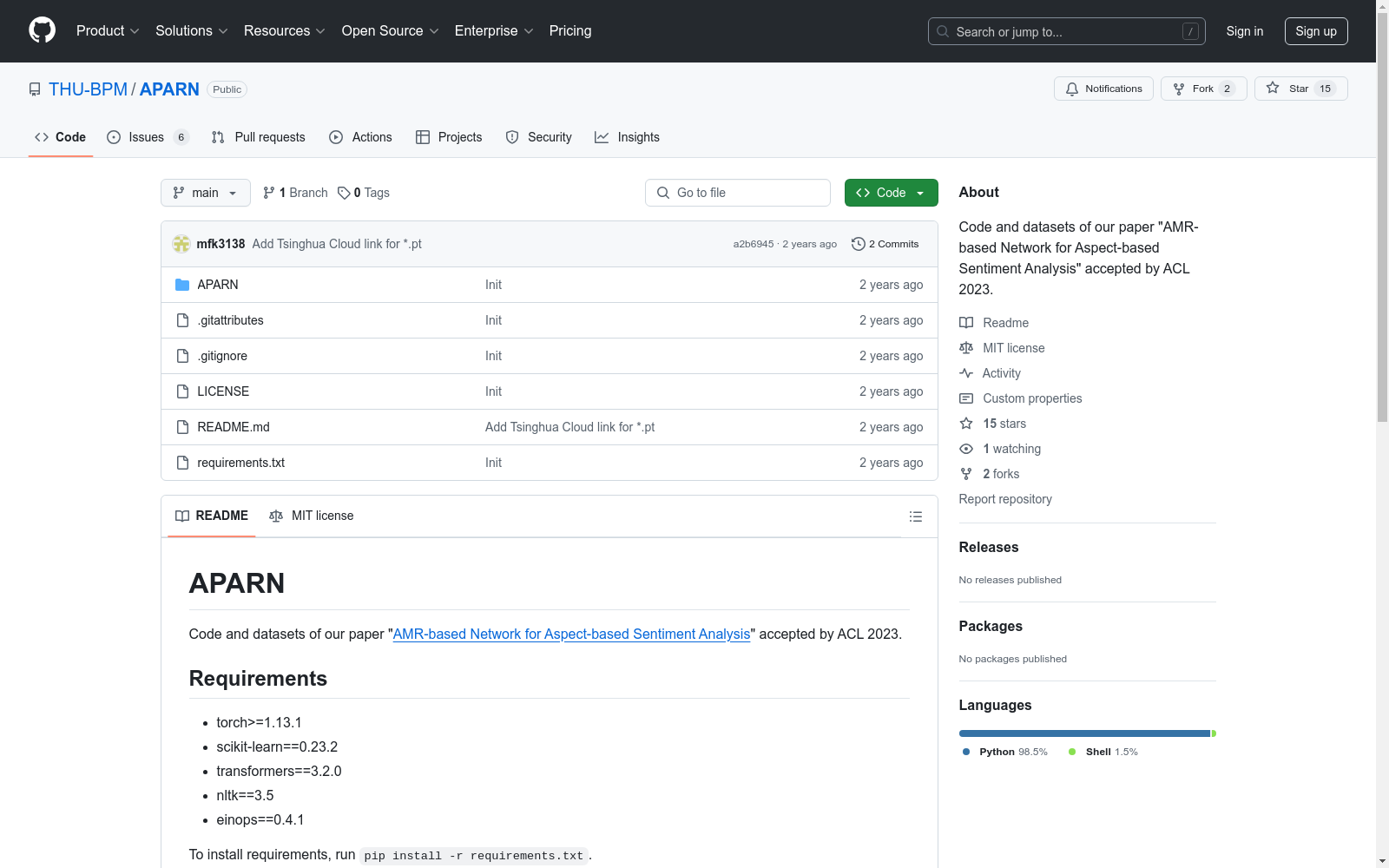
未明确提及数据集的具体名称,但可以推断与Aspect-based Sentiment Analysis相关
收藏数据集概述
数据集名称
APARN
数据集来源
本数据集是论文 "AMR-based Network for Aspect-based Sentiment Analysis" 的一部分,该论文被ACL 2023接受。
数据集用途
用于方面级情感分析(Aspect-based Sentiment Analysis, ABSA)的研究。
数据集依赖
- torch>=1.13.1
- scikit-learn==0.23.2
- transformers==3.2.0
- nltk==3.5
- einops==0.4.1
数据集训练
训练和评估APARN模型通过运行 ./APARN/run.sh 脚本进行。
数据集引用
若使用此数据集,请按以下方式引用:
@inproceedings{ma-etal-2023-amr, title = "{AMR}-based Network for Aspect-based Sentiment Analysis", author = "Ma, Fukun and Hu, Xuming and Liu, Aiwei and Yang, Yawen and Li, Shuang and Yu, Philip S. and Wen, Lijie", editor = "Rogers, Anna and Boyd-Graber, Jordan and Okazaki, Naoaki", booktitle = "Proceedings of the 61st Annual Meeting of the Association for Computational Linguistics (Volume 1: Long Papers)", month = jul, year = "2023", address = "Toronto, Canada", publisher = "Association for Computational Linguistics", url = "https://aclanthology.org/2023.acl-long.19", doi = "10.18653/v1/2023.acl-long.19", pages = "322--337", abstract = "Aspect-based sentiment analysis (ABSA) is a fine-grained sentiment classification task. Many recent works have used dependency trees to extract the relation between aspects and contexts and have achieved significant improvements. However, further improvement is limited due to the potential mismatch between the dependency tree as a syntactic structure and the sentiment classification as a semantic task. To alleviate this gap, we replace the syntactic dependency tree with the semantic structure named Abstract Meaning Representation (AMR) and propose a model called AMR-based Path Aggregation Relational Network (APARN) to take full advantage of semantic structures. In particular, we design the path aggregator and the relation-enhanced self-attention mechanism that complement each other. The path aggregator extracts semantic features from AMRs under the guidance of sentence information, while the relation-enhanced self-attention mechanism in turn improves sentence features with refined semantic information. Experimental results on four public datasets demonstrate 1.13{%} average F1 improvement of APARN in ABSA when compared with state-of-the-art baselines.", }