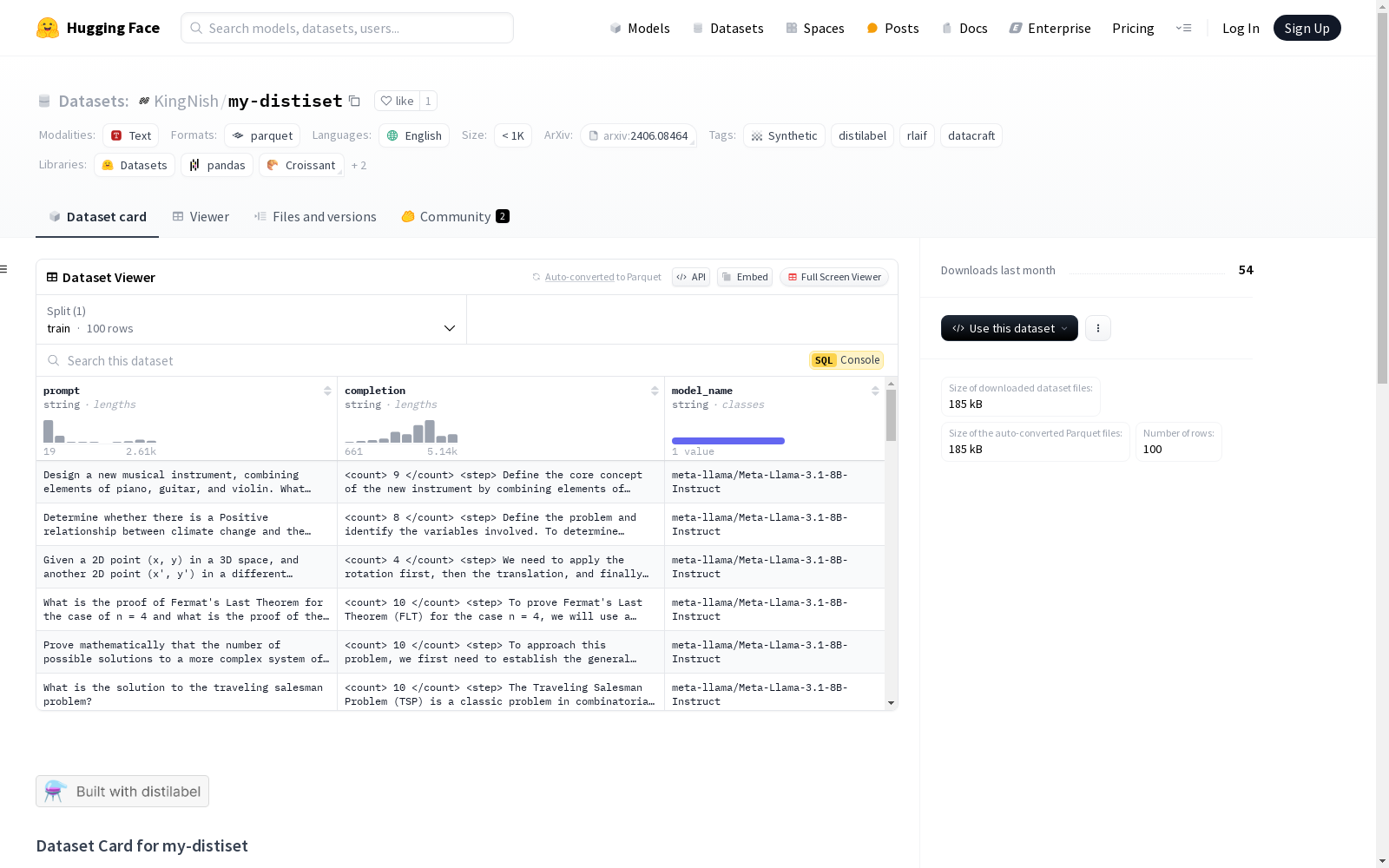
my-distiset
收藏Dataset Card for my-distiset
Dataset Summary
This dataset contains a pipeline.yaml which can be used to reproduce the pipeline that generated it in distilabel using the distilabel CLI:
console distilabel pipeline run --config "https://huggingface.co/datasets/KingNish/my-distiset/raw/main/pipeline.yaml"
or explore the configuration:
console distilabel pipeline info --config "https://huggingface.co/datasets/KingNish/my-distiset/raw/main/pipeline.yaml"
Dataset Structure
Features
- prompt: string
- completion: string
- model_name: string
Splits
- train:
- num_bytes: 420633
- num_examples: 100
Configuration
- default:
- data_files:
- split: train
- path: data/train-*
- split: train
- data_files:
Example
json { "completion": "u003ccountu003e 9 u003c/countu003e
u003cstepu003e Define the core concept of the new instrument by combining elements of piano, guitar, and violin. Consider a hybrid instrument that can produce a wide range of tonal colors and expressions. The new instrument will be a string-based instrument with a keyboard-like mechanism for added versatility. u003c/stepu003e u003ccountu003e 8 u003c/countu003e
u003cstepu003e Name the instrument: u0027Aurorau0027. The name Aurora represents the dawn of new musical possibilities, reflecting the fusion of different elements. u003c/stepu003e u003ccountu003e 7 u003c/countu003e
u003cstepu003e Design the body of Aurora: It will have a sleek, ergonomic shape with a combination of a piano-like keyboard (octave range, white keys, and black keys) and a guitar-like body with six strings. The violin-like neck will be integrated into the guitar body, allowing for bowing and plucking techniques. u003c/stepu003e u003ccountu003e 6 u003c/countu003e
u003creflectionu003e At this point, Iu0027m considering the form factor and the balance between the piano-like keyboard, guitar body, and violin neck. This combination presents an interesting challenge for playability and ergonomics. Iu0027ll need to refine this design to ensure the player can comfortably use all features. u003c/reflectionu003e u003crewardu003e 0.7 u003c/rewardu003e u003ccountu003e 6 u003c/countu003e
u003cstepu003e Introduce a mechanism for the keyboard: The piano-like keyboard will be electronic, allowing for a wide range of tonal expression. The keys will be equipped with sensors to track the playeru0027s touch, enabling dynamic control of pitch, volume, and effects. u003c/stepu003e u003ccountu003e 5 u003c/countu003e
u003cstepu003e Add u0027fretboardu0027 on the violin neck: The fretboard will be fretless, allowing for smooth glissando effects and expressive vibrato. The fretboard will be an essential part of the violin-like playing experience, providing accessibility to the chordal and melodic possibilities. u003c/stepu003e u003ccountu003e 4 u003c/countu003e
u003cstepu003e Develop the six strings: The guitar-like strings will be steel or nylon, offering a range of tonal colors and tonal varieties. These strings will allow for strumming, plucking, and sliding techniques. The strings will also be designed to respond to electronic processing and effect pedals. u003c/stepu003e u003ccountu003e 3 u003c/countu003e
u003cstepu003e Introduce an effects system: The effects system will include built-in reverb, delay, distortion, and other processing options, allowing players to create unique sounds and textures. This will also facilitate the blending of tonal colors from the keyboard, strings, and bowing effects. u003c/stepu003e u003ccountu003e 2 u003c/countu003e
u003cstepu003e Provide bowing options: The violin-like neck will accommodate a traditional horsehair bow, allowing for expressive and legato playing. Additional bowing options can include a carbon fiber bow for an aggressive sound or a sensitive flexi-bow for a gentle timbre. u003c/stepu003e u003ccountu003e 1 u003c/countu003e
u003creflectionu003e Iu0027ve considered the essential features of Aurora, but there are many potential nuances to be explored, such as balancing the electronic and acoustic elements, optimizing the playability, and fine-tuning the effects system. Iu0027ll continually refine Aurora to achieve a seamless playing experience. u003c/reflectionu003e
u003cansweru003e The Aurora is a string-based instrument with a piano-like keyboard, a guitar-like body, and a violin-like neck. It combines electronic and acoustic elements, offering an innovative playing experience with expressive tonal colors and effects, accessible through various techniques and technologies. u003c/answeru003e
u003creflectionu003e Throughout the design process, I focused on balancing the playability, tonal possibilities, and electronic capabilities of the instrument. However, there are potential complexities to consider, such as how the electronic and acoustic elements interact and the ergonomic implications of the hybrid design. u003c/reflectionu003e
u003crewardu003e 0.9 u003c/rewardu003e", "model_name": "meta-llama/Meta-Llama-3.1-8B-Instruct", "prompt": "Design a new musical instrument, combining elements of piano, guitar, and violin. What would it be called, and what features would it have?
" }
Loading the Dataset
python from datasets import load_dataset
ds = load_dataset("KingNish/my-distiset", "default")
Or simply:
python from datasets import load_dataset
ds = load_dataset("KingNish/my-distiset")