Harmonised Night-light Data
收藏资源简介:
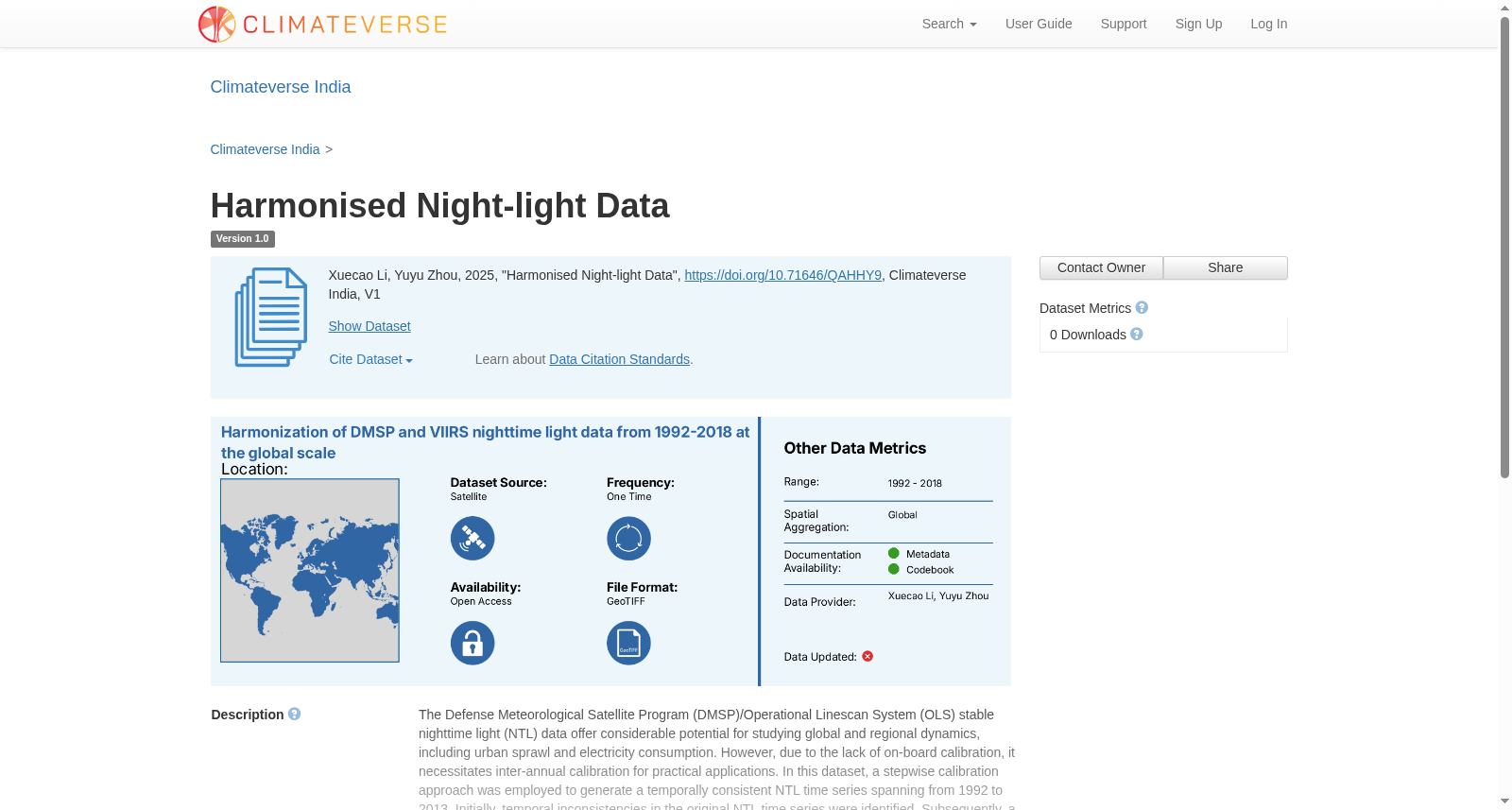
The Defense Meteorological Satellite Program (DMSP)/Operational Linescan System (OLS) stable nighttime light (NTL) data offer considerable potential for studying global and regional dynamics, including urban sprawl and electricity consumption. However, due to the lack of on-board calibration, it necessitates inter-annual calibration for practical applications. In this dataset, a stepwise calibration approach was employed to generate a temporally consistent NTL time series spanning from 1992 to 2013. Initially, temporal inconsistencies in the original NTL time series were identified. Subsequently, a stepwise calibration scheme was developed to systematically address over- and under-estimations in NTL images derived from specific satellites and years, utilizing temporally neighboring images as references for calibration. Following the stepwise calibration, the raw NTL series demonstrated improvement with a more consistent temporal trend. The global sum of NTL magnitude was maximally preserved in the data compared to the raw data, surpassing other conventional calibration approaches. The normalized difference index indicates that this approach can achieve a high level of agreement between two satellites in the same year.
国防气象卫星计划(Defense Meteorological Satellite Program, DMSP)/业务线扫描系统(Operational Linescan System, OLS)稳定夜间灯光(Stable Nighttime Light, NTL)数据,在全球及区域动态研究中具备显著应用潜力,可用于城市扩张、电力消耗等相关分析。然而,由于该数据缺乏星上校准机制,实际应用中需开展跨年度校准工作。本数据集采用逐步校准方法,生成了覆盖1992年至2013年的时间一致性夜间灯光时间序列。首先识别出原始夜间灯光时间序列的时间不一致性问题;随后构建逐步校准方案,以时间相邻影像作为校准参照,系统性修正特定卫星及对应年份获取的夜间灯光影像中存在的高估与低估偏差。经逐步校准后,原始夜间灯光序列的时间趋势一致性得到显著提升。与原始数据及其他传统校准方法得到的结果相比,本数据集最大程度保留了全球夜间灯光总强度,校准效果更优。归一化差异指数显示,该方法可使同年度不同卫星获取的夜间灯光数据达成较高一致性水平。