
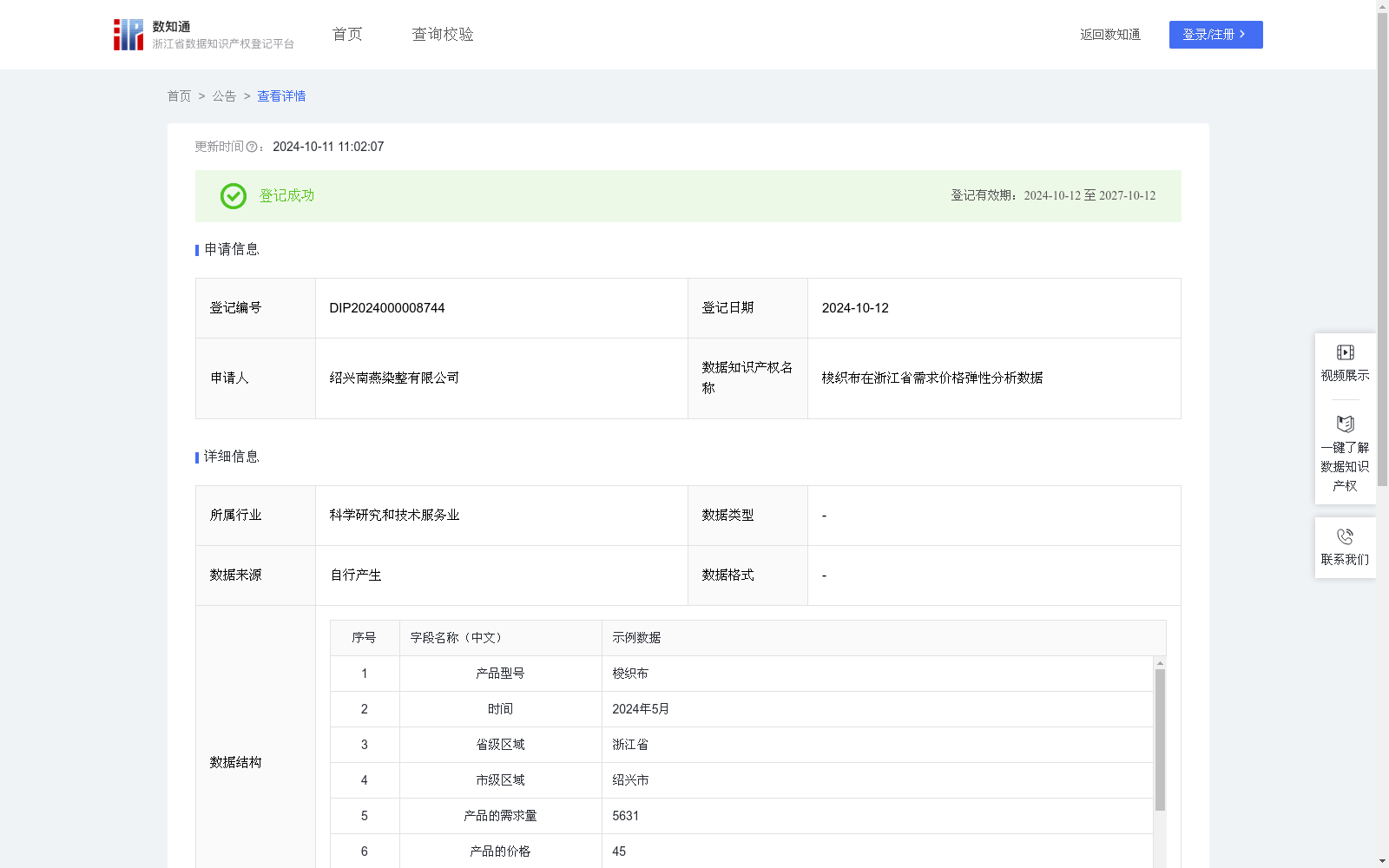
梭织布在浙江省需求价格弹性分析数据
收藏浙江省数据知识产权登记平台2024-10-11 更新2024-10-12 收录
下载链接:
https://www.zjip.org.cn/home/announce/trends/69251
下载链接
链接失效反馈官方服务:
资源简介:
梭织布,作为纺织行业的重要产品之一,广泛应用于服装、家居装饰、工业用品等多个领域,其市场需求量庞大且受多种因素影响。在浙江省这一纺织业发达的地区,梭织布的生产与消费尤为活跃,市场需求不仅受到国内外经济形势、消费者购买力、时尚潮流等因素的影响,还高度依赖于消费者的价格敏感度,通过对梭织布在浙江省的需求价格弹性进行分析,企业可以明确不同消费群体对价格变动的反应程度,从而更精准地进行市场细分和定位,实施差异化竞争策略。1.数据采集:采集相关梭织布在某一时间段浙江省绍兴市的需求数据和价格数据,得到该梭织布的需求量变动数值和价格变化数值。2.算法规则:对采集得到的数据按照如下公式进行计算:需求弹性系数Ed=-(△Q/Q)÷(△P/P),得到需求弹性系数。式中:Q表示产品的需求量,单位为米;P表示产品的价格,单位为元;△Q表示需求量同比变动值,单位为套;△P表示价格同比变动值,单位为元。取需求弹性系数的绝对值|Ed|作为分析数据时的参考系数。 3.数据分析:根据|Ed|的数值可分析该梭织布的需求价格弹性。(1)|Ed|=1(单位需求价格弹性),说明需求量变动幅度与价格变动幅度相同;(2)1<|Ed|<∝(需求富有弹性),说明需求量变动幅度大于价格变动幅度;(3)0<|Ed|<1(需求缺乏弹性),说明需求量变动幅度小于价格变动幅度;(4)|Ed|→0(需求完全无弹性),这表示不管价格怎样变动,需求量总是固定不变;(5)|Ed|→∝(需求完全有弹性),表示在既定价格之下,需求量可以任意变动。
As one of the core products in the textile industry, woven fabric is widely utilized in multiple sectors including apparel, home decoration, industrial supplies and other fields, boasting a massive market demand that is subject to a multitude of influencing factors. In Zhejiang Province, a region with a robust textile industry, the production and consumption of woven fabric are particularly active. Its market demand is not only affected by factors such as domestic and international economic situations, consumer purchasing power and fashion trends, but also highly dependent on consumers' price sensitivity. By analyzing the price elasticity of demand for woven fabric in Zhejiang Province, enterprises can clarify the response degree of different consumer groups to price changes, thereby enabling more accurate market segmentation and positioning, and the implementation of differentiated competition strategies.
1. Data Collection: Collect demand and price data of target woven fabrics in Shaoxing City, Zhejiang Province over a specified time period, to derive the year-on-year change values of the demand quantity and price of the said woven fabrics.
2. Algorithm Specifications: Calculate the collected data using the following formula to obtain the demand elasticity coefficient Ed:
Ed = -(ΔQ/Q) ÷ (ΔP/P)
Where: Q represents the product's demand quantity, with the unit of meters; P represents the product's price, with the unit of yuan; ΔQ denotes the year-on-year change in demand quantity, with the unit of sets; ΔP denotes the year-on-year change in price, with the unit of yuan. Take the absolute value |Ed| of the demand elasticity coefficient as the reference coefficient for data analysis.
3. Data Analysis: Analyze the price elasticity of demand for the woven fabric based on the value of |Ed|:
(1) |Ed| = 1 (Unitary price elasticity of demand): Indicates that the magnitude of change in demand is consistent with that of price;
(2) 1 < |Ed| < ∞ (Price-elastic demand): Indicates that the magnitude of change in demand exceeds that of price;
(3) 0 < |Ed| < 1 (Price-inelastic demand): Indicates that the magnitude of change in demand is less than that of price;
(4) |Ed| → 0 (Perfectly price-inelastic demand): This implies that the demand quantity remains unchanged regardless of price fluctuations;
(5) |Ed| → ∞ (Perfectly price-elastic demand): This means that the demand quantity can vary freely at a given price level.
提供机构:
绍兴南燕染整有限公司
创建时间:
2024-09-13
搜集汇总
数据集介绍
以上内容由遇见数据集搜集并总结生成


